In the autumn of 1986, English hockey experienced something extraordinary.
For two weeks, hockey escaped the confines of clubs, schools and specialist sporting circles and entered the national consciousness. Crowds streamed into Willesden Stadium in London. Television cameras arrived in force. The BBC broadcast matches to a national audience. Newspapers that rarely covered hockey suddenly found themselves following England’s progress day by day. Around the stadium, sponsors, merchandising, schools activities, heritage exhibits and hospitality programmes created the feeling of a major international sporting festival. Which it was – the sixth Men’s Hockey World Cup had arrived.
By the time England walked out to face Australia in the World Cup final, hockey had become one of the country’s biggest sporting stories.
40 years later, the 1986 Men’s Hockey World Cup can be seen as a moment that transformed public perceptions of hockey, helped set Great Britain (GB) on the road to Olympic gold, and played an important role in the heritage movement that would eventually lead to the creation of The Hockey Museum.

Oil painting by Aubrey Sykes of the Hockey World Cup final 1986, England vs Australia.
From The Hockey Museum collection. © The Hockey Museum
From bronze in Los Angeles to gold in Seoul
The story did not begin in 1986. Just two years earlier under the determined coaching and management of Roger Self and David Whitaker, the GB men’s hockey team had defied the odds of a late invitation to the 1984 Olympic Games in Los Angeles to win the bronze medal. Prior to the tournament, the Soviet Union (USSR) had boycotted the Games for political reasons creating a place for GB, which they seized in style. That achievement signalled the emergence of a talented generation of British players and a ‘home’ World Cup provided the perfect stage upon which the English contingent could continue their development and test themselves against the world’s best.
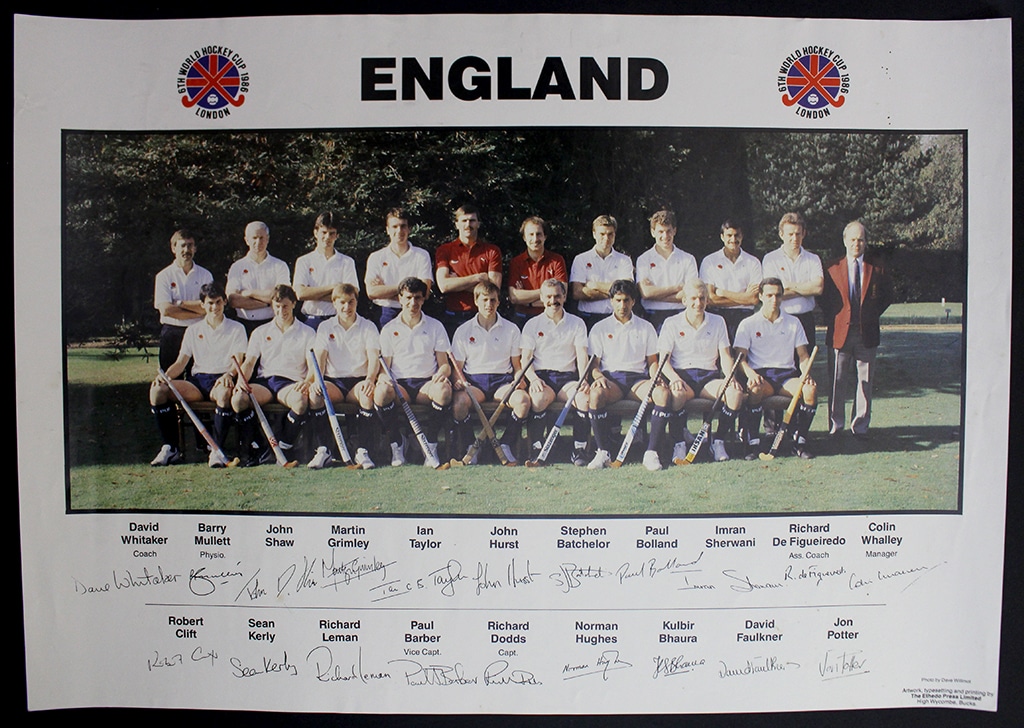
Signed poster of the England squad for the sixth Men’s Hockey World Cup, London, 1986.
For many of those involved, 1986 became the bridge between Olympic promise and Olympic fulfilment.
Names that would become synonymous with Olympic gold in Seoul in 1988 were already central figures in London. David Whitaker brought coaching continuity from 1984 to the World Cup squad, this time under the management of Colin Whalley. Richard Dodds continued to captain GB and England. Sean Kerly was becoming one of the most influential attacking players in world hockey. Imran Sherwani emerged as one of the stars of the tournament. Ian Taylor established himself as the world’s leading goalkeeper, while players such as Martyn Grimley and Rob Clift gained invaluable experience against elite international opposition.
Most importantly, England discovered they could beat the traditional giants of the game.
A memorable 3–1 victory over Pakistan represented England’s first-ever win against the reigning world champions. A tense 1–0 victory over the Netherlands secured a semi-final place courtesy of a penalty corner converted by Imran Sherwani. Then came one of the defining moments of English hockey history: a dramatic semi-final victory over West Germany, secured after England fought back from behind to equalise in the last minute (a penalty corner from Paul Barber), before winning 3–2 in extra time (another Barber penalty corner).
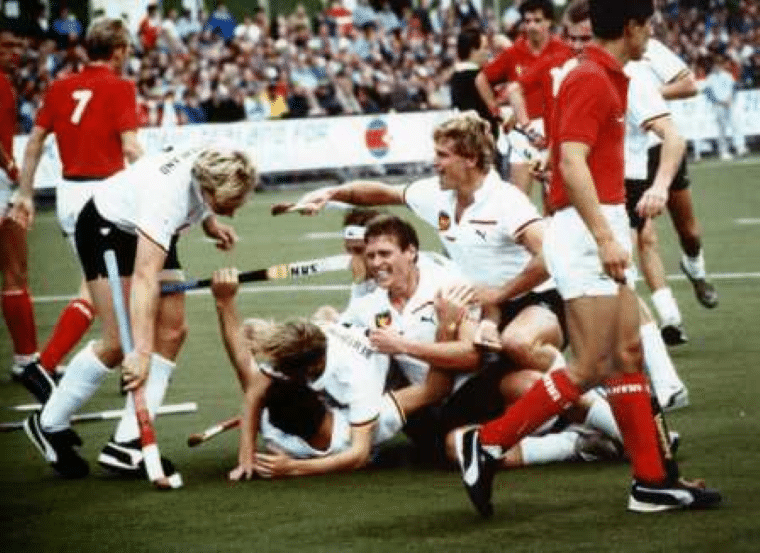
West Germany celebrate scoring a goal against England during the World Cup semi-final.
Although England lost 2–1 to the brilliant Australia in the final, the tournament created a new belief. Players and supporters alike learned that the world’s best teams were no longer untouchable.
Viewed from the perspective of 1988, the World Cup was the point at which the journey that began with GB bronze in Los Angeles gathered momentum and conviction. Seoul would provide the destination for many of the World Cup silver medallists.
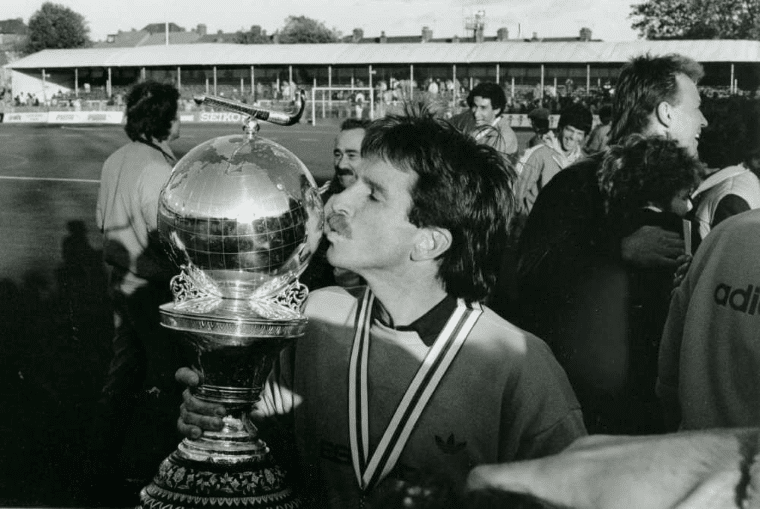
An Australian player kisses the World Cup trophy on the Willesden pitch after the final.
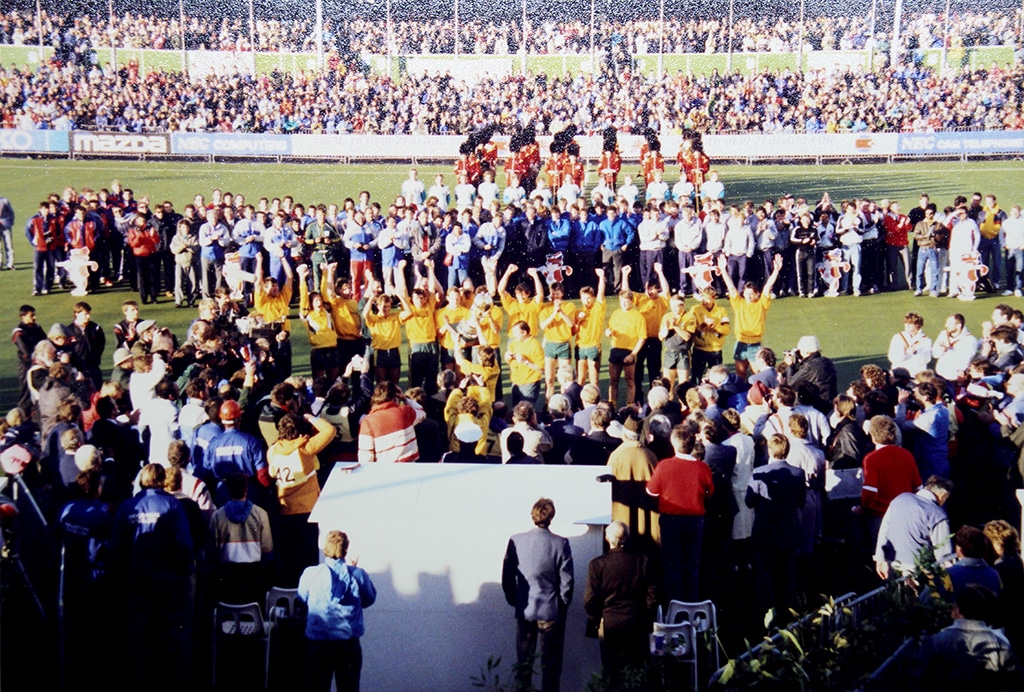
The Australia men’s hockey team lift the World Cup trophy in front of a packed Willesden Stadium.
A tournament for the world
England’s successful tournament dominated headlines at home, but the wider tournament reflected a changing world order in international hockey.
The outstanding team was undoubtedly Australia. Fast, athletic and tactically sophisticated, they swept through the competition, scoring freely and conceding little. Victories over Canada (6–2), Spain (6–0), India (6–0) and the USSR (5–0) demonstrated their superiority before their 2–1 victory over England secured their first World Cup title.
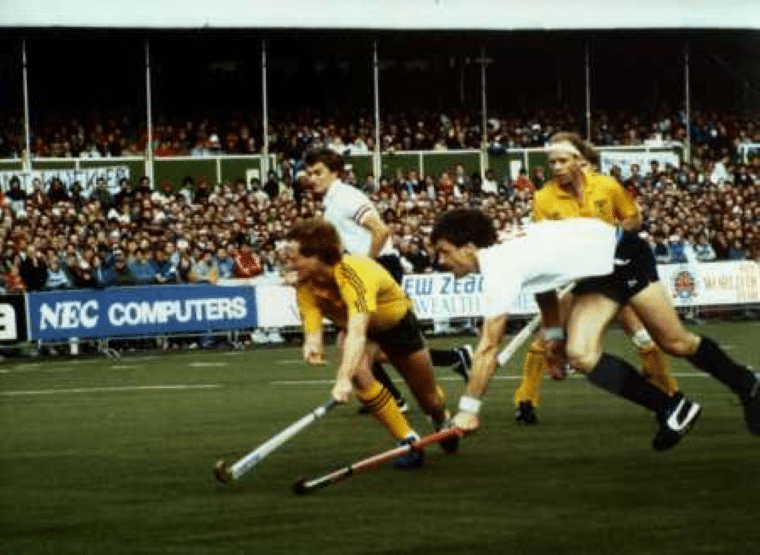
England vs Australia in the final of the 1986 Hockey World Cup.
At the heart of their success was Richard (Ric) Charlesworth, widely regarded as the best player in the world and named Player of the Tournament. His skill and consistency were the cornerstone of the Australian team and made him the defining individual performer of the competition.
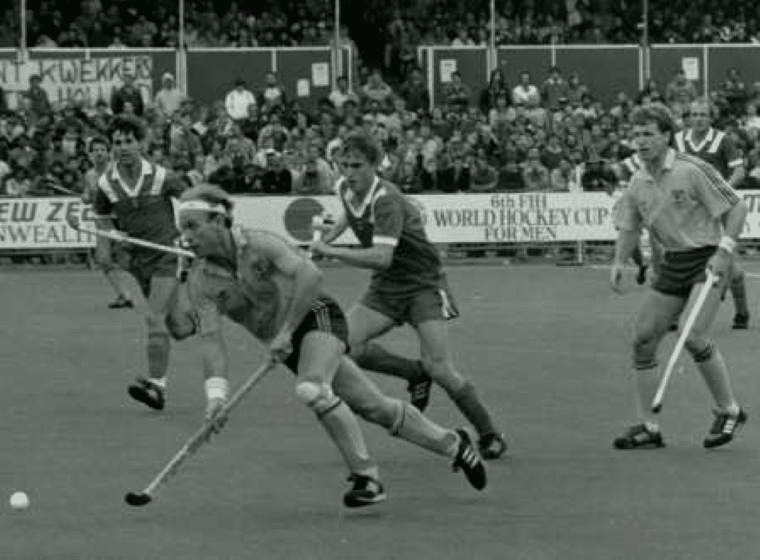
Player of the Tournament Ric Charlesworth in action for Australia at the 1986 Hockey World Cup.
Ric Charlesworth interviewed by Nick Irvine about the 1986 World Cup: https://youtu.be/7jNj9w8av18?si=uT8hNmJLRVwOZy31
Elsewhere, the tournament produced some unexpected stories.
The USSR emerged as a major force, beating New Zealand, England, Argentina and Pakistan in the group stage to reach the semi-finals with a disciplined and highly effective playing style. Players such as right half Sos Ayrapetian earned widespread acclaim and demonstrated the growing strength of Eastern European hockey.
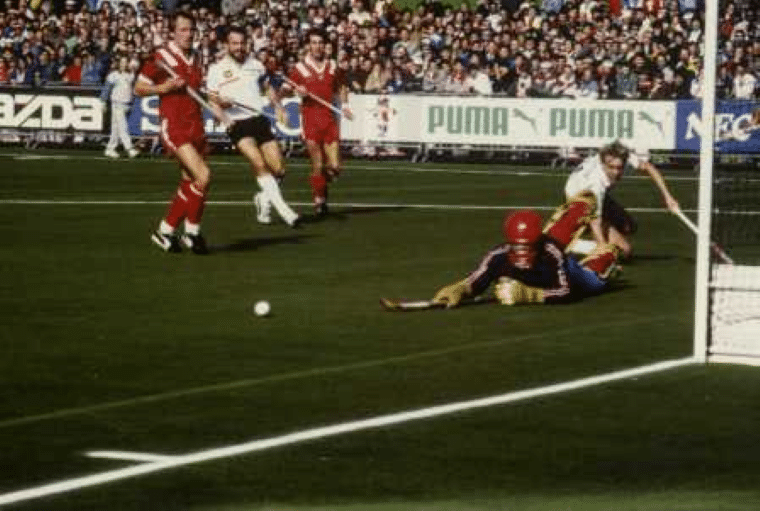
The Soviet Union goalkeeper make a diving save against West Germany.
Argentina impressed many observers with positive and ambitious hockey. They recorded a notable victory against Pakistan (3–1) proving they could compete with the sport’s established powers, drew 1–1 against New Zealand and had close-fought loses to England (1–2) and the Netherlands (0–1).
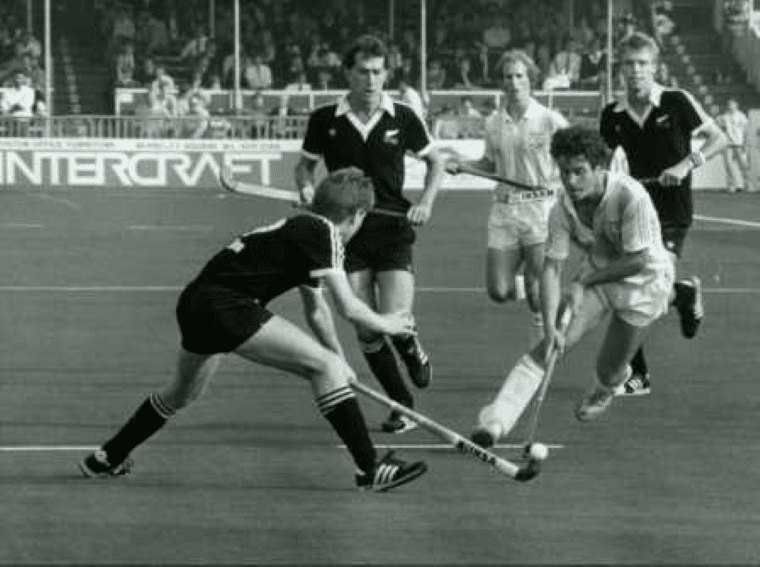
Argentina on the ball attacking against New Zealand.
Most shocking of all was the decline of the traditional Asian hockey giants. Both India and Pakistan, long accustomed to dominating world hockey, failed to reach the semi-finals and ultimately met in the tournament’s eleventh and twelfth place play-off.
The 1986 World Cup was the first World Cup played entirely on artificial turf. Historically, both nations had developed their success on natural grass, where close ball control and individual artistry could flourish. Artificial turf produced a faster game that rewarded different qualities: fitness, pressing, structured tactics and physical intensity. Prior to the World Cup, both nations had competed in the Asian Games where South Korea – a side that embraced these attributes – pipped them to the gold medal. It would prove prophetic of what was to come in Willesden at the World Cup. What had once been unthinkable suddenly seemed to symbolise a changing sport.
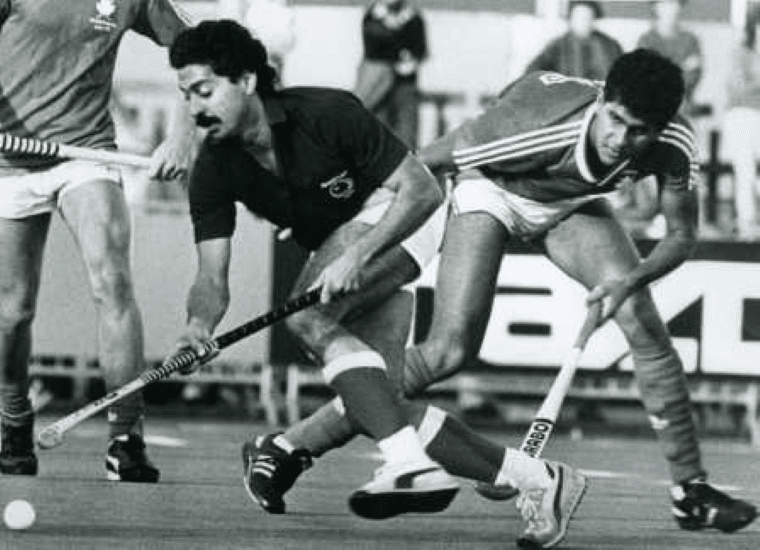
Pakistan on the attack against Canada.
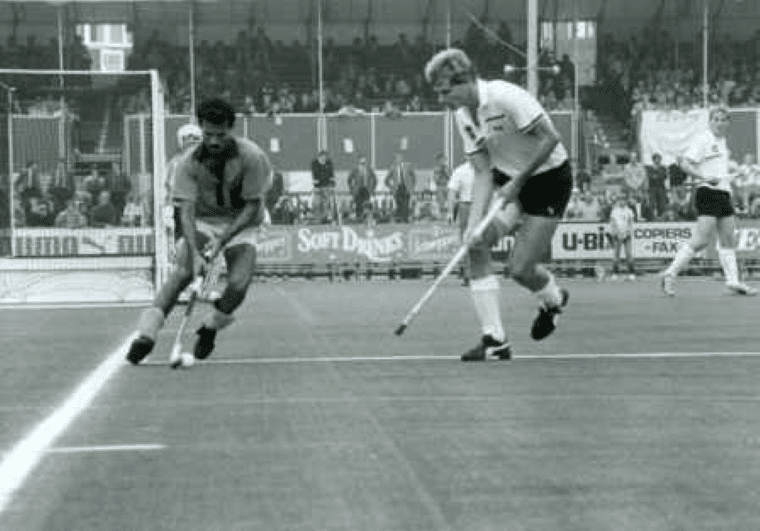
India defend against the West German press.
Hockey fever comes to London
Contemporary accounts drawn from The Hockey Museum’s library and archive repeatedly describe a sense of excitement that grew throughout the tournament. Crowds increased as England progressed. Spectators queued outside the stadium. School groups, club members and families travelled from across the country. Hospitality areas buzzed with conversation in multiple languages as players, officials and supporters mixed together. As England continued winning, the atmosphere changed from excited anticipation to expectation.
The semi-final against West Germany generated scenes rarely witnessed at a hockey venue in Britain. Every attack and save brought roars from the crowd. When England secured victory, celebrations continued long after the final whistle. The final itself attracted a huge crowd. The noise, colour and national attention created an electric atmosphere many participants later compared with much larger professional sports.
For those who attended Willesden, the memory is not simply of thrilling matches but of a feeling: that hockey had suddenly become important.
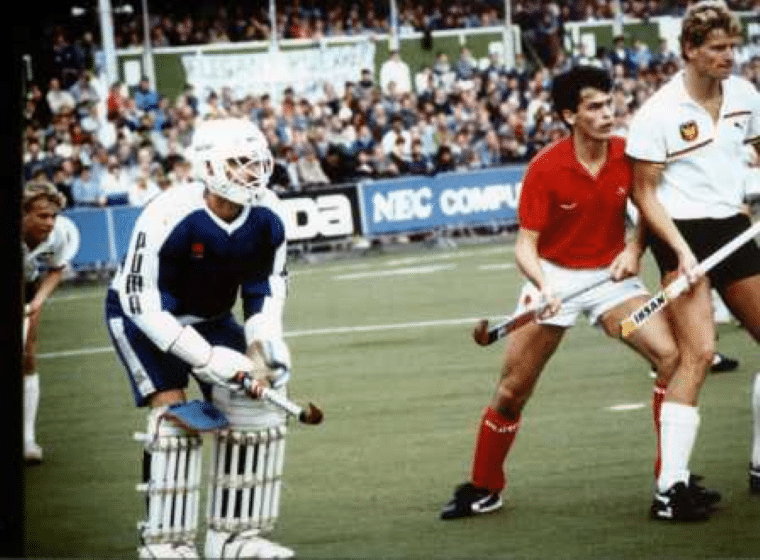
Goalkeeper Ian Taylor and Rob Clift in action for England against West Germany.
The volunteers who made it happen
The 1986 World Cup’s success was not accidental.
Behind the scenes stood a remarkable organising effort that relied heavily upon volunteers from across the English hockey community. Hundreds of individuals gave their time to support every aspect of the event, from accreditation, transport and spectator services to media operations, hospitality and administration.
At the centre of this operation was the Hockey Association president Phil Appleyard, whose brilliant leadership over several years helped secure and deliver the tournament in the Association’s centenary year. As chairman of the World Hockey Cup Organising Board, Phil provided the strategic vision and determination necessary to ensure the Willesden World Cup met the highest international standards. Alongside him was Chris Eldridge, Executive Secretary to the Organising Board, whose drive and administrative expertise coordinated countless details that visitors rarely saw but upon which the success of the event depended.
Read Chrissy Eldridge’s recollections of her extraordinary contribution: The woman behind the sixth Men’s World Hockey Cup, 1986 – The Hockey Museum
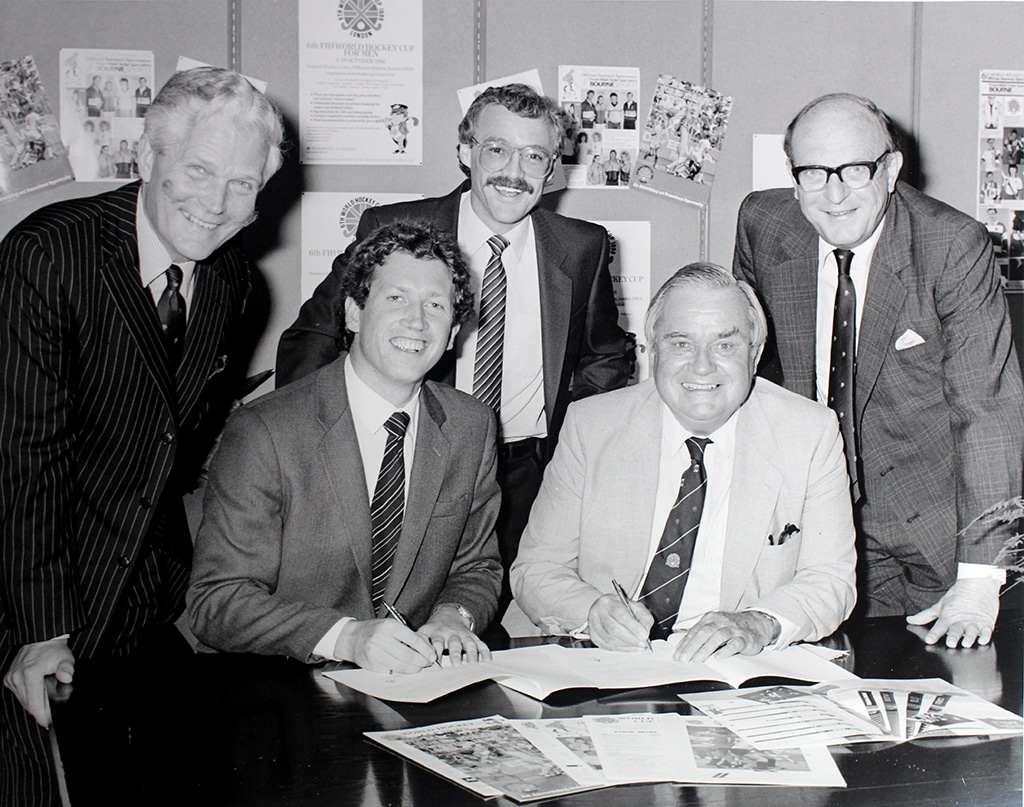
The Hockey Association (HA) signs a sponsorship agreement with Slazenger for the 1986 World Cup.
From left to right: Denis Eagan (HA), Chris Reynolds (Slazenger), Phil Appleyard (HA), and Derek Bennett (HA).
Photograph from Phil Appleyard’s 1986 World Hockey Cup scrapbook in the collection of The Hockey Museum.
The organising committees drew together and coordinated 150 or so volunteers, sponsors, local authorities and international officials. The event required years of planning, fundraising and preparation. Long before the first ball was pushed back, volunteers had been working on accommodation, transport systems, hospitality programmes, sponsorship arrangements, advertising, ticketing systems, ceremonies, exhibitions and media facilities.
When international visitors praised the organisation of the World Cup – at the time regarded as the best World Cup yet, they were recognising the efforts of a vast voluntary workforce.
The tournament remains one of the finest examples of what the British hockey community has been capable of achieving collectively.
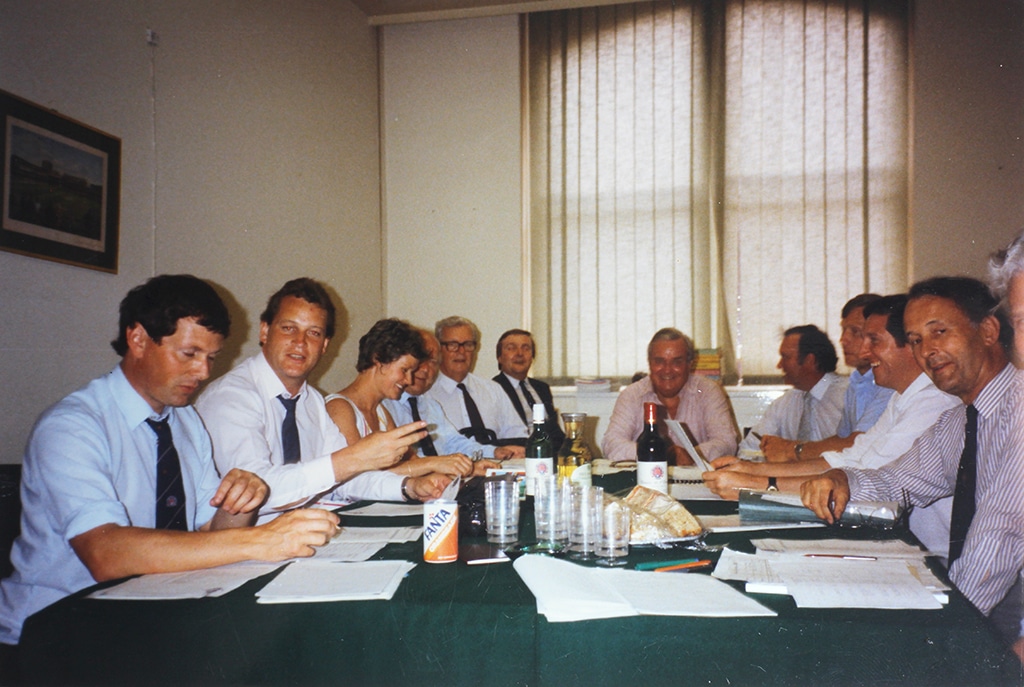
The Organising Board for the 1986 Men’s Hockey World Cup.
Photograph from the Phil Appleyard collection held by The Hockey Museum.
The faces of a new era
Several English figures came to embody what the tournament meant to fans.
For many supporters, Sean Kerly became the new face of British men’s hockey. For younger fans, Imran Sherwani was the tournament’s breakout star. Quick, fearless and exciting to watch, he became one of the most talked-about players of the competition and a symbol of hockey’s growing appeal to wider audiences. On the wing, Stephen Batchelor delighted fans and tormented defences with his unpredictable play. At centre half, captain Richard Dodds marshalled proceedings with calm authority and behind them, completing the spine of the team, stood Ian Taylor. Awarded Goalkeeper of the Tournament, his performances set a new benchmark for the position. Across England, young hockey players had new heroes to emulate.
While players occupied the headlines, organisers such as Phil Appleyard and Chris Eldridge demonstrated that successful sporting events depend on more than those who take the field.
Together, they tell different parts of the same story.
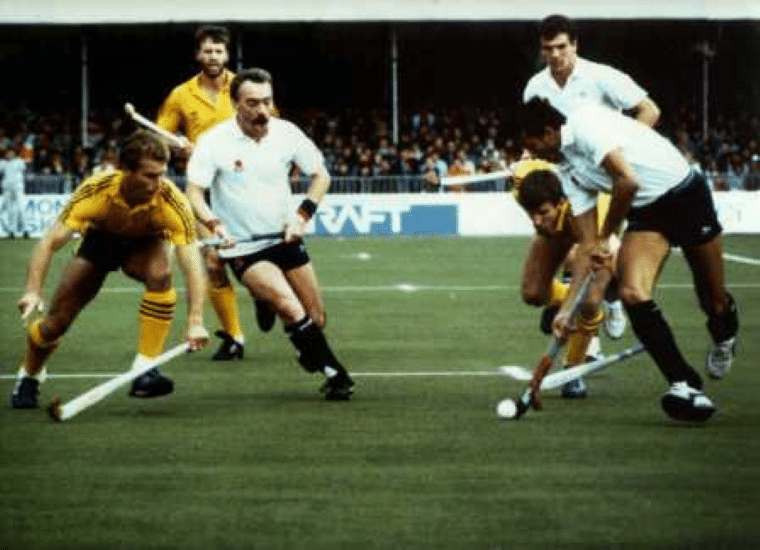
Imran Sherwani on the ball for England vs Australia in the final of the 1986 Hockey World Cup.
The World Cup that helped create The Hockey Museum
One of the most enduring legacies of 1986 is its connection to hockey’s heritage movement.
Alongside the World Cup tournament sat an ambitious exhibition that celebrated the history of the game and demonstrated the value of collecting and preserving hockey’s story. The exhibition was organised by respected hockey historian Ken Howells. At a time when sports heritage was receiving far less attention than today, the exhibition showed what could be achieved through the dedication of enthusiasts determined to safeguard the sport’s past.
The links to The Hockey Museum are direct and significant.
Individuals within with the tournament’s organising committees either directly supported Ken’s exhibition or developed affinities with hockey heritage that would herald their future involvement with The Hockey Museum. Mike Smith (schools and marketing) and David Wareham (marketing) oversaw the exhibition during the tournament fortnight. Alongside them, Dil Bahra (security and police liaison) and Pat Rowley (senior press corps) became founding trustees of the museum, and John Willmott (stadium director) would later become its chairperson. Others, like Dr Malcolm Read (medical), support the museum today as volunteers.
Discover Dr Malcolm Read’s involvement in the Hockey World Cup: The doctor who kept the World Cup running – The Hockey Museum
Undeniably, the success of the 1986 World Cup led to the creation of The Hockey Museum. Following the tournament, Phil Appleyard pursued opportunities for a national home for hockey, which was realised in 1995 with the National Hockey Stadium in Milton Keynes. The stadium became the hub for gathering and displaying England’s hockey heritage. When the stadium closed in 2003, the Archive Steering Group was formed to protect its heritage collections. The group later became the founding board of the National Hockey Museum charitable trust – now The Hockey Museum.
History of The Hockey Museum – The Hockey Museum
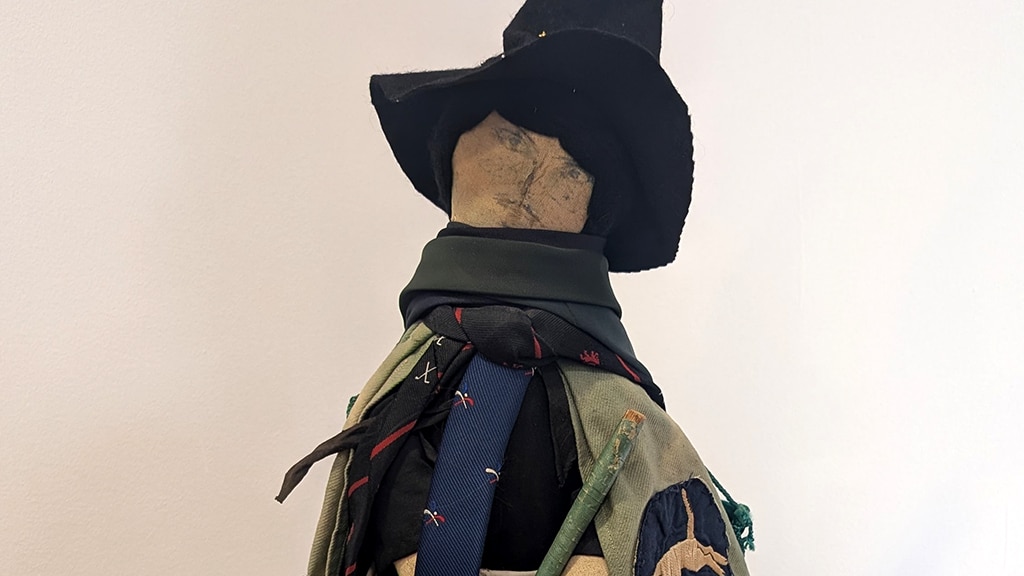
Objects from the original World Cup heritage exhibition survive today within the collection of Ken Howells at The Hockey Museum. In addition, several members of the Organising Board and committees have gifted material to grow the museum collection, including Nick Irvine (club ‘Action Man’ coordinator) and Phil Appleyard himself. Together these collections help tell the story not only of a renowned international tournament but of the beginnings of a movement to preserve and celebrate hockey’s heritage for public benefit.
Perhaps most remarkably, some of the people interpreting and preserving the history of the 1986 World Cup today were there when it happened 40 years ago. They remember the crowds, the noise, the excitement and the sense that hockey was experiencing something unprecedented.
The Holy Grail of Hockey History has been Found: The Ken Howells Collection – The Hockey Museum
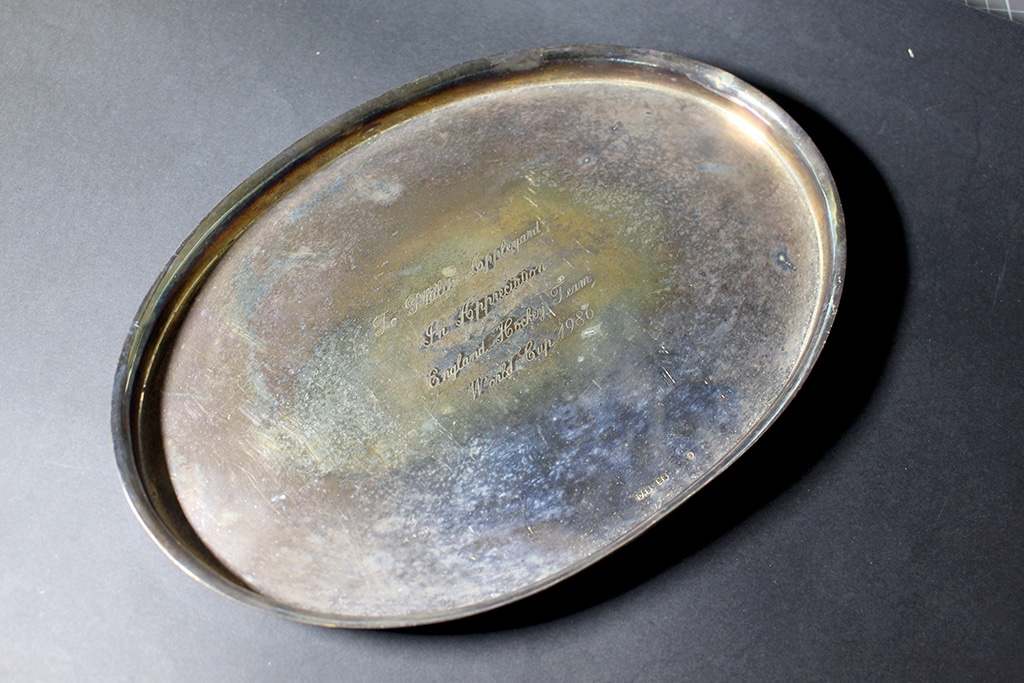
An inscribed dish presented to Phil Appleyard, chairman of the World Cup Organising Board, by the England men’s national hockey team following the success of the World Hockey Cup in London, 1986.
From the Phil Appleyard collection held by The Hockey Museum.
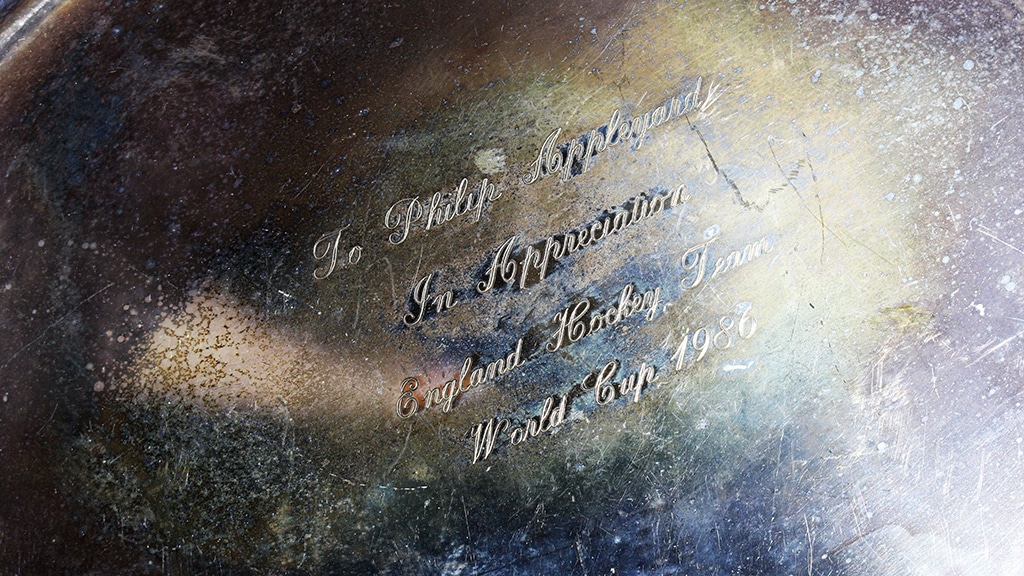
Detail of the inscription on the dish presented to Phil Appleyard by the England men’s national hockey team, 1986. It reads, “To Philip Appleyard In Appreciation. England Hockey Team, World Cup 1986”.
More than a silver medal
The official record shows that Australia won the World Cup and England finished second. Yet this doesn’t reveal the tournament’s significant impact on hockey in England.
The 1986 Men’s Hockey World Cup brought the amateur sport to a national audience and set a global benchmark for international tournament delivery. It built upon the confidence gained through Great Britain men’s Olympic bronze medal in Los Angeles and provided the belief that helped carry a generation of players towards Olympic gold in Seoul. It showcased the commitment and professionalism of hundreds of volunteers, and it helped inspire the heritage movement that would eventually become The Hockey Museum.
40 years later, that may be the greatest legacy of the men’s World Cup. Not that it produced a memorable two-week tournament, but that in the Hockey Association’s centenary year it changed the landscape of English hockey.
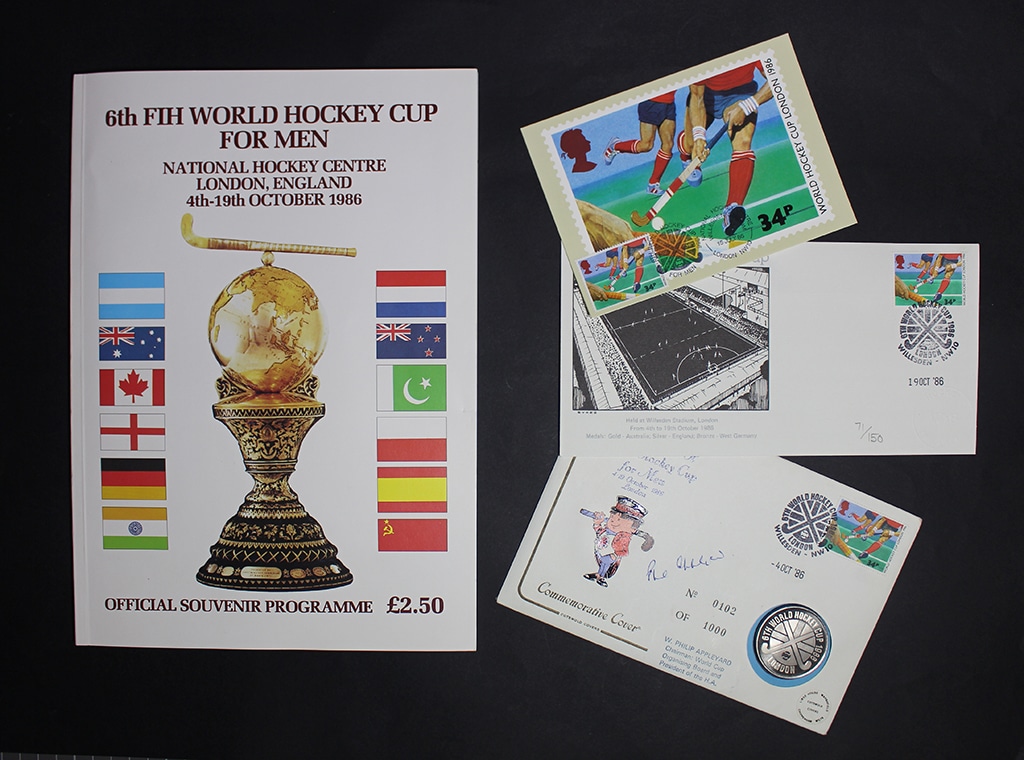
Own a piece of 1986 World Hockey Cup history
To celebrate the 40th anniversary of the sixth Men’s Hockey World Cup held in Willesden, London in 1986, The Hockey Museum is making available 33 limited-edition packages of authentic World Cup memorabilia.
Support The Hockey Museum charity by purchasing yours today. Click here for more information: Own a piece of 1986 World Hockey Cup history – The Hockey Museum