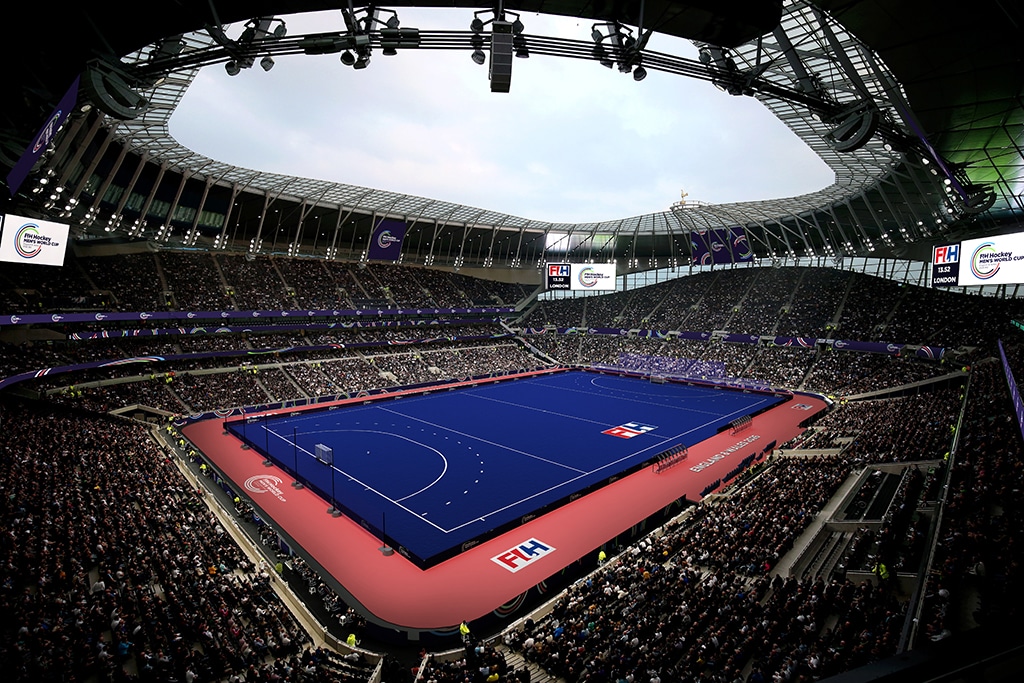
A remarkable but overlooked fact of the modern Hockey World Cup era is that on every occasion when the men’s and women’s tournaments have been staged simultaneously in the same city, they have taken place in the Netherlands. From Utrecht in 1998, through The Hague in 2014, to the current 2026 Hockey World Cups being shared between Wavre in Belgium and Amstelveen in the Netherlands, Dutch hockey has repeatedly provided the stage for the biggest combined celebration of global hockey.
The idea of bringing together the world’s best men’s and women’s teams in a single festival of hockey might seem obvious today, yet when it was first attempted on a large scale in Utrecht it was genuinely groundbreaking. It reflected not only the Dutch passion for hockey, but also its confidence in presenting the sport as a major international spectacle. The experiment helped establish a template for future combined tournaments, though these still don’t happen frequently.
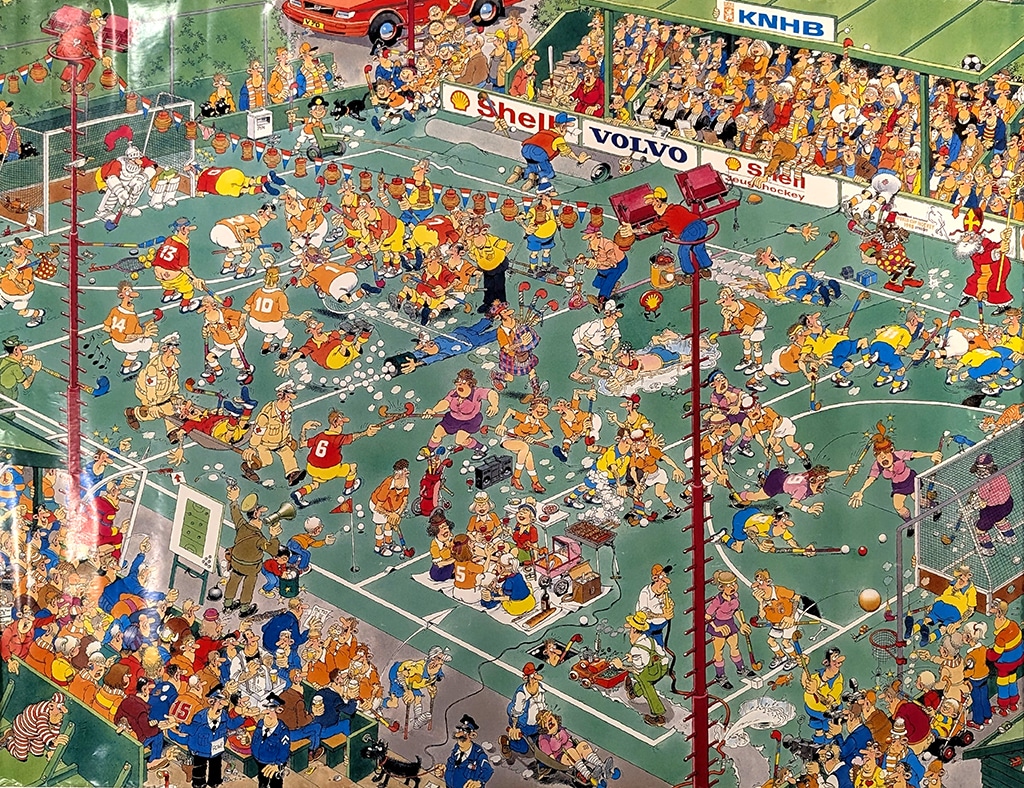
Official poster for the Hockey World Cup held in Utrecht, Netherlands, 1988. The chaotic scene is reminiscent of a Where’s Wally cartoon! The poster was also marketed as a jigsaw puzzle, also in The Hockey Museum collection.
Utrecht 1998: the first twin World Cups
The twin World Cups of 1998 transformed Utrecht into the centre of the hockey world. For two weeks the city’s Galgenwaard Stadium (the home of football’s FC Utrecht) became a daily showcase for the finest male and female players on the planet, with fans able to watch both tournaments in the same venue and under a shared spotlight. According to Hockey Sport magazine, it was an event that “could only have happened in the Netherlands”.
The scale of public enthusiasm was extraordinary. The 15,000-seat stadium sold out eight times, while every Dutch match generated the atmosphere of a major football international. Thousands of supporters dressed in orange packed the stands, creating an unforgettable backdrop that left players and journalists astonished. So influential was the crowd support that British columnist Peter Savage joked it was worth several goals a game to the host nation, quipping that his “76-year-old mother could score a hat-trick” with such backing.
By the end of the fortnight, many observers were describing Utrecht as the finest Hockey World Cup ever staged. Outstanding organisation, packed crowds and high-quality hockey combined to produce a tournament that set new standards for the sport. Even innovations now commonplace, such as playing snippets of popular music after goals for the first time, were enthusiastically embraced by spectators.
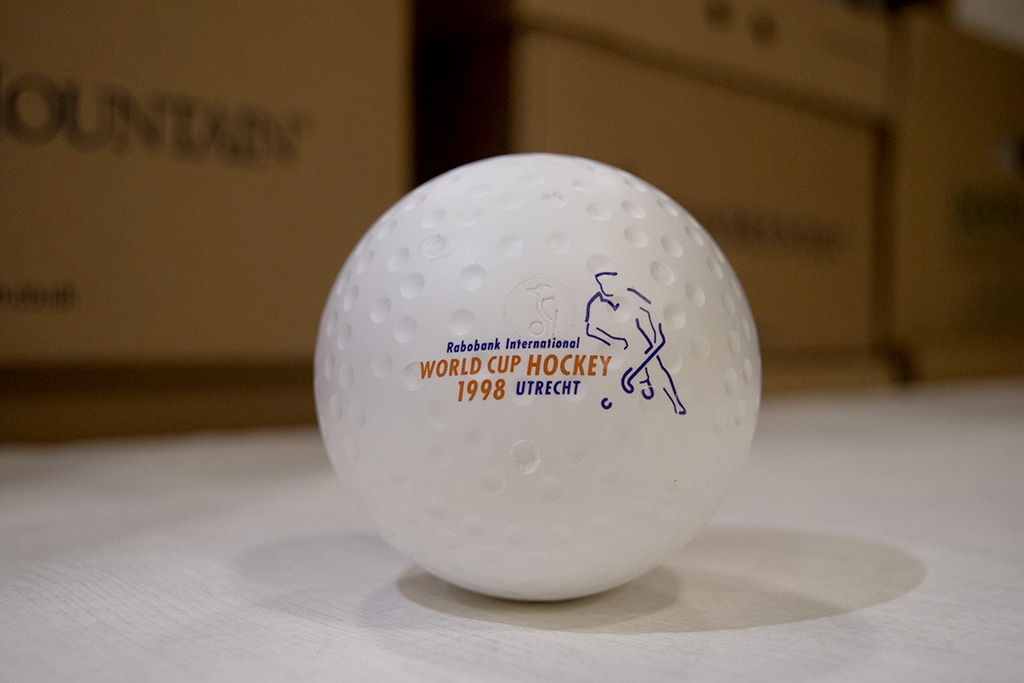
Official hockey ball from the 1998 Hockey World Cup.
From The Hockey Museum collection.
Dutch glory in the men’s tournament
The men’s competition delivered a dream ending for the hosts. The Netherlands claimed their third world title in dramatic fashion, defeating Spain 3–2 after extra time in a thrilling final. The decisive moment came when Dutch superstar Teun de Nooijer scored the golden goal with only two minutes remaining, sending the orange-clad crowd into delirium.
What made the achievement even more impressive was the team’s resilience. Earlier in the tournament the Dutch had suffered a heavy 5–1 defeat against Germany during the pool stages, yet they recovered brilliantly when it mattered most. Germany ultimately took the bronze medal with a 1–0 victory over Australia, while defending champions Pakistan failed to reach the medal matches.
The final standings:
- Netherlands
- Spain
- Germany
- Australia
- Pakistan
- England
England’s sixth-place finish ensured qualification for the forthcoming Champions Trophy. Drag-flick specialist Calum Giles was their principal goal-scoring threat throughout the tournament. Two England stalwarts, Nick Thompson and Julian Halls, also celebrated their 100th international caps against Pakistan. Behind the scenes, team manager David Whittle quietly reached his own milestone of 100 matches.
Individual honours went to Germany’s Oliver Domke as Player of the Tournament, Australia’s Jay Stacy as top scorer with 12 goals, Spain’s Ramon Jufresa as best goalkeeper and Pakistan’s Shahbaz Ahmed as the tournament’s most sporting player.
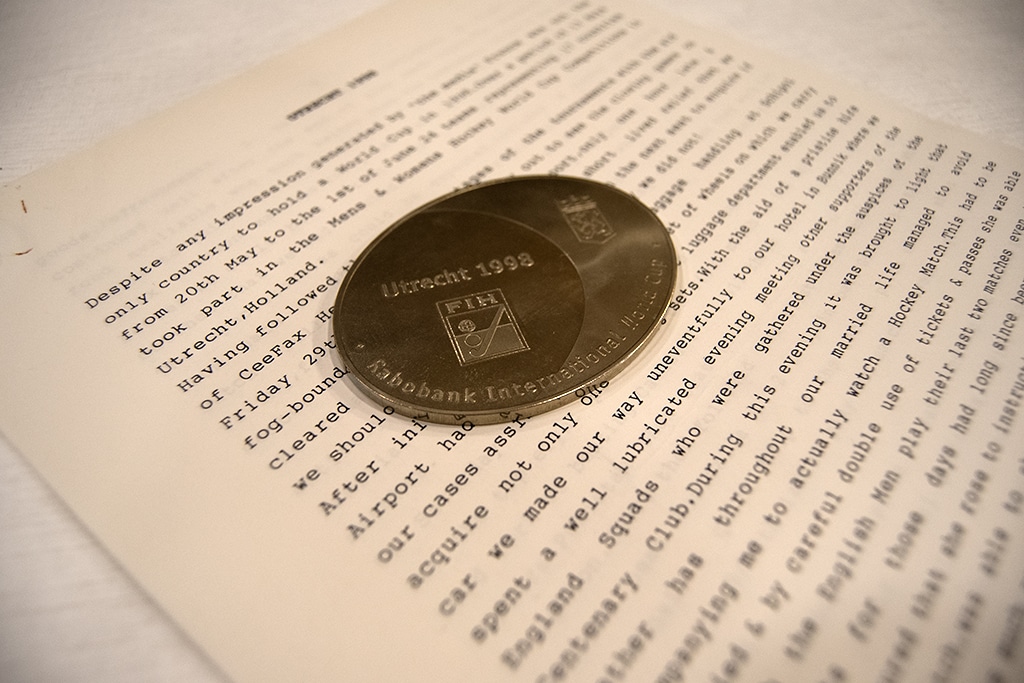
Medallion presented to Roger Webb, judge for the World Cup final in Utrecht, 1998. Beneath it, a report chronicling Bernard French’s trip to Utrecht for the World Cup.
Items from The Hockey Museum collection.
Australia reigns supreme in the women’s competition
If the men’s final delighted the home crowd, the women’s final ended in heartbreak for Dutch supporters. In a packed stadium, Australia retained the world title with a gripping 3–2 victory over the Netherlands. The hosts made the perfect start by scoring after only 46 seconds, but the Australians fought back demonstrated the quality and resilience that had already made them Olympic champions.
Germany recovered from a crushing 6–1 semi-final defeat by the Dutch to claim bronze. Behind the medal winners, Argentina’s fourth-place finish hinted at the emergence of a future powerhouse in women’s hockey.
One match in particular entered World Cup folklore. South Korea appeared defeated when they trailed New Zealand 4–0 with just 16 minutes remaining. What followed was extraordinary: five unanswered goals, including a last-minute winner, completed a scarcely believable 5–4 comeback that remains one of the greatest recoveries in World Cup history.
The women’s final standings were:
- Australia
- Netherlands
- Germany
- Argentina
- Korea
- New Zealand
Australia’s Alyson Annan dominated the individual awards, being named Player of the Tournament and finishing as top scorer with eight goals. Argentina’s Laura Estela Mulhall was received the award for best goalkeeper, while New Zealand’s Mandy Smith was recognised as the most sporting player.
England finished ninth after defeating Scotland 2–0 in the play-off match, with injuries to key forwards Mandy Nicholls and Tina Cullen having severely disrupted their campaign. Scotland, despite finishing tenth, won many admirers with their spirited performances throughout the competition.
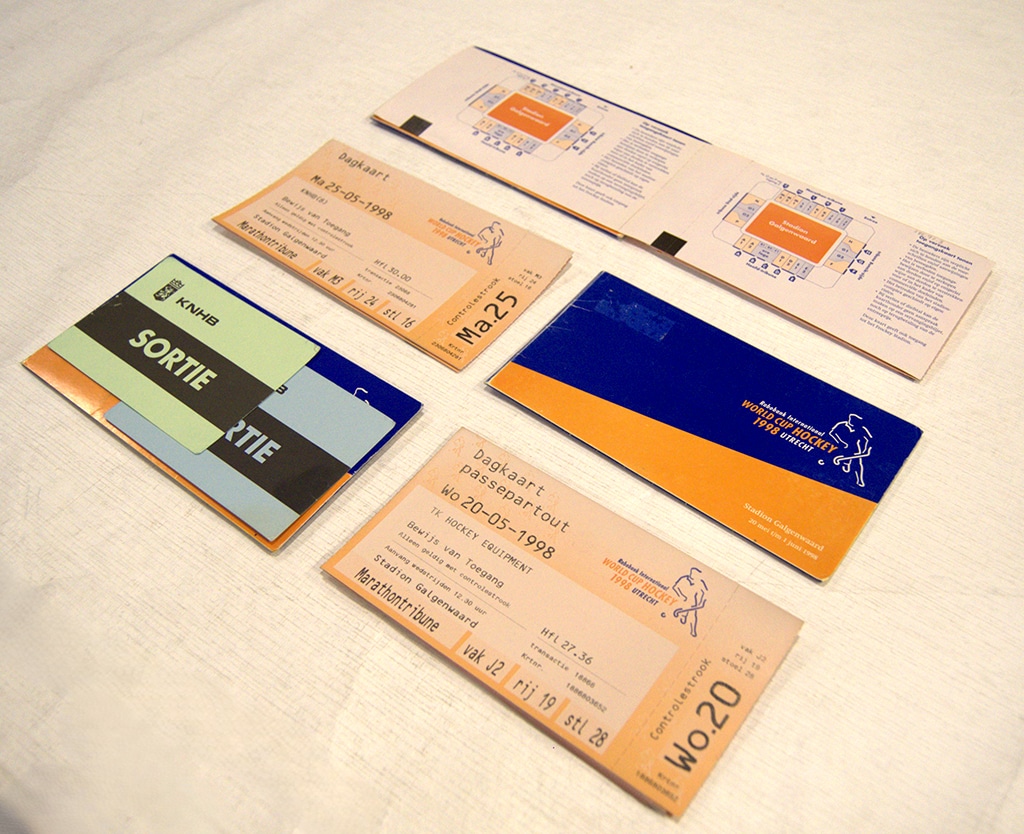
Selection of match tickets and passes from the 1998 Hockey World Cup in Utrecht, alongside the event-branded wallet in blue and orange tournament colours.
A lasting legacy: simultaneous tournaments at a temporary international hockey venue for the first time
Nearly 40 years later, the Utrecht World Cups are still remembered as a landmark event in hockey history. They demonstrated the appeal of staging men’s and women’s elite competitions side by side and showed what could happen when the sport was presented as a single, inclusive festival. Packed stadiums, dramatic matches, and an unforgettable atmosphere combined to create a tournament that many still regard as the benchmark for Hockey World Cups.
As the sport celebrates another simultaneous men’s and women’s World Cup in 2026, the roots of that concept can be traced directly back to Utrecht. It was there, amid a sea of orange and in a temporary hockey venue, that hockey first proved the power of bringing its biggest stars together on one stage.
Discover how the Utrecht World Cups of 1988 also planted the seed for an exciting future innovation that will manifest itself at next year’s European Championships: Big Stadium Hockey.
Big Stadium Hockey: from Utrecht to the World Cups of the future – The Hockey Museum