Article by Sue Catton, former Head of Events at England Hockey and now Big Stadium Hockey consultant.
In 1998, the Hockey World Cup took a significant step outside the traditional hockey venues.
For the first time, a major permanent football stadium was transformed into a temporary international hockey venue, as the Galgenwaard Stadium, home of FC Utrecht, prepared to host the joint men’s and women’s Hockey World Cup.
With a capacity of around 20,000, Galgenwaard was a very different proposition from the traditional hockey venue. At the end of the 1997/98 football season, its football pitch was removed and replaced with a full international-standard, water-based hockey pitch for the duration of the tournament.
The significance of the installation wasn’t necessarily the engineering itself. It was what the installation demonstrated. Hockey could successfully move into a major football stadium, attract large crowds and create an atmosphere and profile that would be difficult to achieve at a traditional hockey venue.
The 1998 World Cup was a landmark event for Dutch hockey and provided a glimpse of what might be possible if hockey could increasingly partner with major sporting stadia.
One stage, two World Cups: how Utrecht changed hockey history – The Hockey Museum
From Utrecht to The Hague
Following the success of the 1998 World Cup, the KNHB sought to repeat the concept for the next joint men’s and women’s Hockey World Cup. This was held in 2014 at the Kyocera Stadium in The Hague, the home of ADO Den Haag.

Kyocera Stadium in The Hague, Netherlands. Host stadium for the Hockey World Cup 2014.
Image credit: FIH; Grant Treeby – Treebyimages.
Once again, a full engineered base was installed at the end of the football season and a world-class hockey pitch was created inside a major football stadium.
This time, however, there was an important difference.
Rather than gluing the hockey turf to the elastic underlay shockpad, as was still normal practice at the time, the turf was installed in a way that allowed it to be removed afterwards. The pitch could therefore be rolled up, transported and re-installed at a legacy hockey club venue.
It was an important step forward.

Argentinian and Dutch pennants and a staff accreditation pass from the Hockey World Cup in The Hague, 2014.
From the Andy Halliday collection, The Hockey Museum.
Both Utrecht in 1998 and The Hague in 2014 demonstrated that major football stadia could successfully host international hockey. Yet there was still a fundamental problem with the approach, the cost and environmental implications of installing what was effectively a new hockey pitch for a single event, before having to remove and relocate or dispose of the materials afterwards.
For hockey to make genuine use of the world’s major sporting stadia, something different was needed.
Enter Big Stadium Hockey
This is where England Hockey came in.
Following the 2018 Women’s Hockey World Cup, England Hockey invested in research and development to explore a different approach. Could a temporary international-standard hockey pitch be installed over an existing stadium playing surface, without damaging or altering what was underneath?
The ambition was to create a genuinely temporary overlay pitch that could be dismantled after an event and reused repeatedly. Crucially, there would be no excavation. The stadium’s existing pitch would remain completely untouched beneath the hockey installation.
Working with the International Hockey Federation (FIH), the Sports Turf Research Institute (STRI), Polytan and Polypipe, and with financial support from Sport England, a series of tests and trials took place. These established the combination of components required to comply with the FIH’s Temporary Overlay Pitch (TOP) standard, developed specifically to support this approach.
The resulting technology was patented by England Hockey.
The concept was simple, but potentially transformative, take international-standard hockey to a major stadium, whilst protecting the stadium’s delivery of its primary sport, in or outside of the sports season.
Proving the concept
The first Big Stadium Hockey installation was delivered at the Twickenham Stoop in 2019 for ProLeague matches against New Zealand, played in front of 12,000 fans.
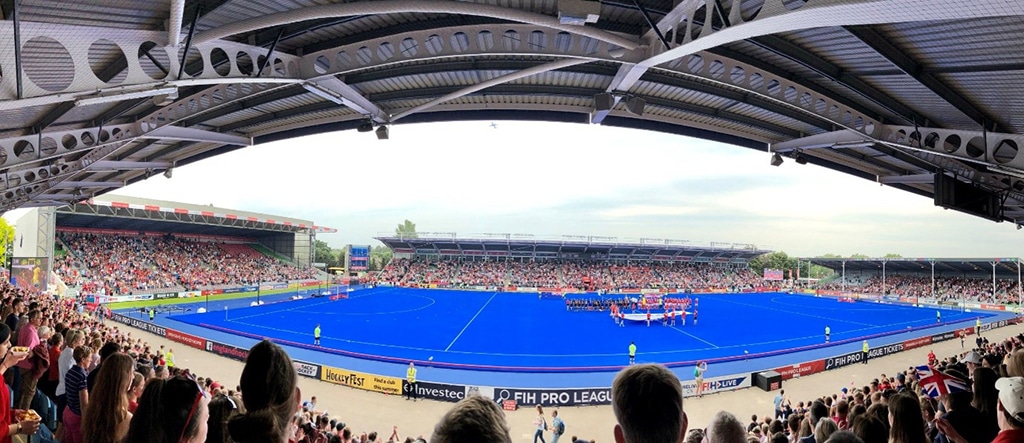
Big Stadium Hockey was hosted at the Twickenham Stoop for the ProLeague matches in 2019.
Image credit: England Hockey/Big Stadium Hockey.
It was quickly followed by another important test in Dublin. In partnership with Hockey Ireland, a Big Stadium Hockey pitch was installed over a 3G rugby pitch at Energia Park for the Olympic Qualifiers.
The significance of the installation was perhaps best demonstrated by what happened afterwards. Within a day and a half of the event, rugby was again being played on the 3G pitch.
The stadium had hosted international hockey and then simply returned to its normal use. That was the breakthrough.
The opportunity of the 2026 World Cup
Covid put paid to the immediate repeat use of Big Stadium Hockey technology, but the concept remained at the heart of the England and Wales joint bid to host the 2026 Men’s Hockey World Cup.
The ambition went far beyond simply finding venues for the tournament. At its heart was a desire to transform the sport, to reach more diverse audiences and fans, grow the game and create a better experience for everyone involved.
Putting hockey into major permanent stadia could offer better experiences for spectators, players and guests, create more commercial opportunities and deliver a stronger television product.
Most importantly, it could put hockey in front of audiences who might never otherwise walk through the gates of a hockey club.
Four stadia were selected for the proposed tournament: the Twickenham Stoop in London, cinch Stadium at Franklin’s Gardens in Northampton, and Cardiff Arms Park, with the semi-finals and final planned for the iconic Tottenham Hotspur Stadium in London.
With a capacity of more than 60,000, Tottenham would have elevated the concept.
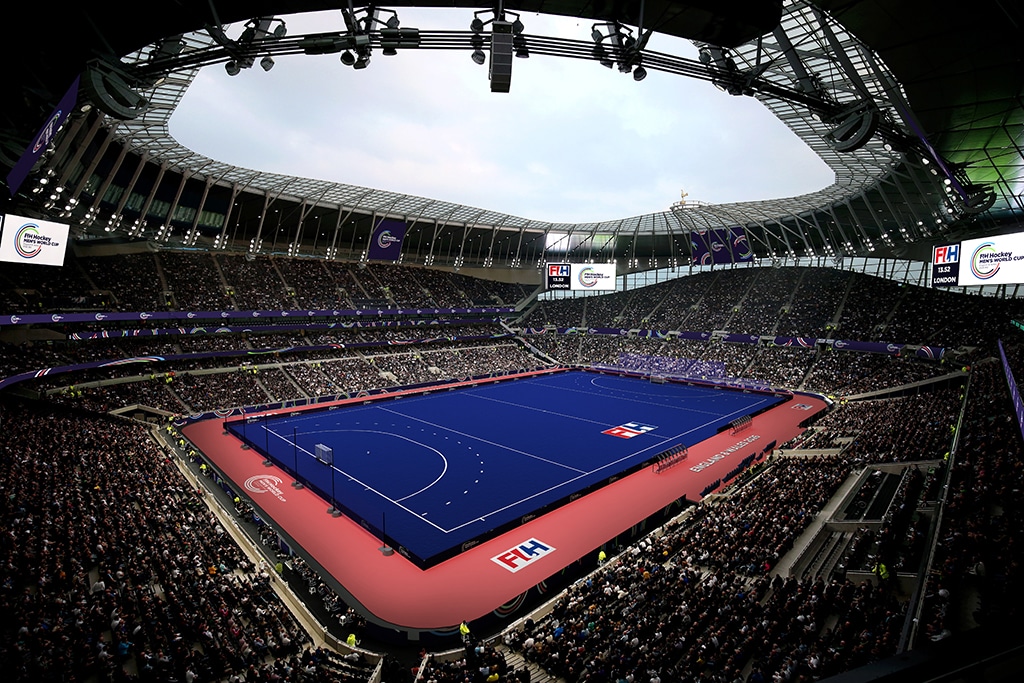
An artist impression of a Big Stadium Hockey installation at Tottenham Hotspur Stadium. Part of England Hockey’s unsuccessful bid for the 2026 Hockey World Cup.
Image credit: England Hockey/Big Stadium Hockey.
It would have been reminiscent of the Wembley era, when 68,000 spectators watched hockey at Wembley Stadium — except this time with no grass to protect!
All four stadia would have used Big Stadium Hockey temporary overlay pitches to full international standard. The technology was designed to be sustainable and reusable, while also creating a legacy by allowing the pitch systems to be subsequently used by hockey clubs.
It was an ambitious vision for the future of the sport.
The story continues
The bid was ultimately unsuccessful, with the FIH choosing a different model for the 2026 World Cup, another joint men’s and women’s tournament but this time spread across two venues in two countries, the Netherlands and Belgium.
But the Big Stadium Hockey concept did not disappear.
EuroHockey has embraced the technology and the potential of a multi-venue and Big Stadium Hockey approach. In 2027, the EuroHockey Championships will take the concept to another level when the Twickenham Stoop hosts the final stages of both the men’s and women’s competitions.
It will be the first time a continental championship has used Big Stadium Hockey technology.
From Utrecht in 1998, when the football pitch was removed to make way for hockey, to The Hague in 2014, when the hockey pitch itself became reusable, and ultimately to Big Stadium Hockey, the journey has been towards something much more flexible.
The stadium no longer needs to change its identity for hockey.
Hockey can simply arrive, utilise a world-class international stadium, deliver the event and then leave, ready for its primary sport once again.
That opens up a very different future for hockey.
The technology exists. The opportunity is huge.
The challenge now is whether hockey is brave enough to embrace it in the future – and take the sport into the next era, an era of major stadium events.