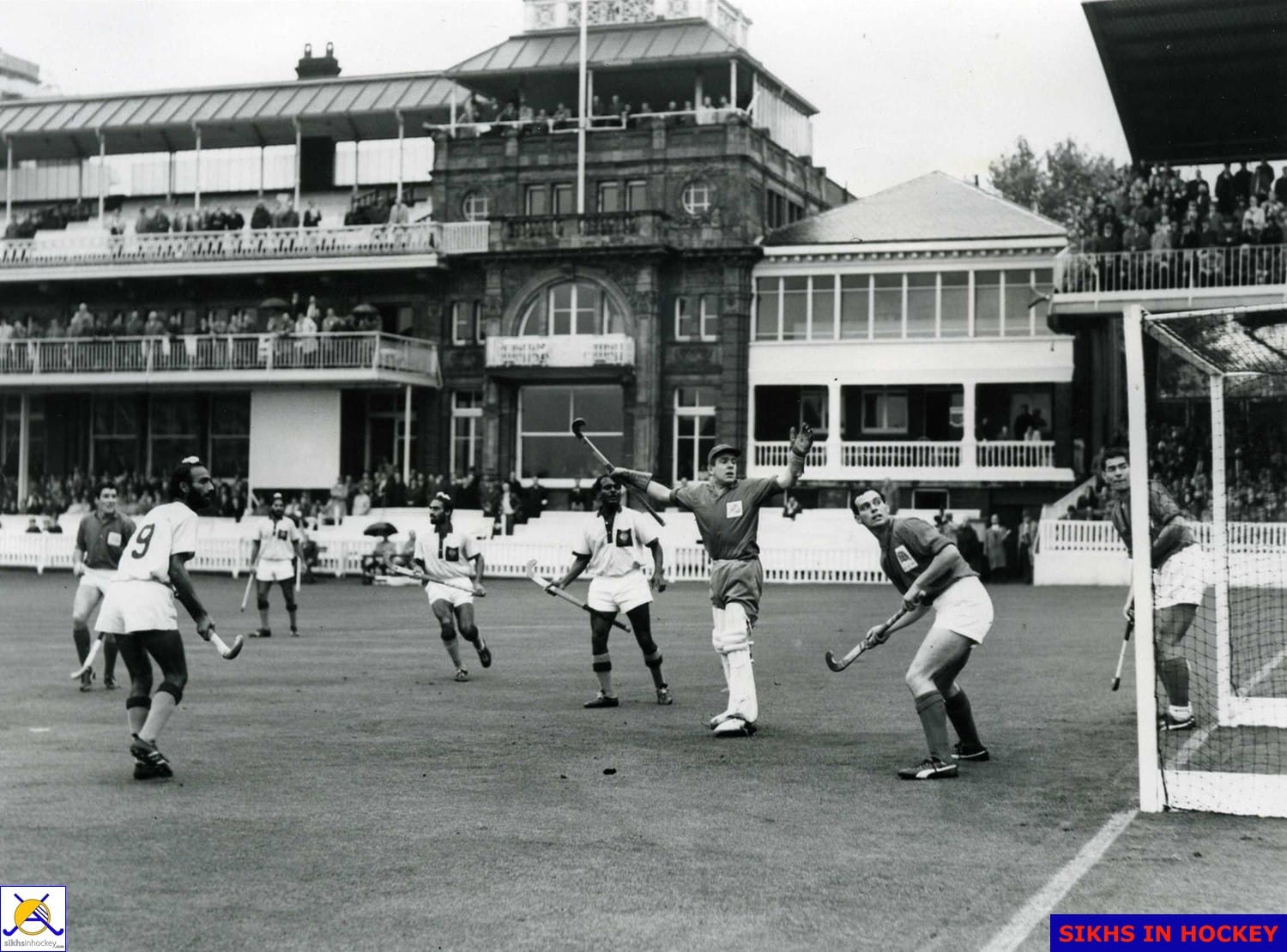
In October 1986, while England’s dramatic run to the final of the 1986 Men’s Hockey World Cup was capturing national attention, another tournament was unfolding across hockey clubs and grounds throughout Greater London. It attracted former international players, touring sides and old friends from across Europe, Australia, Indian, Malaysia and beyond. Few could have realised it at the time, but the John Lelliott Veterans Tournament would become one of the most important milestones in the history of Masters hockey.
Today, Masters hockey (previously known as veterans’ hockey) encompasses age-group international competition from Over 35s to Over 80s, with World Cups attracting hundreds of players from around the globe. The roots of this modern movement can be traced directly back to the autumn of 1986. It laid the foundations for what has now become a worldwide explosion of Masters hockey.
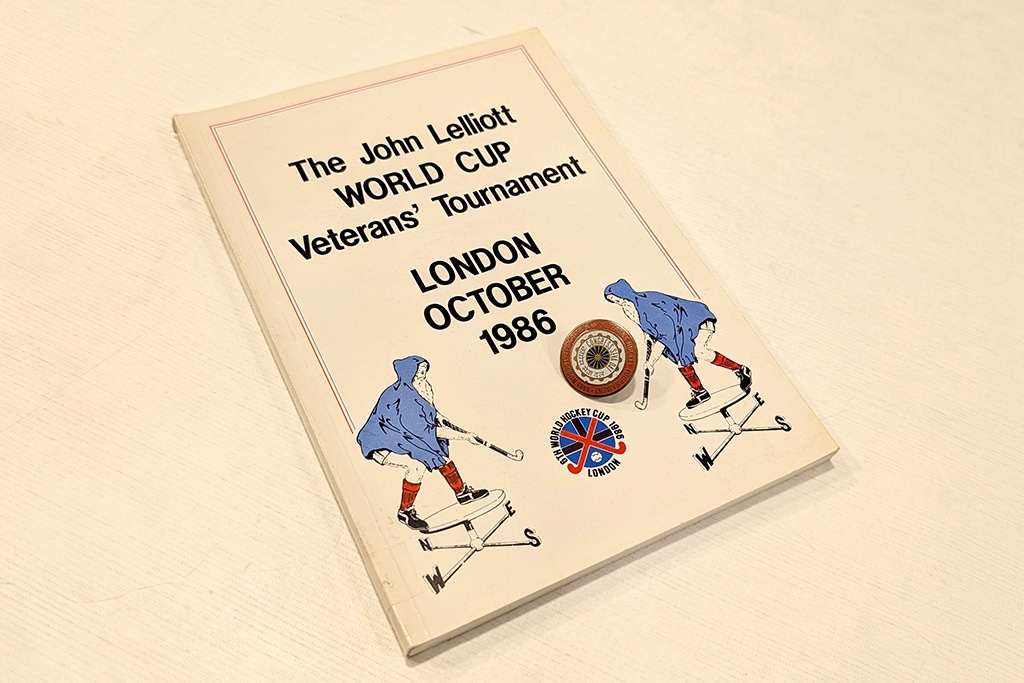
Programme booklet for The John Lelliott World Cup Veterans Tournament, held across Greater London in October 1986, with a pin badge from one of the participating teams. The tournament was contested by 80 Masters hockey teams from around the world.
A World Cup of remarkable scale for the whole hockey family
The veterans’ tournament in 1986 formed part of the wider programme surrounding the Men’s World Cup, itself a transformational event for hockey in Britain. The sport was enjoying a surge in media attention, packed crowds at Willesden Stadium and extensive BBC coverage. The organisers wanted the tournament to be more than an elite competition. It would be a celebration of hockey for all.
Contemporary reports in Hockey Digest magazine described the veterans’ competition as a demonstration that hockey was truly “an all-age game”, bringing together players who had remained connected to the sport long after their peak competitive years. The tournament sat alongside the World Cup, the hockey heritage exhibition, trade stalls and social events, helping create what participants later remembered as a genuine hockey festival.
What distinguished the veterans’ event was its ambition. Rather than a small invitational gathering, it attracted 80 teams drawn from clubs and touring sides from within England and around the world. Matches were hosted by hockey clubs throughout the London area: Bromley, Hampstead, Richmond, Southgate, Surbiton, Teddington, Tulse Hill, and Wimbledon. The surviving results demonstrate the scale of the undertaking. Teams included Real Club de Polo from Barcelona, Amsterdam, Athenians from Athens, Hannover, Hotspurs from Perth, Indian Veterans, Munich, Devon Dumplings, London Indians, Hounslow, Guildford and many more.
Looking back, the calibre of players involved was striking. Former international players featured throughout the competition. Jim Tranter of Shifnal Kingpins remembered facing a powerful Hounslow side containing former Great Britain (GB) internationals, including Roly Brookman, who had represented GB only months earlier. The Shifnal Kingpins regarded reaching half-time at 0–0 as a triumph before eventually losing 3–0.
The knockout stages were played at Willesden Stadium itself, giving veterans the opportunity to experience the same venue hosting the world’s best players. After a series of fiercely contested quarter-finals and semi-finals (both semi-finals were drawn 1–1 and won only of penalty flicks), Real Club de Polo Barcelona defeated Devon Dumplings 1–0 in the final.
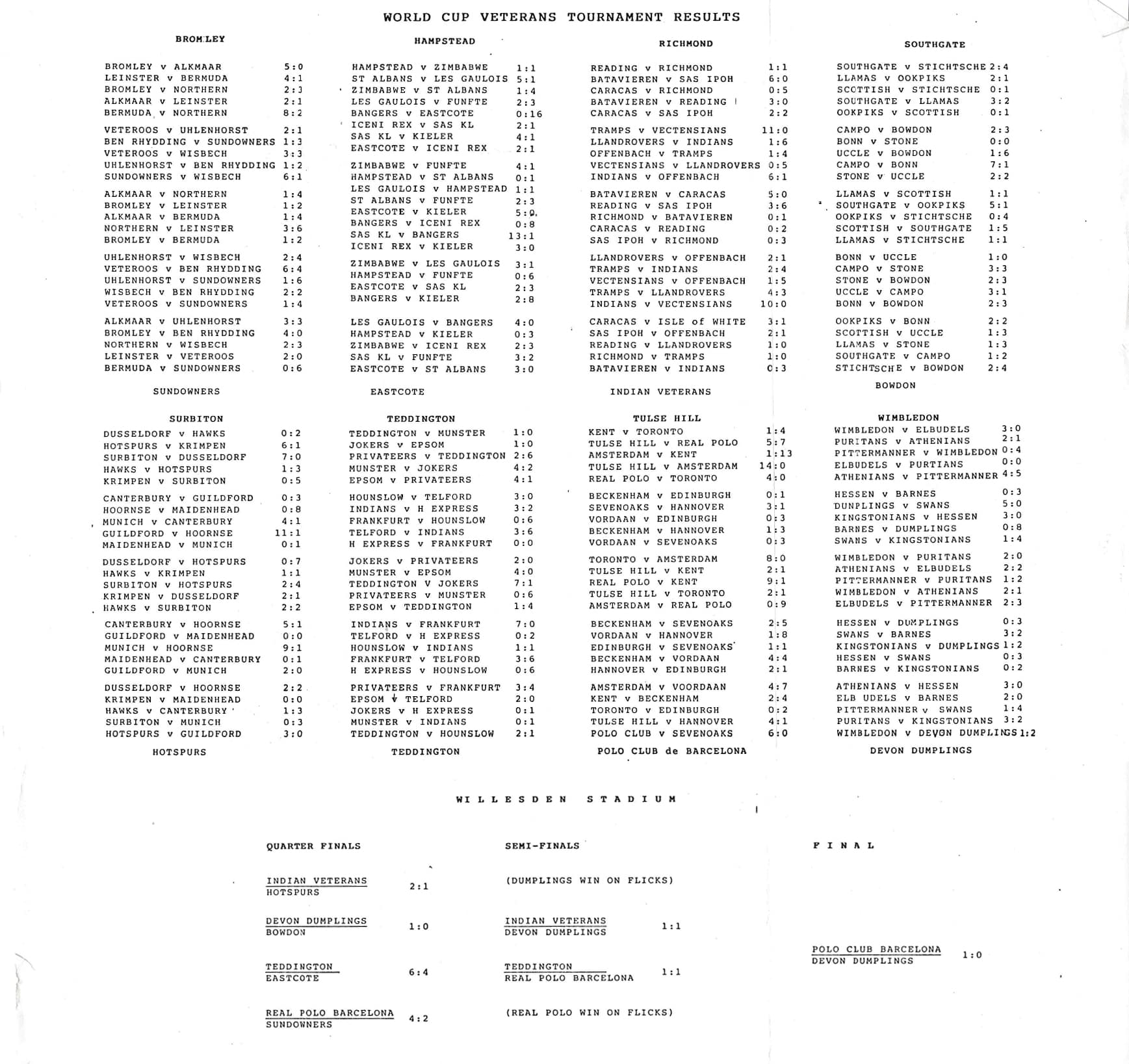
Results sheet from World Cup Veterans Tournament, 1986.
For the Devon Dumplings, reaching the final was the culmination of a remarkable campaign. Mike Harris describes a squad assembled from players across Devonshire clubs, including a core of players from Plymouth and Isca hockey clubs. Managed by longstanding Dumpling John Franklin of Torbay Hockey Club, the side emerged from a strong group that included host club Wimbledon and a Western Australia touring team (Black Swans) before progressing to the knockout rounds. Success brought its own challenges, forcing players to rearrange work commitments and accommodation as their stay in London extended beyond expectations.
After defeating Bowdon in a closely fought quarter-final, they faced an Indian Veterans side that pre-tournament publicity had claimed could field an entire team of former Olympians. Our records are unclear if that was the case. Harris remembered the prospect as daunting, but Devon overcame the highly fancied Indians to secure a place in the final where they met Real Club de Polo Barcelona before a large and vocal crowd. According to Harris, it was an evenly matched contest in which the Dumplings had genuine opportunities to lift the trophy, including two penalty strokes that went unconverted. Powered by recently retired Spanish internationals in midfield, Polo eventually took their chances and claimed a 1–0 victory.
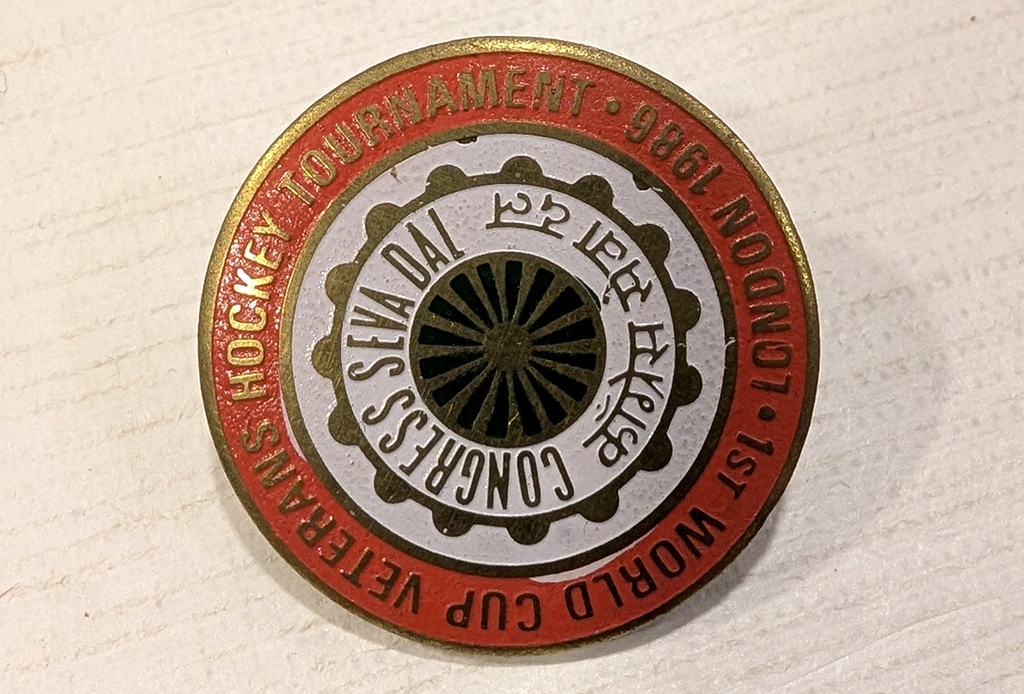
Pin badge believed to be from the Indian Veterans touring team that reached the semi-finals of the Veterans Hockey World Cup Tournament in 1986. The team organiser in India was Tariq Anwar, a Member of Parliament of the All India Congress in Delhi.
The story did not end there. The mutual respect forged during the tournament led the Spanish club to invite the Dumplings to their own festival in Barcelona the following year. The Devon side accepted and, in a satisfying postscript to the 1986 final, defeated Polo on their home ground in 1987, demonstrating the lasting friendships and international connections that became one of the tournament’s defining legacies.
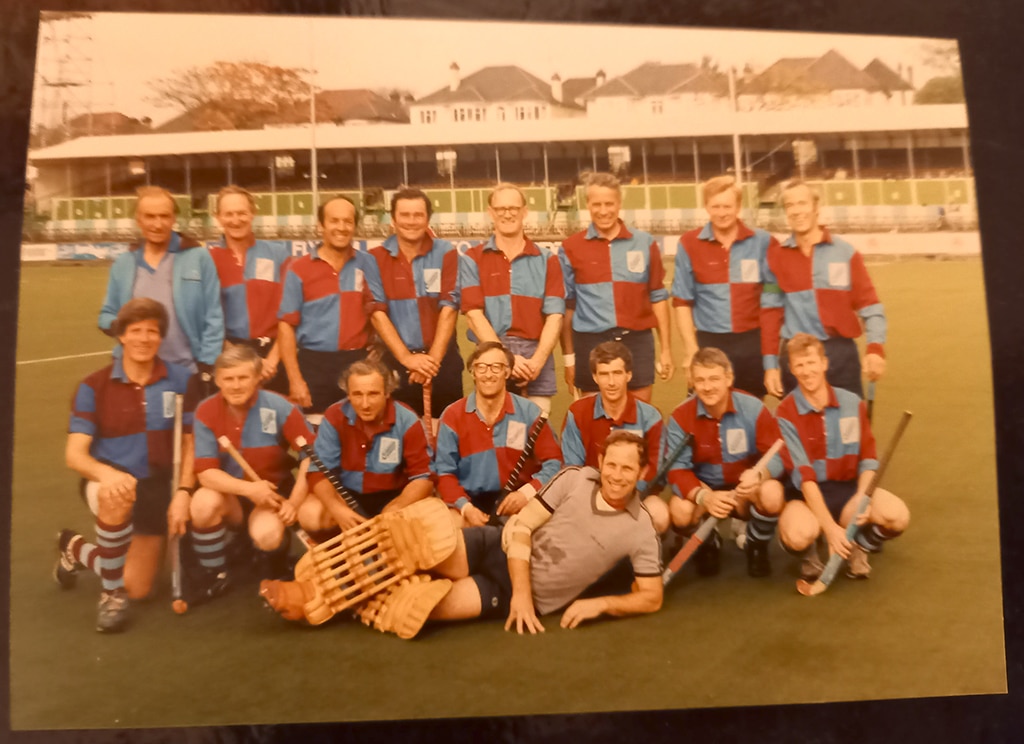
The Devon Dumplings Hockey Club team, runners up at the World Cup Veterans Tournament, 1986.
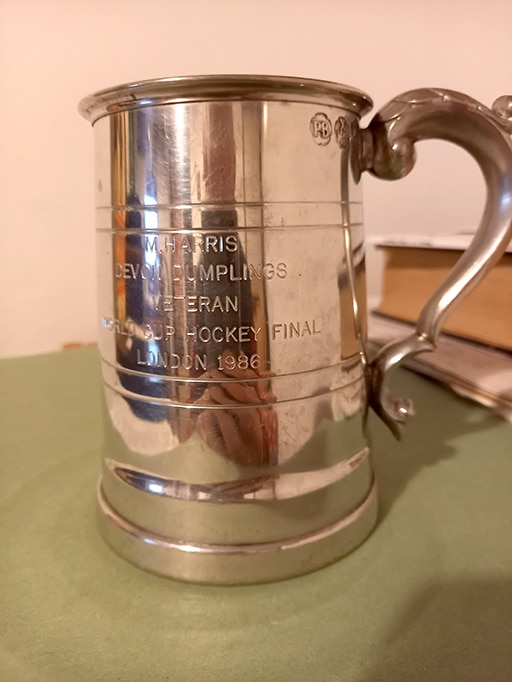
The commemorative tankard presented to Mike Harris of the Devon Dumplings by the club president Leslie Willcock at a reception held at Newton Abbot Racecourse after the Veterans Hockey World Cup Tournament, 1986.
Fiercely competitive, not merely nostalgia
One theme runs consistently through both contemporary reports and later recollections: nobody treated the tournament as an exhibition.
Hockey Digest wittily observed that the veterans “made the main event, the World Cup itself, sound like a vicarage tea party.” The intensity was perhaps most clearly demonstrated by disputes over the tournament’s age regulations.
The rules were unusual. Players generally had to be at least 40 years old, although up to three players over the age of 35 could be included. More importantly, the combined age of the players on the pitch had to remain above 440. Every substitution therefore required rapid mental arithmetic by team managers and captains. This led to heated disagreements and eligibility challenges.
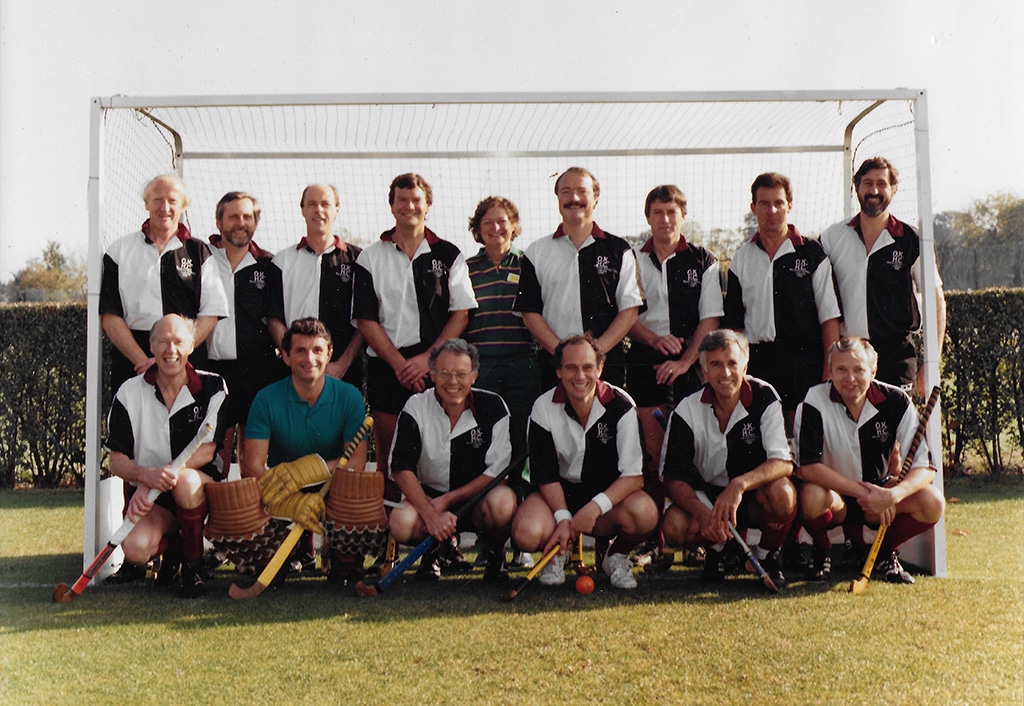
The Old Kingstonians Hockey Club team from the World Cup Veterans Tournament, 1986.
One of the best stories came from Adrian Stephenson who played in the St Albans team based at Hampstead Hockey Club. After suffering a badly torn hamstring and being taken to hospital, he later learned that their German opponents had complained because St Albans temporarily fell below the required age total while awaiting a replacement player. Despite the dispute, St Albans won their pool on goal difference before going out to Eastcote (winners of the other Hampstead pool) in the qualifying match.
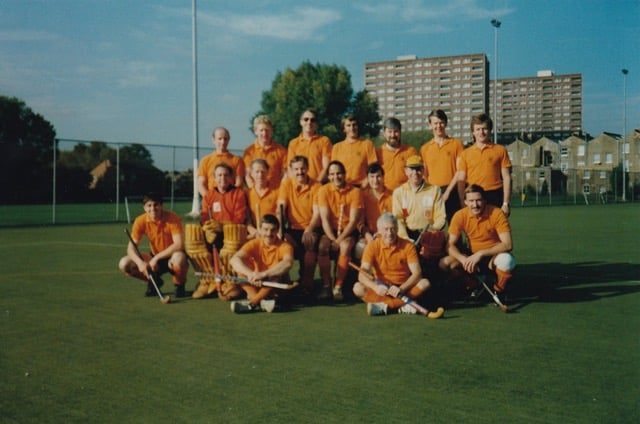
The St Albans Hockey Club team from the World Cup Veterans Tournament, 1986.
Several participants recall how eventual tournament winners Real Club de Polo had a team of younger, recently retired Spanish international players. Among them was Juan Angel Calzado, who would go on to become President of the International Hockey Federation (FIH). Polo allegedly got around the minimum combined age rule by fielding an 80-year-old winger!
Another participant, John Kaylor of Iceni Rex (made up of Essex County veterans), recalled being challenged by a Dutch supporter on the sideline who insisted he could not possibly be old enough to qualify. As a self-confessed “fit 39-year-old playing at inside forward”, his response was as fast as his game:
“Please put that in writing for my wife.”
The strength of the field was reflected not only in the players taking part but also in the preparation many teams undertook before the tournament. John Miller, captain of Reading Rustlers, recalled that the club attracted around 40 players of varying abilities to trial matches before settling on a committed squad of more than 20. Far from treating the event as a social gathering, the team trained regularly and played practice matches against local opposition, winning almost all of them and arriving at the tournament with high expectations.
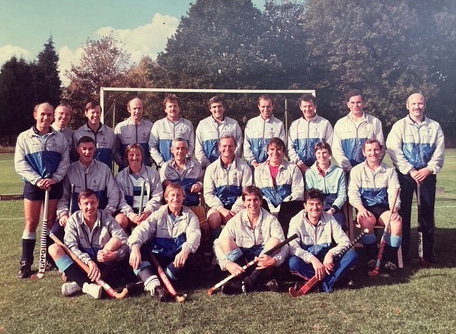
The Reading Hockey Club team from the World Cup Veterans Tournament, 1986.
Playing out of Richmond Hockey Club, Miller remembered a series of closely contested matches. He regarded Dutch side Battavieren as the strongest team Reading faced and recalled meeting Dymm Shah (Ipoh), whose side contained several former Malaysian internationals. Such recollections underline how many teams contained players with recent top-level experience and why the tournament was remembered as fiercely competitive.
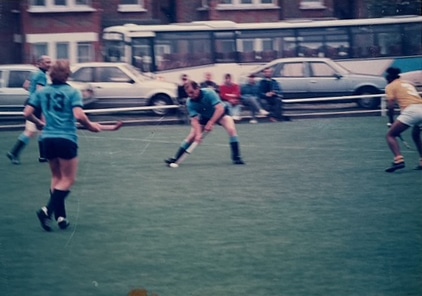
Reading vs Dymm Shah at Richmond Hockey Club.
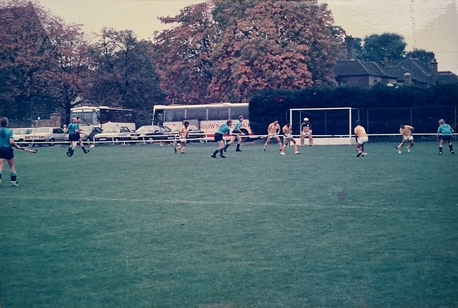
Reading vs Dymm Shah at Richmond Hockey Club.
Building an international hockey community
Beyond the competition itself, the tournament created something equally important: connections.
Leandro Negre, later President of the FIH, competed with his team Hockey Express. 40 years later, he still described the event as one of the finest memories of his hockey life. He remembered the tournament’s scale, organisation and quality, noting that he had never since participated in such a large and well-run Masters competition.
Before the first match at Teddington Hockey Club, Negre and Étienne Glichitch, then President of the FIH, participated in a ceremonial tree planting marking Teddington’s place in hockey history.
Read about the tree planting history here: 1986: a tree, two tankards and a toast to hockey’s future – The Hockey Museum
For many participants, lasting friendships proved as important as the results. Negre recalled that Hockey Express, initially formed by Spanish players for summer tournaments, evolved into a multinational team of friends from Spain, England, Germany and the Netherlands, many of whom remain in contact today.
Similarly, Peter Child, who played for the Munich team at Surbiton and would later become the first President of the World Grand Masters Association (WGMA), remembered reuniting with old acquaintances from across the hockey world at the tournament’s closing celebrations. So much so that he nearly missed his flight back to Munich!
A direct line to modern Masters hockey: the beginning of a second hockey career
For many players, 1986 marked not an ending but a beginning.
Jim Tranter (Shinfal Kingpins) described the tournament as “the beginning of my second hockey career”. Two decades later he began representing England in Grand Masters hockey and ultimately competed at every age group from Over 60s to Over 80s.
His experience captures the tournament’s wider significance. Veterans’ hockey provided a pathway for players who might otherwise have left the game. Rather than struggling to keep pace with players half their age, older participants could continue competing alongside contemporaries of similar age and ability. As one recollection noted, many players who might otherwise have hung up their hockey boots discovered “a new lease of hockey life”.
The concept seems obvious today, but in 1986 it was still emerging.
Perhaps the most striking observation comes from the participants themselves. Multiple recollections describe the tournament as the foundation of modern Masters hockey. At the time, there were no Masters World Cups, no established international age-group pathways, and no global calendar for players in their fifties, sixties, seventies and beyond. Today the situation is dramatically different. International Masters hockey features structured competition from Over 35 through to Over 80 age groups. Former participants in the 1986 tournament remain active within the Masters community, with some still playing more than 40 years later in Over 80 competitions.
The influence of 1986 can also be seen in the people involved. Participants such as Peter Child and Adrian Stephenson would go on to help shape international Masters hockey governance, while others remained ambassadors for the movement for decades afterwards.
Legacy
The story of the John Lelliott Veterans Tournament is about much more than who won.
Yes, Real Club de Polo Barcelona lifted the trophy. Yes, former internationals renewed old rivalries and played highly competitive hockey. However, its real importance lies in what it demonstrated: that there was a huge appetite for meaningful hockey competition beyond a player’s fortieth birthday.
The event brought together hundreds of players, dozens of teams and multiple generations of hockey experience. It proved that veterans’ hockey could be competitive, international, sociable and sustainable. Most importantly, it created a model that others would follow.
40 years later in 2026, as Masters World Cups welcome players from Over 35s to Over 80s, the legacy of 1986 remains visible. What took place alongside the Men’s World Cup at Willesden was not merely a veterans’ tournament. It was the moment a global movement began.
________________________________________
1986: More Than a World Cup
Discover the stories beyond the final whistle.
This article forms part of our series exploring the people, events and unexpected stories surrounding the 1986 Men’s Hockey World Cup.
Willesden 1986: the World Cup that changed English hockey – The Hockey Museum
The woman behind the sixth Men’s World Hockey Cup, 1986 – The Hockey Museum
The doctor who kept the World Cup running – The Hockey Museum
1986: a tree, two tankards and a toast to hockey’s future – The Hockey Museum
Own a piece of 1986 World Hockey Cup history – The Hockey Museum