In July 1914, two men umpired a historic women’s hockey match in Sydney – Australia’s first international match. Neither man could have imagined how dramatically his life would change as the world descended into war.
In the summer of 1914, an England women’s hockey team was making history on the other side of the world. Organised by the All-England Women’s Hockey Association (AEWHA), the tour of Australia and New Zealand was a significant undertaking at a time when international travel was expensive, lengthy and beyond the means of many players.
The visitors were helping to establish new sporting relationships and inspiring growing interest in women’s hockey in Australasia, but events thousands of miles away would soon overshadow their achievements. On 28 July 1914, the First World War began.
For two of the men who had helped make hockey history by umpiring the match in Sydney, the conflict would change the course of their lives.
A landmark match in Sydney
In July 1914, the England touring side faced Australia at Rushcutters Bay in Sydney in what Australia recognises as its first women’s international hockey match. England won 11–3, but the occasion represented something far more important than the score line.
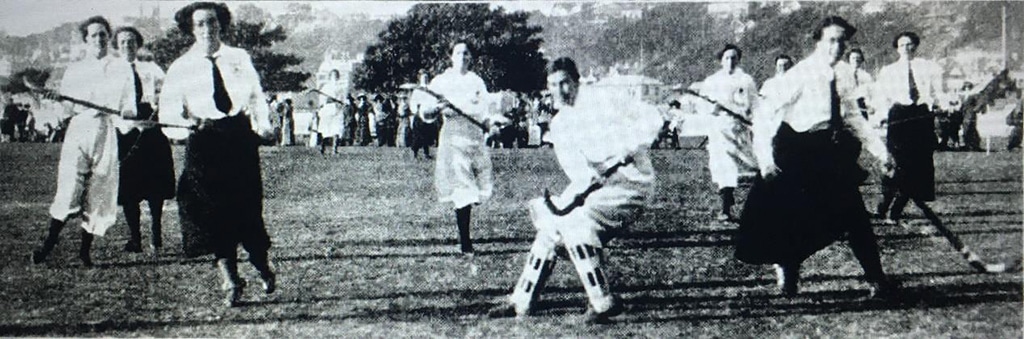
England vs New South Wales. England women (dark skirts) playing New South Wales during the inter-state tournament held at Rushcutters Bay Park, Sydney, July 1914.
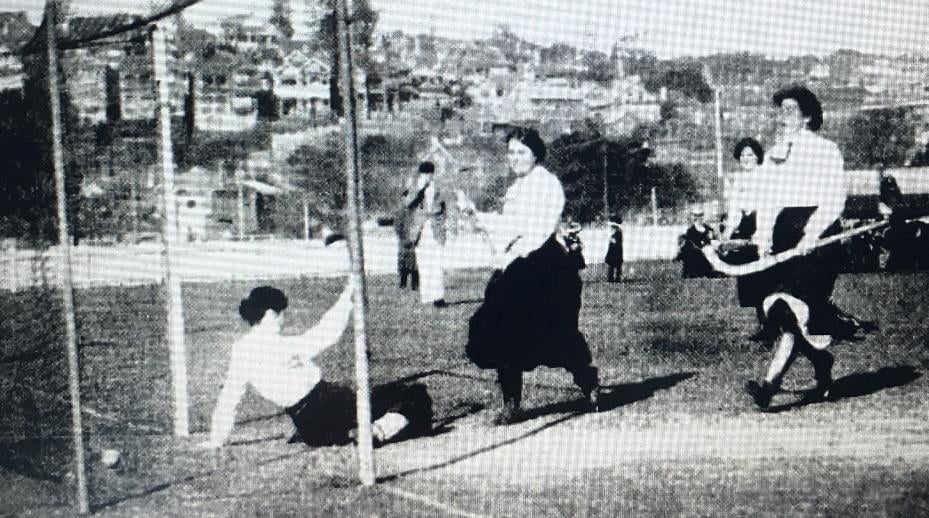
Women’s inter-state tournament action, July 1914. South Australia scoring against Victoria at Rushcutters Bay, Sydney.
Women’s hockey was developing rapidly in Australia. The visiting English team had joined an expanded inter-state tournament, giving Australian players the opportunity to test themselves against experienced overseas opposition.
The two umpires appointed to the international were Lancelot Mervyn Redgrave and Professor Frederick Alldis Eastaugh. Both were prominent figures in Australian hockey, but they came from very different backgrounds. Redgrave was a talented young player who captained New South Wales in 1914. Eastaugh was an English-born academic and metallurgist at the University of Sydney, who had helped establish the sport’s early administrative structures in New South Wales.
In recognition of their contribution, the women presented both men with silver-mounted Malacca canes. It was a moment of sporting celebration, but within weeks, the world they knew had changed.
Lance Redgrave: from hockey captain to the Western Front
Lancelot Mervyn Redgrave was just 21 when he umpired the historic Australia vs England match. Already an accomplished athlete, he had represented New South Wales at hockey and captained the state’s men’s team.
In April 1916, Redgrave enlisted in the Australian Imperial Force. He initially served as a private, leaving Sydney aboard the Suevic in November 1916. He subsequently gained a commission and became a lieutenant.
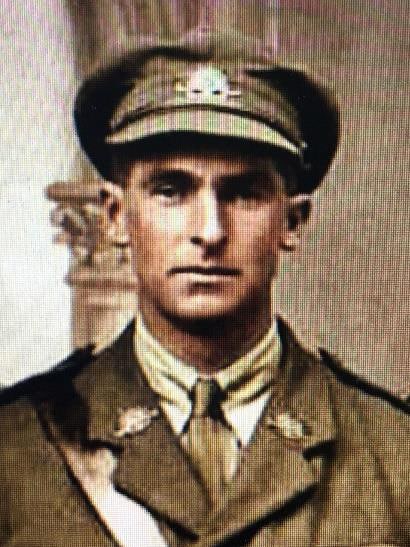
Lieutenant Lancelot Mervyn Redgrave, pictured in 1918 during his First World War service.
His wartime service took him to the Western Front, including Ypres in Belgium. In August 1918, during the Battle of Amiens, Redgrave suffered a gunshot wound. He was treated at the London General Hospital in Wandsworth before returning to military service. He survived the war and eventually returned to Australia, where he resumed civilian life and remained closely involved in hockey.
He helped establish the Marrar Hockey Club and the Riverina Hockey Association, continuing to contribute to the sport for many years.
The young umpire who had helped officiate Australia’s first women’s international in 1914 had become a soldier, survived the Western Front and returned home to help build the game he loved.
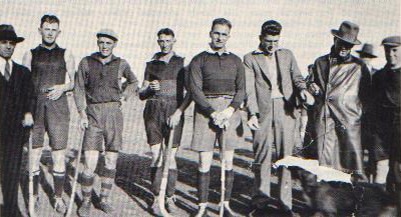
Marrar Hockey Club team, 1931 (Australia). Lance Redgrave is pictured to the right of centre.
Frederick Eastaugh: a different kind of wartime service
Professor Frederick Alldis Eastaugh’s contribution to the war took an entirely different direction.
Born in Enfield, Middlesex, in 1882, Eastaugh was a distinguished scientist who had moved to Australia in 1907. He became an important figure in the development of hockey in New South Wales, helping establish its governing association and supporting players and umpires.
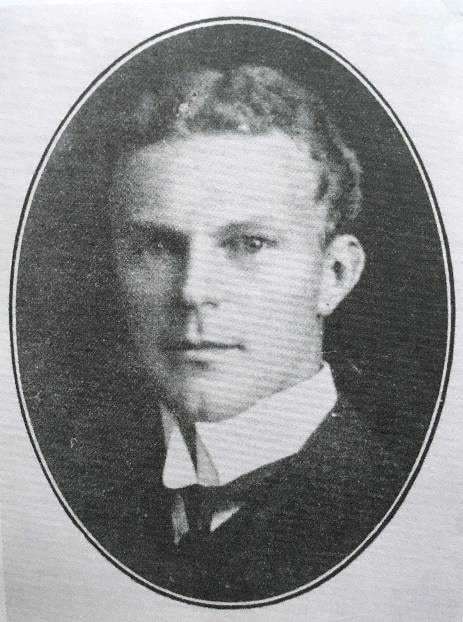
Professor Frederick Alldis Eastaugh. From the Sydney University Engineering Handbook, 1926.
When war came, Eastaugh entered military service, but his specialist scientific knowledge was considered too valuable to be used in a conventional fighting role. Initially, he worked on the chemical composition of steel used in shell production. In 1916, he travelled to Britain, where he was assigned to HM Factory Gretna, the enormous munitions complex on the Scottish-English border. There, Eastaugh worked on technical processes associated with the production of nitrocellulose (known as ‘guncotton’, a replacement for gunpowder as a shell propellent), including drying, dehydration and solvent recovery.
The factory’s wartime production became associated with the term ‘Devil’s Porridge’, a phrase famously penned by Arthur Conan Doyle to describe the production of cordite at Gretna during his time as a war correspondent.
This was dangerous, demanding and highly specialised work, essential to the enormous industrial effort supporting Britain’s armed forces.
Discover: The Devil’s Porridge Museum
While Redgrave experienced the war on the Western Front, Eastaugh contributed his scientific expertise to the production of munitions.
Two hockey umpires. Two very different forms of wartime service.
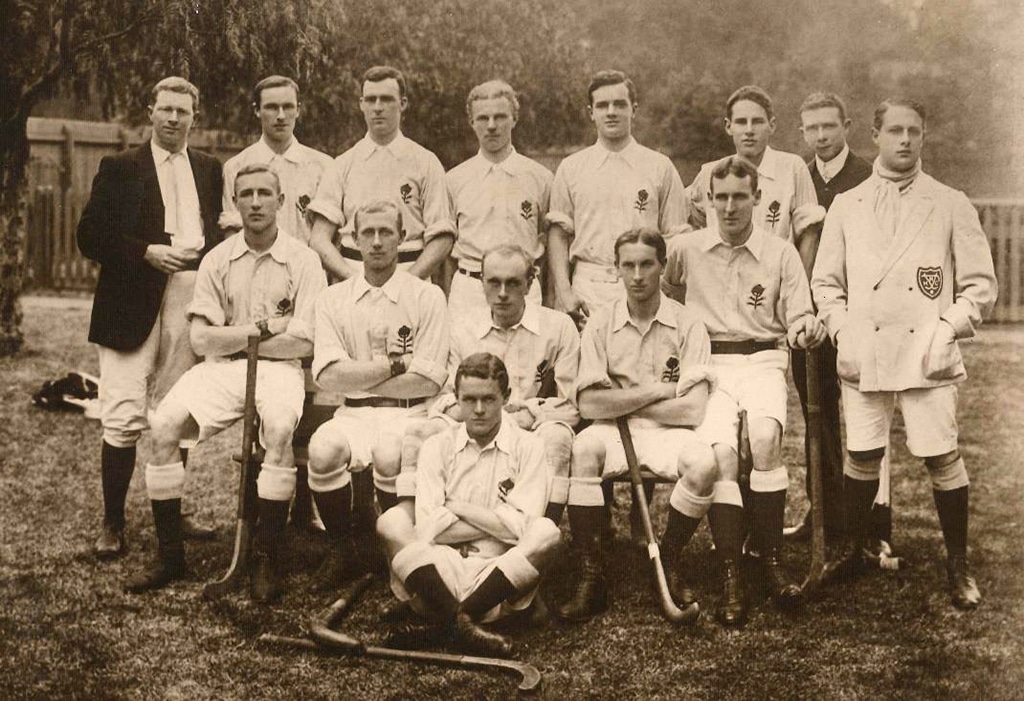
The New South Wales men’s hockey team, 1908. Frederick Eastaugh is fourth from the left in the back row.
The women whose tour was overtaken by war
The England women’s touring team continued its journey to New Zealand as the global crisis developed. What had begun as a pioneering sporting tour became a much more uncertain experience. The players were far from home, with wartime conditions disrupting international travel. The team experienced considerable difficulty returning to Britain as the conflict spread.
Yet the tour also left an important sporting legacy. It helped establish international relationships between women hockey players in England, Australia and New Zealand, while demonstrating the growing status of women’s sport.
The Hockey Museum preserves a remarkable physical connection to that journey: an original England playing skirt from the 1914 tour. More than a century later, this surviving item of clothing helps tell the story of the women who travelled halfway around the world to play the sport they loved, unaware of the upheaval that lay ahead.
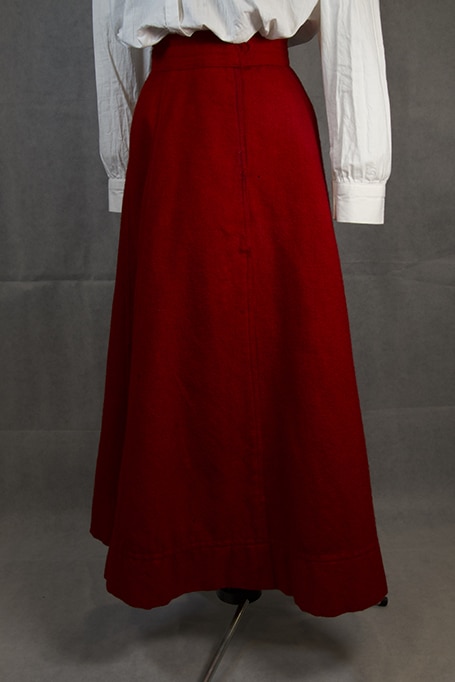
England women’s ankle-length hockey skirt from the tour to Australia and New Zealand in 1914. Displayed on a mannequin with a replica blouse.
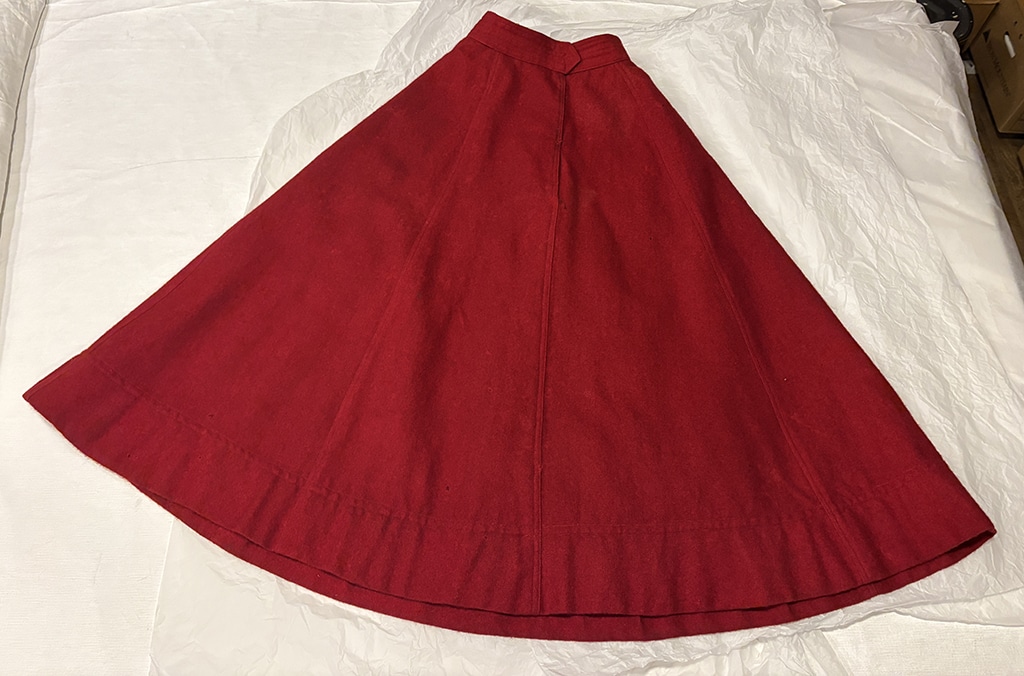
England women’s ankle-length hockey skirt from the tour to Australia and New Zealand in 1914.
Held in the collection of The Hockey Museum.
Remembering lives beyond the hockey field
Armistice Day is a time to remember the human consequences of war, particularly those who served, suffered and never returned. The stories of Lance Redgrave and Frederick Eastaugh remind us that the First World War reached into every part of society, including the hockey community. Their experiences were very different, but both men’s lives became intertwined with a conflict that transformed the world.
For those who played, umpired, organised and supported hockey in 1914, the game was part of everyday life. Then, suddenly, everyday life changed. On this Armistice Day, The Hockey Museum remembers the people behind our sport’s history, their experiences beyond the pitch and the generations whose lives were altered by war.
We will remember them.
________________________________________
Research and acknowledgements
Based on research by Colin Allerdice into the 1914 England women’s tour and the lives of Lance Redgrave and Frederick Alldis Eastaugh, alongside material held and previously published by The Hockey Museum.
Further reading: Tracing the Match Ball from England Women’s Australia and New Zealand Tour of 1914 – The Hockey Museum