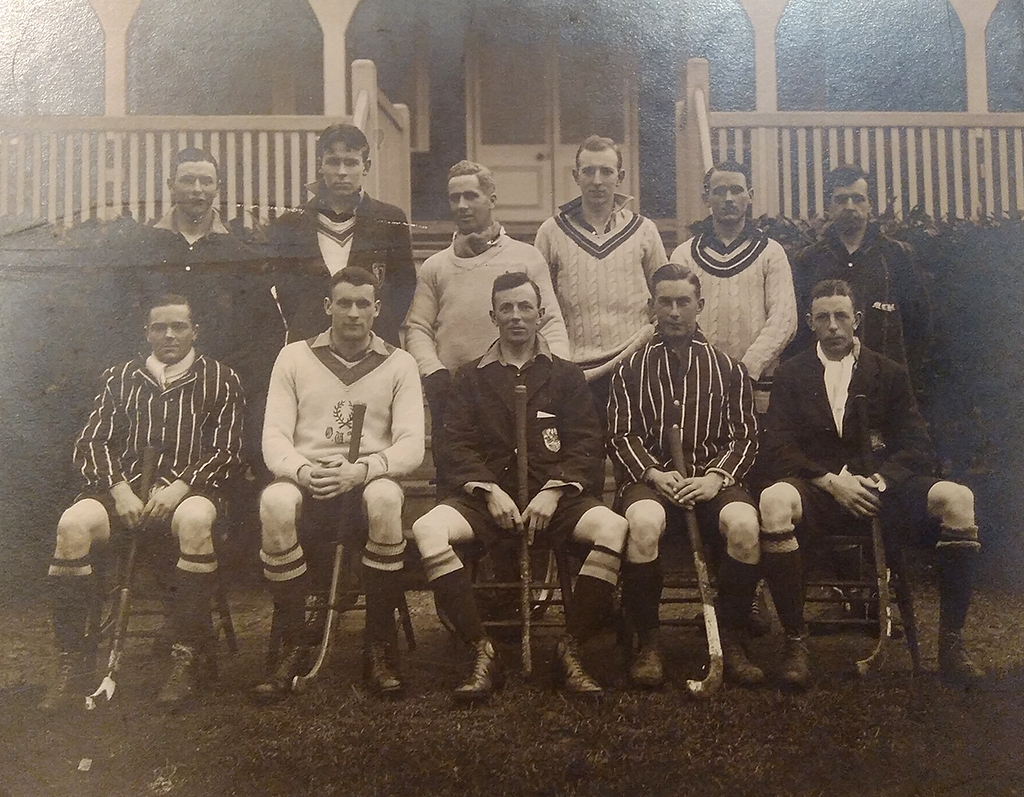
Reginald Charles Cooke was a distinguished Welsh international hockey player and decorated First World War officer whose short life exemplified sporting excellence and military courage. A talented athlete who played his club hockey in Weston-super-Mare and Cardiff, Cooke exchanged the hockey field for the battlefield when war broke out in 1914 by volunteering for service. Awarded the Military Cross for exceptional bravery under fire, Cooke was killed during the Battle of the Somme in July 1916.
As European nations acknowledge the 110th anniversary of the Battle of the Somme, The Hockey Museum looks into Reginald’s life of hockey and heroism.
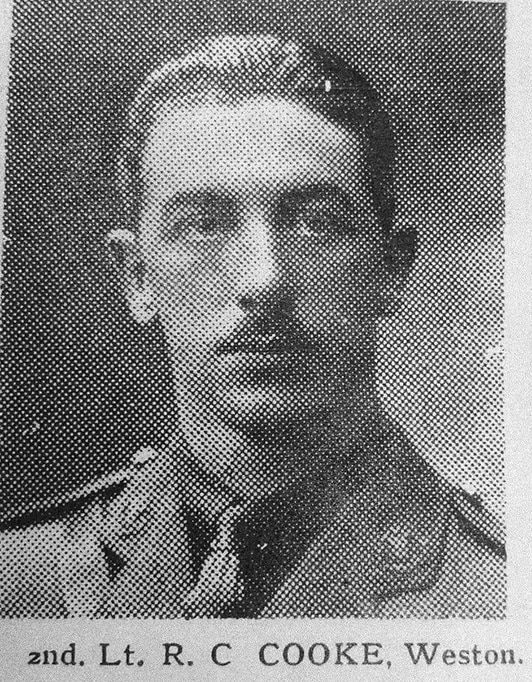
2nd Lieutenant Reginald Cooke in Army uniform
Reginald Charles Cooke: Hockey and Heroism
Reginald Cooke was born on 17 November 1886 in Cardiff. In his younger years he attended Cardiff High School (1898–1901) and went on to attend Bristol Grammar School (1901–1903). He passed his law exams in 1907 and by 1911 he was a fully qualified practicing solicitor in Weston-Super-Mare where he lived and played for the local hockey club. He joined Weston-Super-Mare Hockey Club for the 1906/7 season and played until 1912/13 when he moved to Cardiff and joined Llanishen Hockey Club to play in the final season of hockey before the outbreak of the First World War.
Reginald was regarded as a “fine hockey player” and throughout his career represented Somerset’s county-side and earned four caps playing internationally for Wales.
- 1st cap: Wales vs Scotland (18 Feb 1913)
- 2nd cap: Wales vs Ireland (11 Feb 1914)
- 3rd cap: Scotland vs Wales (23 Feb 1914)
- 4th cap: Wales vs England (4 March 1914)
The First World War started on the 28 July 1914 and by August of the same year, Reginald had enlisted to fight as a private in the Cardiff Pals and eventually the 9th Battalion Welsh Regiment on 10 April 1915. The Cardiff Pals was one of many local volunteer battalions that had organised themselves in response to the British Government’s call for volunteers. At the start of the First World War, Britain was fighting with an army of only 750,000 men and within two months 760,000 additional volunteers had come forward to fight.
Reginald arrived in France as part of the 58th Brigade, an infantry formation of the 19th Western Division, in August 1915 – a few months before the Battle of Loos where he earned the Military Cross for showing “distinguished service in the field”. He had risked his life numerous times to complete trips back and forth under heavy artillery fire to cut German wires.
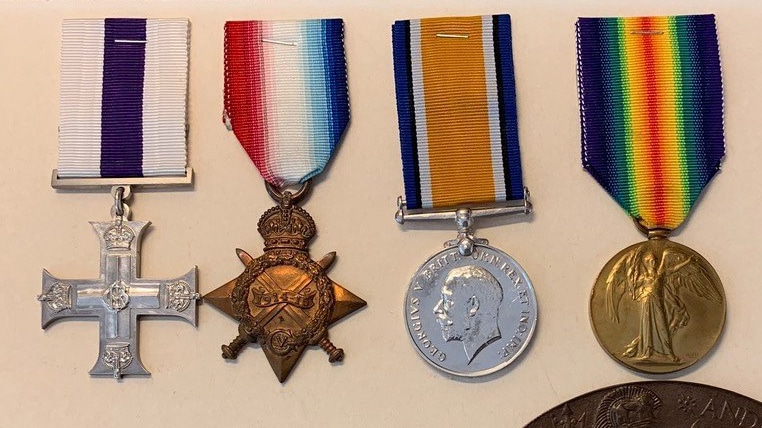
The military medals of Reginald C Cooke, including his Military Cross (first left).
Battle of the Somme
The Battle of the Somme began on 1 July 1916 and the first day of conflict saw the loss of 57,000 British troops. German defences were tough and progress through enemy lines was challenging. In the South of the British Front, several divisions launched attacks to break through the German lines and reach villages to establish advantageous positions.
By the second day, allied advances had broken through the first line of German defence and captured the village of Mametz. For soldiers to advance through the second line of defence at the village of Contalmaison, the Allies had to first take Mametz Wood and Bailiff Wood which were heavily wooded and well defended.
They launched an attack on 7 July 1916 and Reginald, along with the 9th Welsh Battalion, targeted a German trench known as ‘Heligoland’. Facing machine-guns and heavy artillery, they attempted the impossible task of taking on the German line with little prior experience of fighting in such dense woodland. The attack was successful in capturing eight enemy officers and 400 Germans but the Allies faced many casualties. Second Lieutenant Reginald Charles Cooke was fatally shot during the attack at age 30.
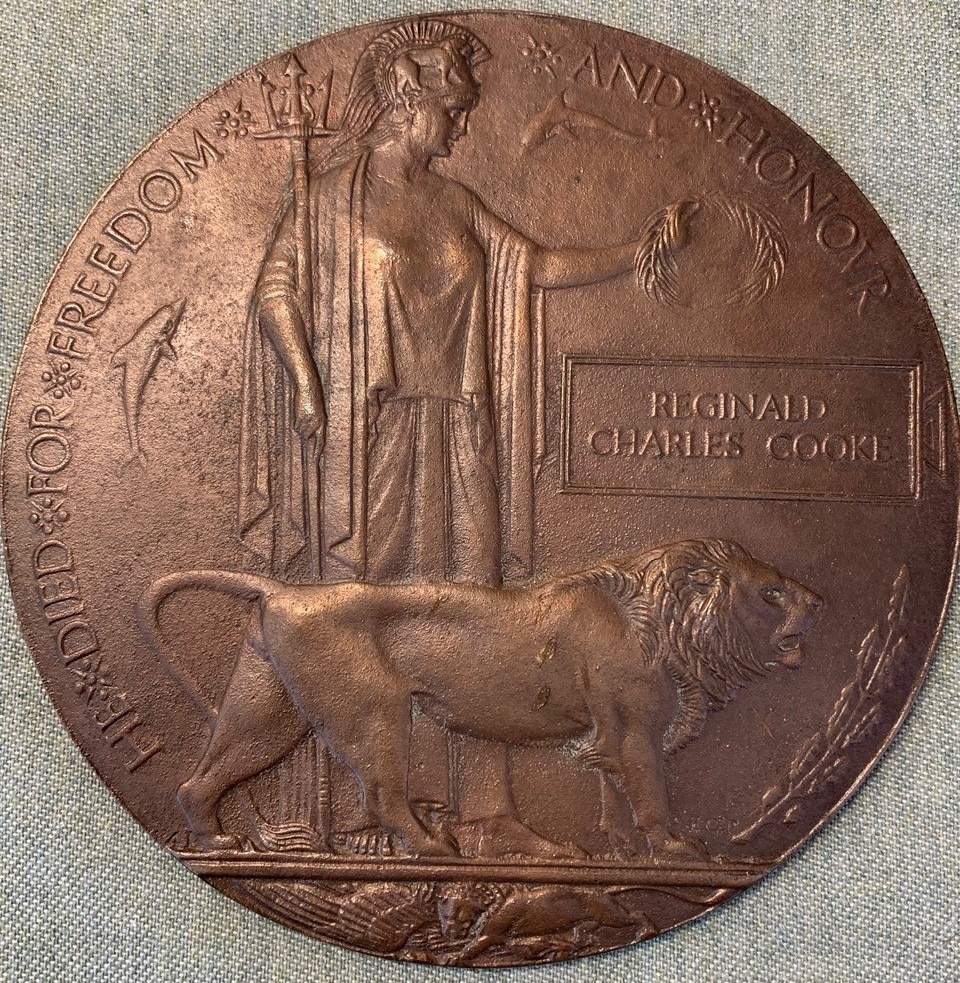
A bronze medallion known as a ‘dead man’s penny’ commemorating the death of Reginald Cooke. It reads, “He died for Freedom and Honour”. 1.3 million of these medallions were created after the First World War.