Is this one of the most important hockey sticks in the world?
At first glance, it is simply an old wooden hockey stick with a twine grip. It is not even the oldest stick in The Hockey Museum’s collection, which includes examples dating back to the nineteenth century. Its significance lies instead in where it travelled, who played with it and the moment in hockey history that it survived to represent.
The stick belonged to Captain Cox of the 2nd Battalion, 8th Punjab Regiment of the British Indian Army. In 1926, he carried it on an Indian Army hockey tour through Ceylon (modern-day Sri Lanka), Australia and New Zealand. Among the 17 players travelling with him was a young sepoy (an Indian soldier serving under British command) named Dhyan Chand.
During the tour, the team played three test matches against New Zealand. Those matches were later incorporated into India’s national playing record and are now recognised as the country’s first men’s international matches. Captain Cox therefore became an international hockey player for India retrospectively, without ever knowing that he had acquired that status.
Cox’s stick also survived; it is perhaps the only tangible relic of India’s first international hockey match. The word perhaps is important: the story is remarkable enough without extending the claim beyond the surviving evidence.
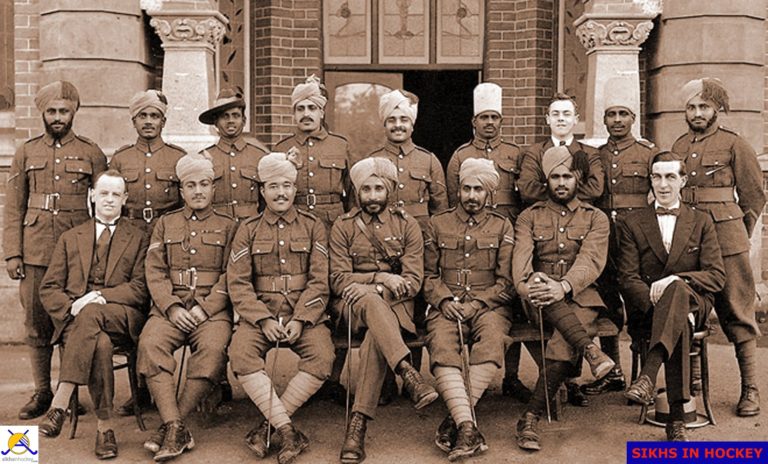
The Indian Army Hockey Team that toured to New Zealand and Australia in 1926.
Photo credit: Thakar Singh family collection and SikhsinHockey.com
Before the journey: an English stick in India
Recent examination of the object adds another layer to its history. The stick appears to be of English manufacture, as much sporting equipment was at the time. Its head is made from the wood of an English ash tree, while the handle is cane, a material associated with the cricket-equipment trade. It was almost certainly manufactured in the early 1920s and was probably taken to India by Captain Cox.
This places the stick within an important transitional period in sporting manufacture. Sport was a significant part of life for British military personnel stationed in India during the Empire, but equipment had to travel enormous distances from Britain by sea. Supply was slow, and damaged sticks, bats and rackets could not be replaced quickly.
Skilled craftspeople in the Punjab, particularly around Sialkot (in modern-day Pakistan), began repairing sporting equipment for British military customers. Repair developed into manufacture, and local makers started producing rackets, cricket bats, hockey sticks and other sporting goods themselves.
Local mulberry wood proved well suited to stick manufacture and eventually replaced imported ash in much regional production. Over the following decades, the Punjab became one of the world’s major centres of hockey-equipment manufacture. Sialkot remains a globally significant sports-goods manufacturing centre today, with records of production extending back well over a century.
Cox’s stick therefore sits at a historical intersection. It was made in England and taken to India at precisely the time when India’s own sporting-equipment industry was developing the expertise that would later supply hockey players around the world.
Hockey had already taken root in India
Captain Cox did not bring hockey to India. The rules of modern hockey had been created in England and the sport had already become established on the Indian Sub-continent during the preceding decades, with British servicemen among those who helped introduce and spread the game. By the mid-1920s, its popularity had grown sufficiently for an Indian Army side to contemplate a major overseas tour.
The tour had been under discussion since 1924, when the New Zealand Hockey Association invited an Indian Army representative side. Trials were subsequently held and the final touring squad was announced in March 1926. The 17 selected players comprised four English officers, one Sikh officer and twelve Indian soldiers. They were captained by Captain David Tenant Cowan MC, widely known as ‘Punch’ Cowan.
Captain Cox was among them, as was Sepoy Dhyan Chand of the 4th Battalion, 1st Punjab Regiment. At that stage, Chand had won no Olympic medals and possessed none of the worldwide reputation that would later earn him the nickname ‘The Wizard’. The 1926 tour captures him at the beginning of that journey.
A 30-day journey from Calcutta to Auckland
The team assembled in Calcutta and sailed on 11 April 1926. They travelled first to Colombo in Ceylon where they played two matches, before boarding the ship Chitral on 18 April. They reached Melbourne on 3 May, played Melbourne University that same afternoon and later faced an Australian Army side at the Royal Military College, Duntroon. From there, they continued across the Tasman Sea.
On 11 May 1926, exactly 30 days after leaving Calcutta, the players arrived in Auckland. They came ashore in Army uniform and were met on the wharf by representatives of the Auckland and New Zealand Hockey Associations, Government and Army. A civic reception was held in their honour the following day.
A modern itinerary can compress the route into four place names: Calcutta –> Colombo –> Melbourne –> Auckland. In 1926, however, it was a journey measured in weeks at sea, taking the players through different countries, unfamiliar grounds and new audiences. Although the surviving evidence cannot tell us exactly how the players felt, it clearly demonstrates the scale of the opportunity before them.
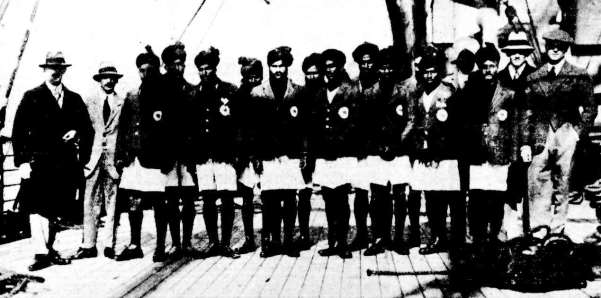
The India men’s hockey team arrive in Melbourne, Australia. They stand together on the deck of the passenger ship Chitral.
Photo credit: the Australian Indian Historical Society.
Captain Cox and Sepoy Dhyan Chand
Contemporary reporting provides a fascinating glimpse of the playing relationship between Captain Cox and the young Dhyan Chand. After an early match in Auckland, a New Zealand newspaper described Chand as a “slightly built youth” and praised his exceptional stickwork and ball control. The report also observed that many of Chand’s short passes went to his inside-left, Captain Cox, and concluded that the two players shared the honours in the forward line.
In the team’s first scheduled New Zealand match, against Waipa, Cox scored four goals and Chand three. Across the complete New Zealand programme, the Indian Army side played 21 matches, winning 18, drawing two and losing only one. They scored 192 goals and conceded 24; Dhyan Chand scored 80 of those goals!
Impressive as those figures are, it was the three matches against the New Zealand national team that gave the tour its lasting historical significance.
India’s first recognised international match
On Saturday 26 June 1926, the Indian Army team walked onto Lancaster Park in Christchurch to face New Zealand. They wore red shirts, white shorts and red socks. Captain Cox played at inside-left, while Dhyan Chand lined up at centre-forward.
The Indian Army won 5–2, with Chand scoring three goals. Today, this fixture is recognised by Hockey India as the first match included in their international record.
Two further test matches followed. New Zealand won the second 4–3 on 10 July, while the final match on 17 July ended 1–1, with Dhyan Chand scoring India’s goal. The three games were subsequently incorporated into India’s national playing record, with the unexpected consequence that the British officers who had taken part, including Captain Cox, became international hockey players for India.
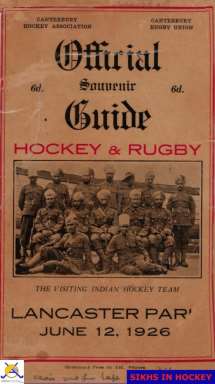
Official souvenir guide from India’s fixture against New Zealand at Lancaster Park in Christchurch on 12 June 1926. Today, this test match is recognised as India’s first international match.
Photo credit: Thakar Singh family collection and SikhsinHockey.com
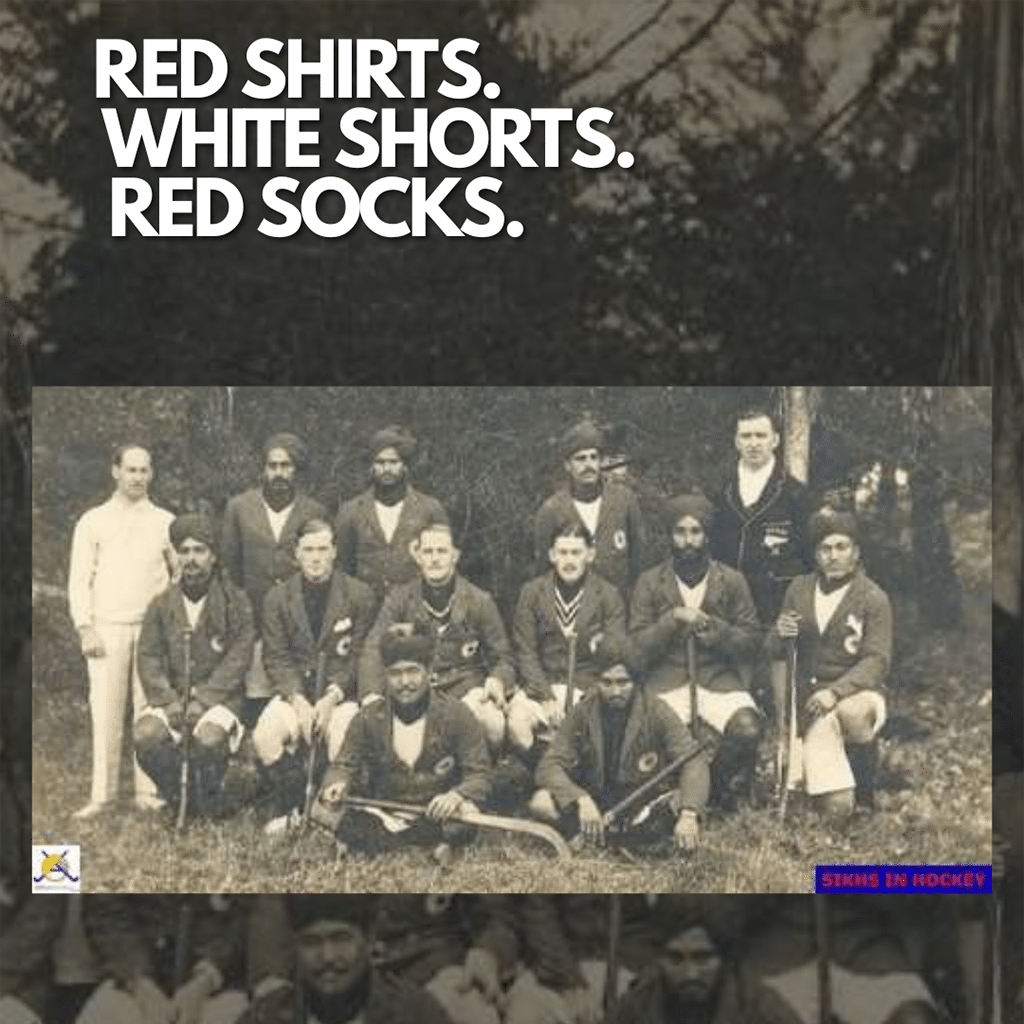
The first India men’s hockey team poses for a formal group photograph. Whilst the photograph is black and white, it is from an era when the side wore distinctive red shirts, white shorts and red socks.
The evidence carried by the stick
Cox’s stick carries a metal plate commemorating the tour. It records the Indian Army Hockey Team’s 1926 visit to New Zealand, states that the stick was used by Cox throughout the tour and gives the figures “390 goals for” and “37 against”.
Those figures require careful interpretation. Detailed research into the 21 New Zealand matches records 192 goals scored and 24 conceded. The figures on the plate should not, therefore, be presented automatically as the New Zealand-only playing record; they may refer to a wider set of tour matches or to another calculation.
The discrepancy is worth preserving rather than quietly resolving. It demonstrates how museum research develops: objects and documents provide evidence, but they can also raise new questions. Acknowledging those questions raises the sense of intrigue and strengthens the history rather than diminishing it.
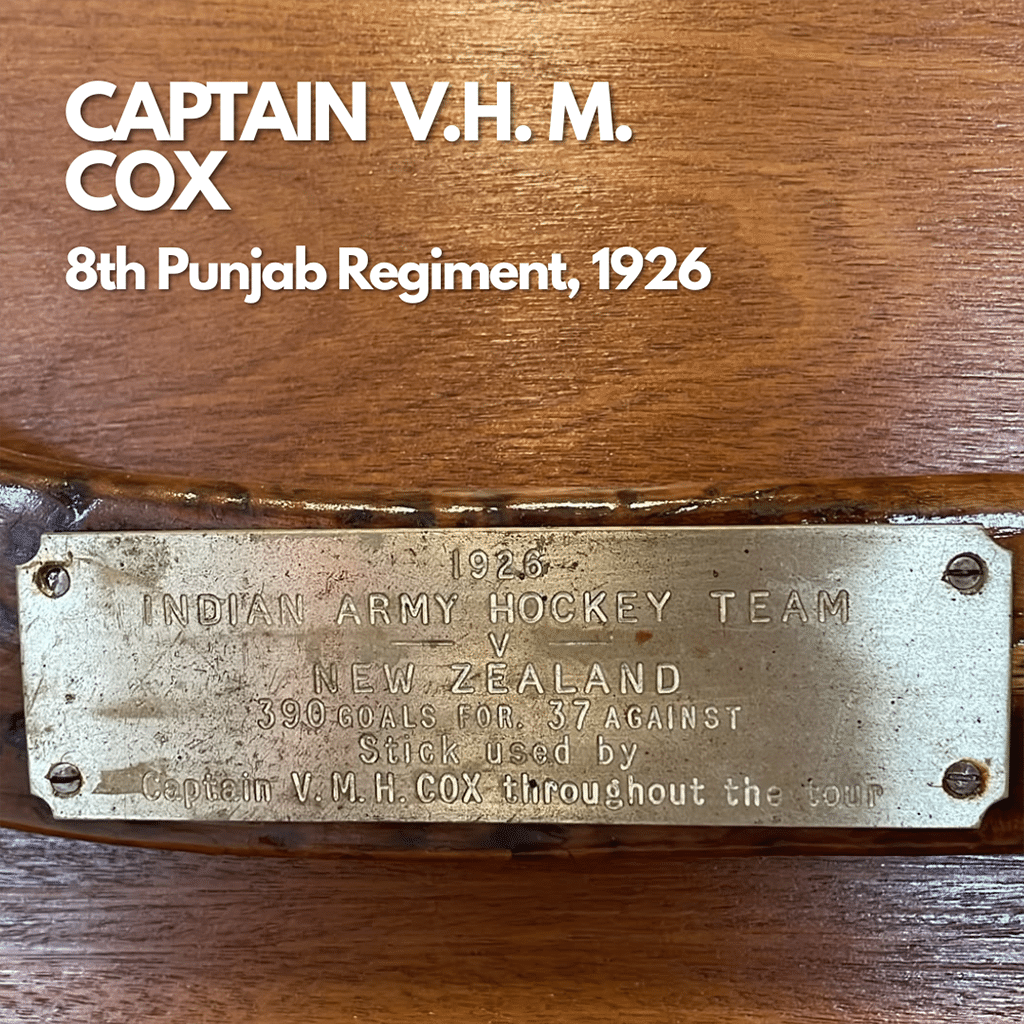
Detail of the plaque fixed to Captain Cox’s hockey stick.
Before Dhyan Chand became ‘The Wizard’
Dhyan Chand’s story is nothing short of spectacular. He won Olympic gold in Amsterdam in 1928, repeated the achievement in Los Angeles in 1932 and captained India to a third gold medal in Berlin in 1936. The International Hockey Federation (FIH) recognises him as one of the game’s all-time greats, and his extraordinary stickwork earned him the nickname ‘The Wizard’.
None of those achievements had taken place when he boarded the ship in 1926. The tour offers a rare view of Chand before international fame, as a young soldier whose exceptional ability was beginning to attract attention.
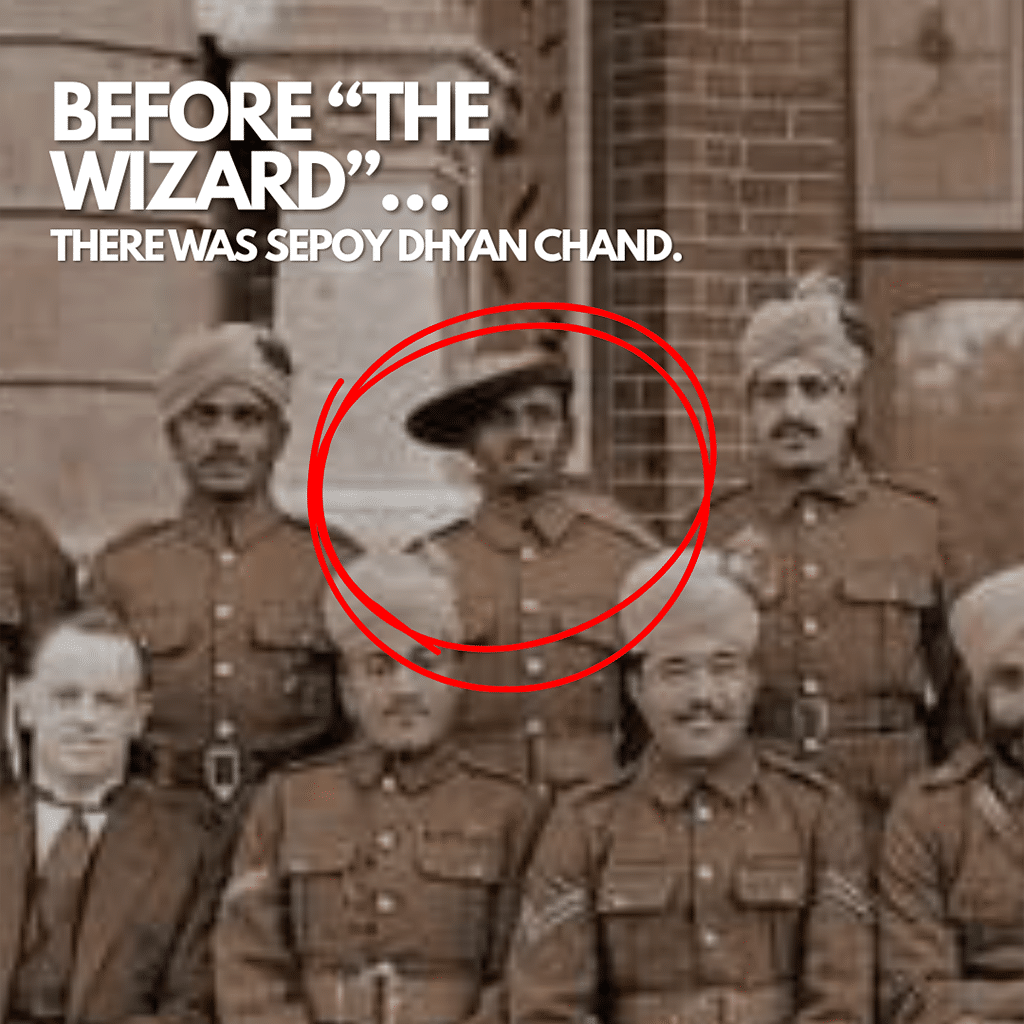
Before securing global fame, Dhyan Chand served in the British Indian Army as a sepoy. This historic group photograph shows his military years before becoming one of hockey’s most legendary players.
The final match of the wider tour provides another indication of his growing stature. Against South Australia at Adelaide Oval on 5 August, Sepoy Dhyan Chand was given the rare honour of captaining an Indian Army side that included three officers. He scored nine goals! Of the 17 players who made the 1926 tour, Chand was the only one subsequently selected to represent India at the 1928 Olympic Games. Two years after arriving in New Zealand, he was an Olympic champion.
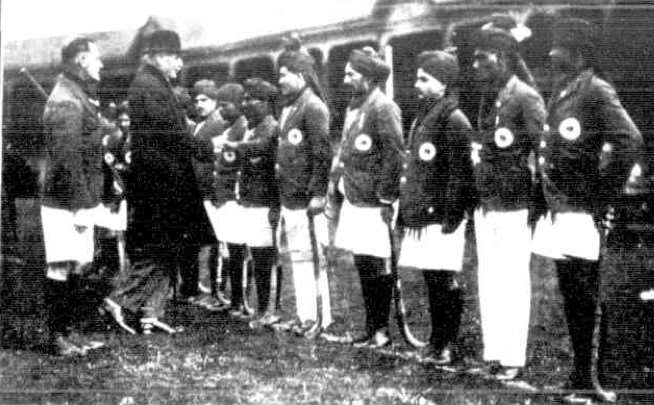
Members of the Indian Army hockey team meet Governor Tom Bridges in Adelaide on 5 Aug 1926. This formal reception is an example of the public recognition and ceremonial welcomes the hockey pioneers received during their tour of Australia and New Zealand.
Photo credit: the Australian Indian Historical Society.
One of the world’s most important hockey sticks?
There can be no objective league table for museum objects. Cox’s stick is not significant because it is the oldest, most expensive or most ornate. Its importance lies in the number of histories that converge in one surviving object.
The stick connects English sporting manufacture with the emerging sports-goods industry of the Punjab. It links a British officer serving in India with the rapid development of hockey across the Indian Sub-continent. It travelled on a 30-day voyage across oceans, accompanied 17 players into New Zealand and was present during three matches that later became India’s first recognised men’s international matches. Its owner became an India international without knowing it, while the young sepoy playing alongside him was taking the first steps towards becoming one of hockey’s greatest figures.
This is why museums and heritage are important. They make large and complex histories accessible, connecting people and events across countries and generations.
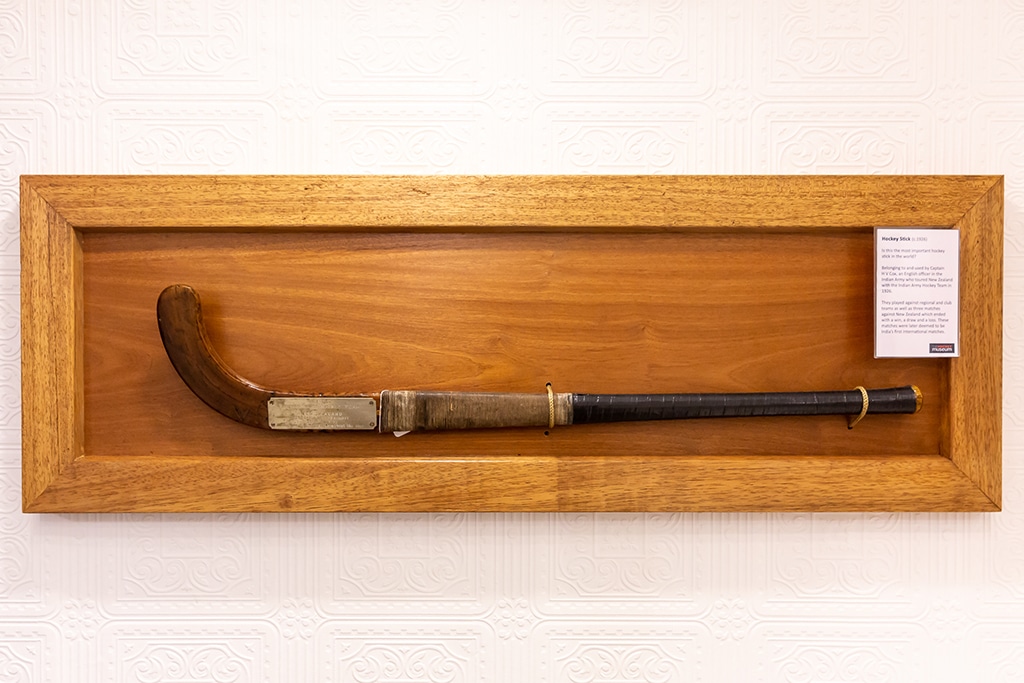
Hockey stick belonging to Captain Cox, hockey playing officer in the British Indian Army, on display at The Hockey Museum.
A story that continues
For The Hockey Museum, preserving Captain Cox’s stick is not simply about protecting an old piece of wood. It is about preserving the people and journeys that the object allows us to comprehend and explore.
Hockey heritage does not belong only to those who played before us. Every generation inherits the game and, through the way it plays, organises and shares it, adds something new. Dhyan Chand could not have known in 1926 where hockey would take him. The same is true of every young player stepping onto a pitch today.
The stick therefore leaves us with questions that reach beyond its own history: where could hockey take the next generation, and what will they add to the story?
Help us add to the story
The Hockey Museum is continuing to research Captain Cox, the 1926 Indian Army tour and the people who took part. We would be pleased to hear from anyone who holds photographs, programmes, objects, letters, family memories or other documentary evidence connected with the tour or its players.
We are particularly interested to discover whether any other object survives with direct provenance to the match played at Lancaster Park on 26 June 1926. Until further evidence emerges, Captain Cox’s stick remains perhaps the only tangible relic of India’s first international hockey match.
Original research by Diljit Singh Bahra | sikhsinhockey.com