1935 – 28 February 2026
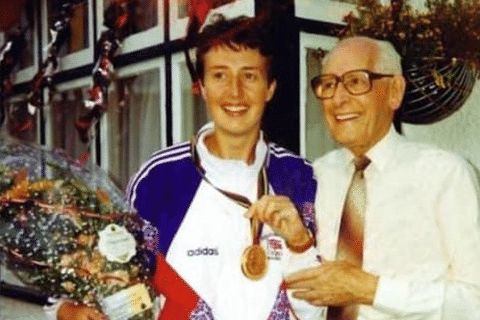
USA Field Hockey is mourning the loss of hockey great Vonnie Gros (pronounced grow) who passed away on 28 February 2026 at the age of 90. The tribute on the USA Field Hockey Association website described Vonnie as:
“a pioneer, a legend, and one of the true architects of women’s field hockey in the United States. Vonnie did more than coach teams. She reshaped what women’s field hockey in the United States believed it could become and what it ultimately achieved.”
Vonnie was a talented player and a coach who took US women’s hockey (known as field hockey in North America) from an ‘amateur’ game in American colleges to a more professional sport that resulted in an Olympic bronze medal in 1984.
Vonnie went to Ursinus College (Pennsylvania) in the mid-1950s and became one of the school’s most celebrated athletes, distinguishing herself in hockey (as team captain) and in lacrosse. She was the school’s first ‘All-American’ in hockey and lacrosse – an award given in US Colleges for exceptional performance at a national level – and a national champion as both a player and coach.
Nan Williams (England international player 1961-1967) first met Vonnie in 1961 when an England touring team visited the USA. She then played against her at the International Federation of Women’s Hockey Associations (IFWHA) Tournaments in Towson, Maryland, USA (1963) and Leverkusen, West Germany (1967). Nan remembers:
“Vonnie was really good company and Freda Walker [England teammate] and I used to stay with her when games were played in Pennsylvania. She was so much fun, a hockey friend of great value.”
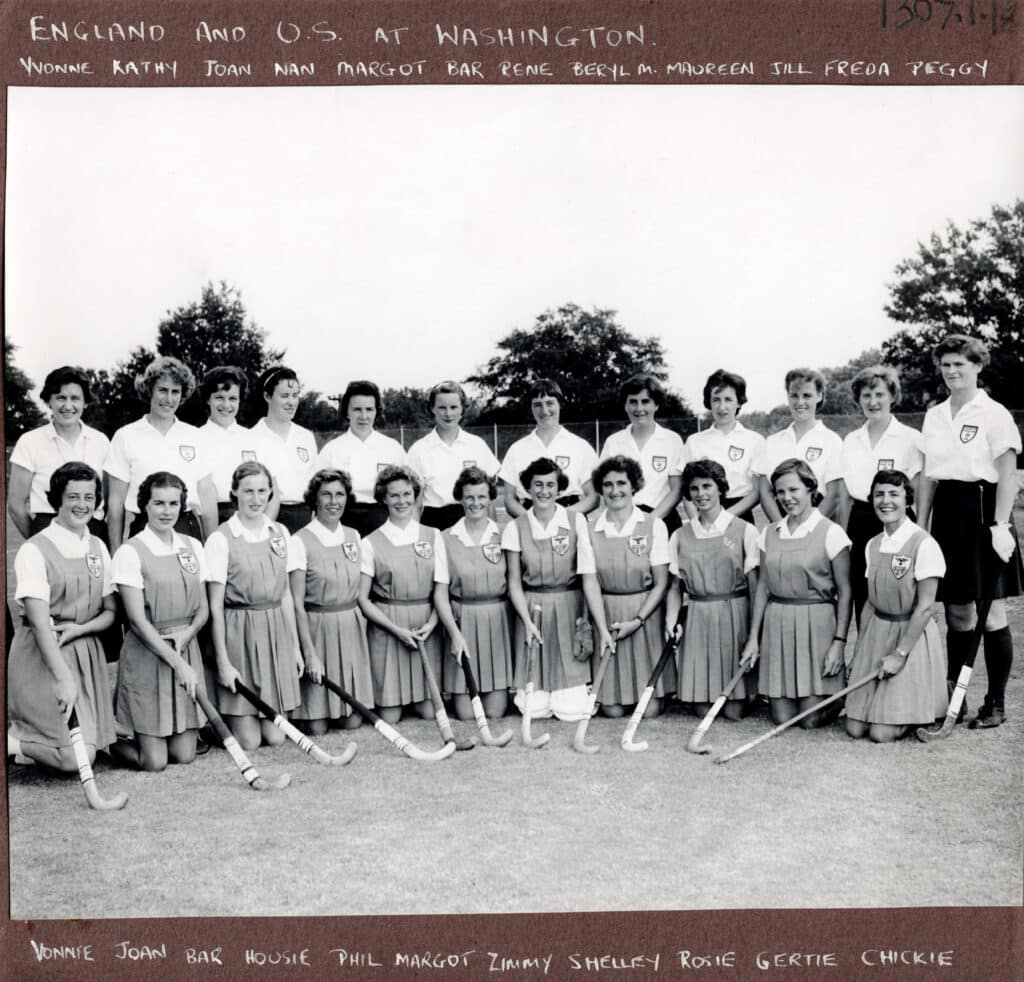
The USA field hockey national team and the England Touring Team in Washington DC in 1961. Vonnie Gros is in the bottom row, furthest left.
Vonnie Gros represented the US national hockey team for 13 years before she moved over to coaching the national side. She took them to an IFWHA World Championship bronze in 1979 and then to its only Olympic medal in 1984. She has initially been appointed to coach the team ahead of the 1980 Summer Olympic Games before the United States boycotted the Games in Moscow, Soviet Union. Fortunately, Vonnie received a second chance when she was asked to return to coach the 1984 Olympic team. Despite being heavy underdogs, she guided the USA to a bronze medal at these games, a breakthrough accomplishment for the US in hockey. In a country where basketball, ice hockey, softball, and track and field were the main sports for women, this gave hockey a new and more visible profile.
Brenda Read (former England international player and coach) recalls meeting Vonnie while coaching in the USA during the 1970s:
“Adele Boyd took me to meet Vonnie and ‘The Apple’ [Constance Applebee]. We talked about hockey and coaching through into the evening. A real privilege. Vonnie thought deeply about the game and was ahead of her time. Highly respected, with a droll sense of humour and a kind nature. A sad loss.”
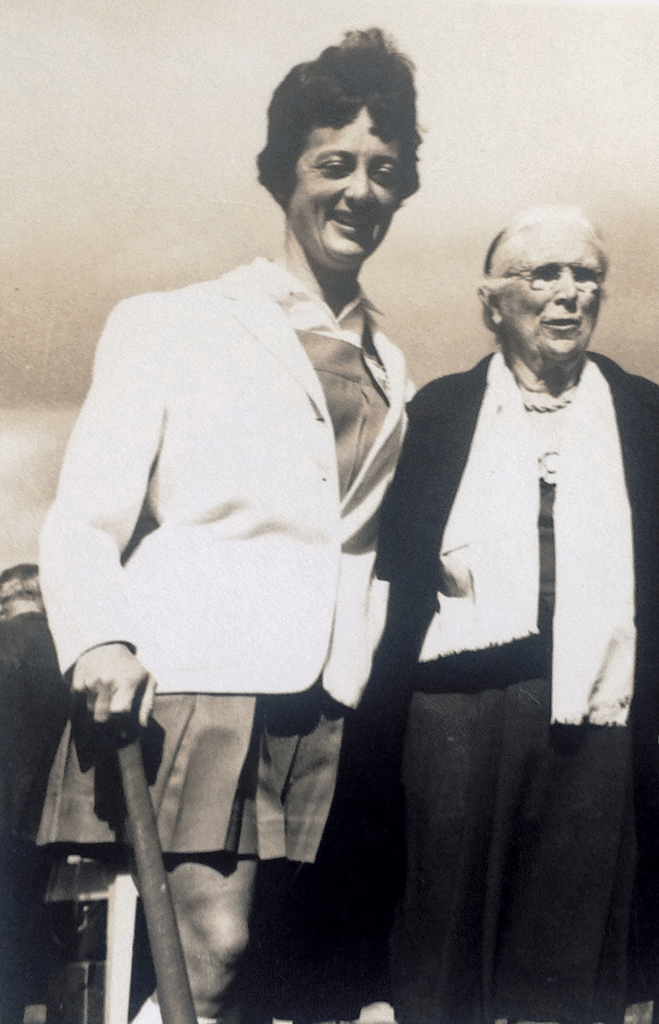
Vonnie Gros (left) with Constance Applebee.
Vonnie was certainly a trailblazer for women’s hockey in the United States, introducing possession-based play, strategic discipline, and mental focus well before they became common. She researched widely and sought to learn from men’s and women’s teams around the world. Despite scarce resources and low expectations, she shaped the direction of women’s hockey in the USA and earned respect from players and administrators as a visionary leader.
Success did not come without some controversy. When Vonnie Gros brought her USA team to England in 1978, they came with a fitter, more tactical and aggressive style of play. England, still hanging on to the ‘amateur’ beliefs of winning ‘fairly’, did not take kindly to the tactics that Vonnie used in that year’s showpiece Wembley fixture. From the start, the US team employed more assertive, ‘man-to-man’ marking tactics relying on fitness and fast breaks to catch the England team out. This approach paid off and early in the second half the USA were 2–0 up. England’s greater skills and pressure eventually paid off; Jan Jurischka scored two late penalty strokes to level the match 2–2. Correspondence in the following editions of Hockey Field magazine was heated. Many objected to what they saw as overly an aggressive style of play. Interestingly, Vonnie chose to respond to these criticisms and in her letter to the 6 May edition she explained:
“England was the leader of [women’s] hockey for years and so long as the world rigidly followed the English standard, England was supreme. Only when hockey nations began experimenting on skill improvement, player organization and versatility was England’s supremacy seriously threatened. The USA was one of the last countries, if not the last country, to move out of the nest to find its own identity. The Wembley match was a clear indication that the US is committed to improving its hockey program using all the knowledge, techniques and tactics that are available, applicable and fair. We recognize and are committed to growth— we will no longer play the same way every year. We no longer fear the unknown and will learn by making mistakes and correcting them.”
In another letter in the same edition of Hockey Field, former England goalkeeper Hazel Feltwell agreed that the US approach merited credit for its tactical success:
“For me the USA’s real strength lay in their man-to-man marking. England’s strength was their ball-carrying ability. Together these two styles of play always tend to lead to numerous obstructions. To perfect the man-to-man marking the US players need to develop shorter running steps and greater body mobility and then they will not be criticised for obstructing. On the other hand, however, England need to develop their running off the ball and their receiving and delivery of the ball, if they are to succeed against teams using man-to-man marking tactics. Pulling opposing defences about leaves spaces for either the ball to be hit through/into, for midfield players, or defenders without man-to-man markers in attendance, quickly to move into, or for appropriate carrying of the ball. Only when our players can receive the ball cleanly and deliver it immediately will England be able to outwit such defensive tactics.
So, please, let us be big enough (a) to give credit where credit is due and (b) to accept the fact that although we have the players to beat man-to-man marking, we do not yet employ the right tactics.”
Vonnie’s desire to push the boundaries of what is possible in the sport she loved continued throughout her life and she continued to be a role model and an active coach and supporter until late on. A truly remarkable woman.
The USA Field Hockey website has published a full tribute to Vonnie. You can read it by clicking here: Vonnie Gros: Pioneer, Legend & Architect of American Women’s Field Hockey | USA Field Hockey
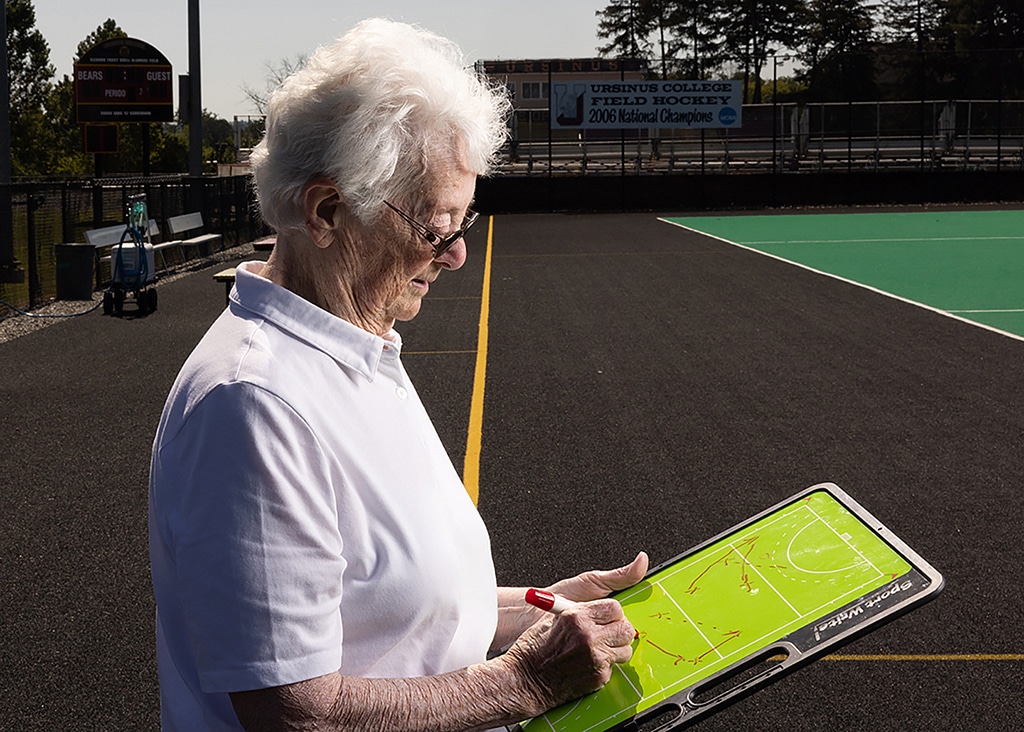
Vonnie Gros. Image courtesy of Ursinus College