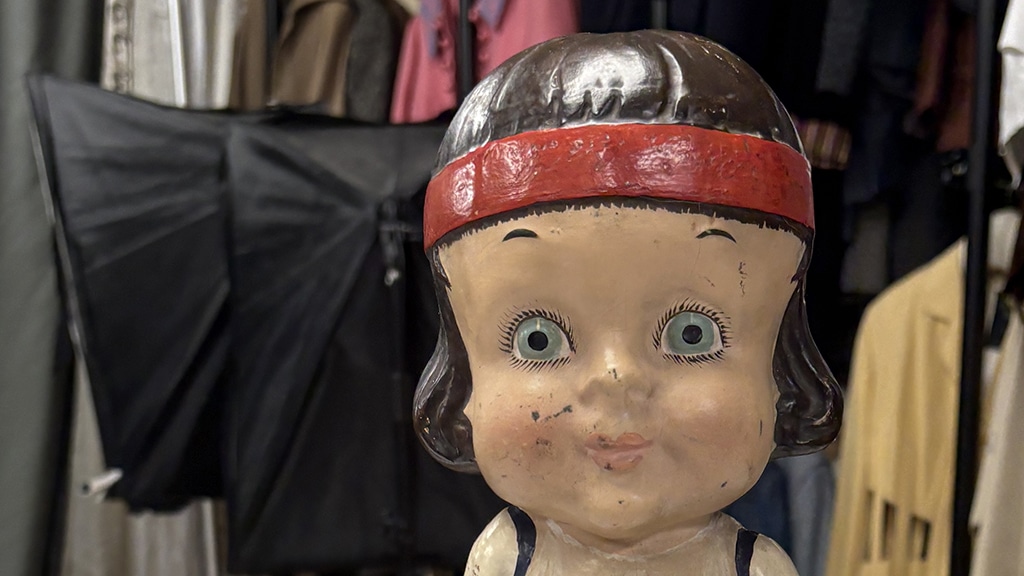
Meet Dashing Dora, who was found by doctoral researcher Emmy Sale in the archive of the Leicestershire Museum Collections. Dora’s uniform is typical of the 1920s when most women and girls wore pleated gym slips, long stockings, long-sleeved blouses or slips and shin pads. Her fashionable bob, also known as the ‘Eton crop,’ required a hairband to keep her hair in place and out of her face during play. The All-England team players were even told that hairbands had to be black and no wider than 1 ½ inches! (All England Women’s Hockey Association Council Meeting minutes, 30th November 1923.)
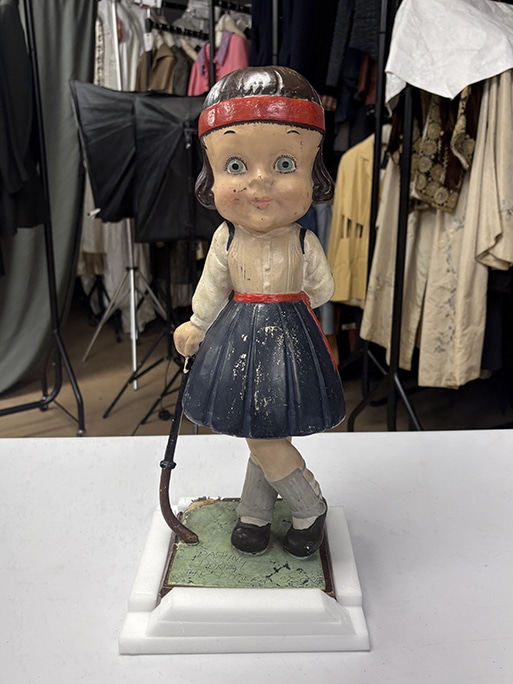
Dashing Dora: shop window or counter display figure. Used to promote the Liberty Bodice designed and made by R & WH Symington. c1920s. Leicestershire Museum Collections.
However, Dashing Dora unusually wears her Liberty Bodice, made and designed by R & WH Symington, on top of her tunic as she was created to promote the bodice as a shop window or counter display figure. The Liberty Bodice was first introduced by Symington in 1908 for children as a successor to the binders previously used on infants. The Bodice was made of flexible soft knitted cotton with shoulder straps and no boning, offering warmth and comfort to the wearer. By 1912, adult sizes were available and it was quickly advertised as a suitable sports undergarment for women. In 1913, the Hockey Field magazine described it as “the most hygienic garment ever invented for wear in hockey” emphasising its freedom of movement and “remarkably graceful” silhouette.
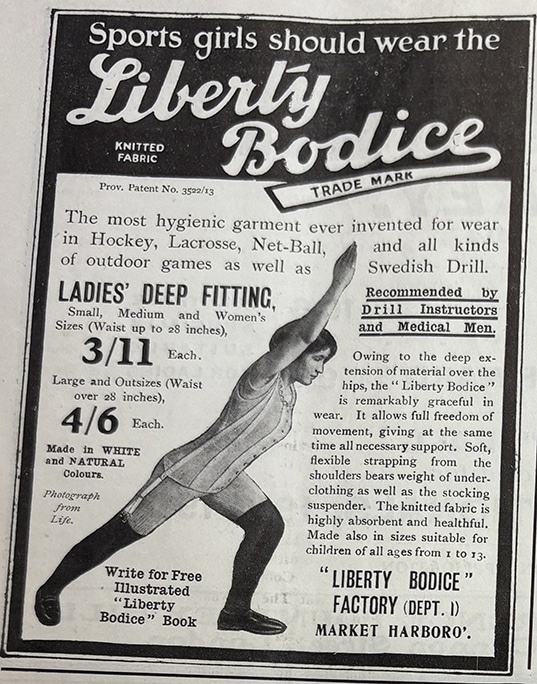
“ADVERTISEMENT: Liberty Bodice,” Hockey Field, 13 November, 1913.
The following year, Mabel Bryant (England international player 1901–1929) endorsed the Liberty Bodice in national newspapers such as the Daily Mirror, testifying: “I find your ‘Liberty Bodice’ the most comfortable bodice I have ever worn when taking part in games and gymnastics. I can strongly recommend it to any sportswoman who does not wear corsets.” Bryant probably wore the bodice when she completed her training at I M Marsh College of Physical Education (Liverpool Physical Training College) in 1908, as photographs of the students in the clothing worn for every sport also featured in shop cards for the Liberty Bodice. The Liberty Bodice provided a practical alternative for women players who wanted to balance comfort and support in clothing with the movement required of their bodies in playing the game. You can see a 3D digital model of Dashing Dora, here: Dashing Dora – 3D model by Leicestershire Museum Collections
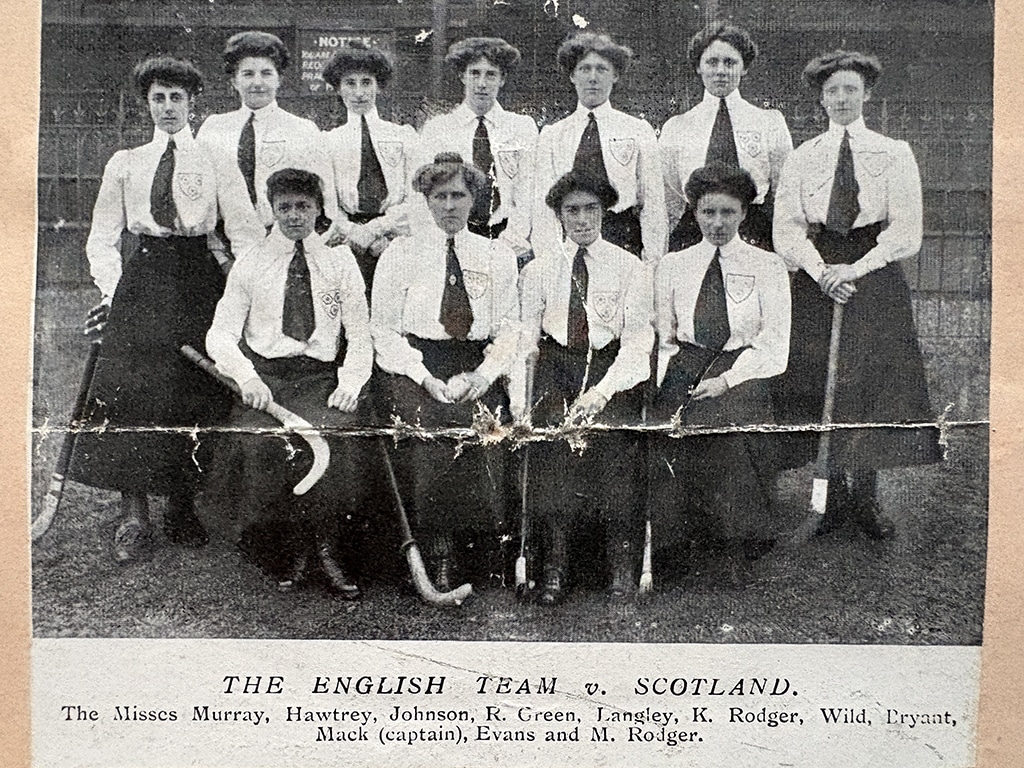
England 1907 team, Mabel Bryant is the player far right of the back row. (University of Bath AEWHA collection: D/2/85, part of cuttings relating to Mabel Bryant’s career in the Pat Ward collection.)
Dora’s dashing day: an imaginary story
If Dora could blink her painted eyes, move her feet, and hop down from the shop window, she would be off like a flash! She would have grabbed her hockey stick and straightened her hairband before racing across the grass. Swish went her pleated skirt and thwack went the ball as Dora dashed into play. Dora was small, but she was speedy. Her Liberty Bodice kept her warm and comfy, and she felt ready for every sprint, skip and dash. By the end of the match, Dora’s cheeks would have been glowing, her stick would have been muddy, and her smile would have been enormous. Then, just before anyone noticed she was missing, she would tiptoe back to the shop window, stand very still and pretend she had been there all along. But if you looked closely, you might spot a tiny splash of mud on her shoe – proof that Dashing Dora really had lived up to her name!
Help us find a Dashing Dora of our own
The Hockey Museum is seeking a Dashing Dora of our own as we aim to acquire more comprehensive representations of women’s hockey clothing in the early twentieth century. If you have an object to donate, please get in touch through the contact form on our website: Contact Us – The Hockey Museum