27 March 1934 – 4 March 2026
John Frank Cadman, one of the most influential and pioneering figures in the history of English hockey, died on 4 March 2026 at the age of 91. Born in Colchester, Essex, John’s life was defined by his devotion to sport, his generosity of spirit, and his unwavering belief in the potential of every player and coach he encountered.
Educated at Friends School, Saffron Walden, and later Loughborough Colleges, John’s playing career saw him reach the highest level of hockey, including competing at an Olympic Games. John was a dynamic centre forward and right winger known affectionately as ‘Cannonball Cadman’ for the immense power and accuracy he generated when striking a hockey ball. He represented Essex, Kent and Suffolk, and played for a remarkable list of hockey clubs including Canterbury, Southgate, Bury St Edmunds, Broxbourne, Chelmsford and Saffron Walden. While Master in charge of Physical Education at Friends’ School from 1959 to 1964, he introduced hockey there in 1960 – an early glimpse of the transformative impact he would later have on the sport nationwide.
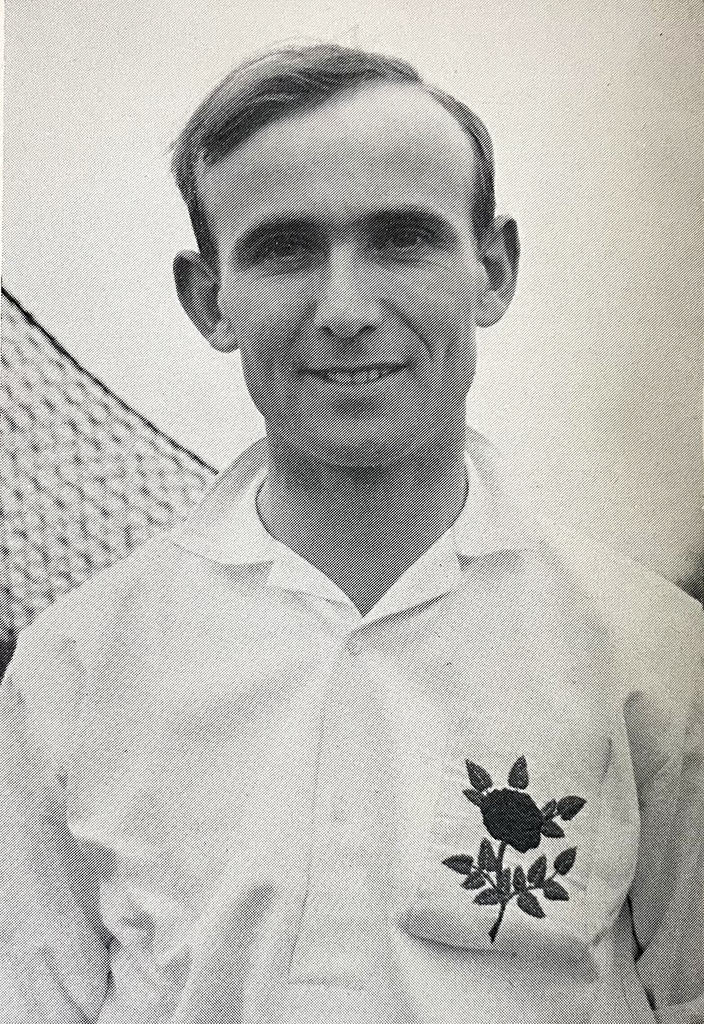
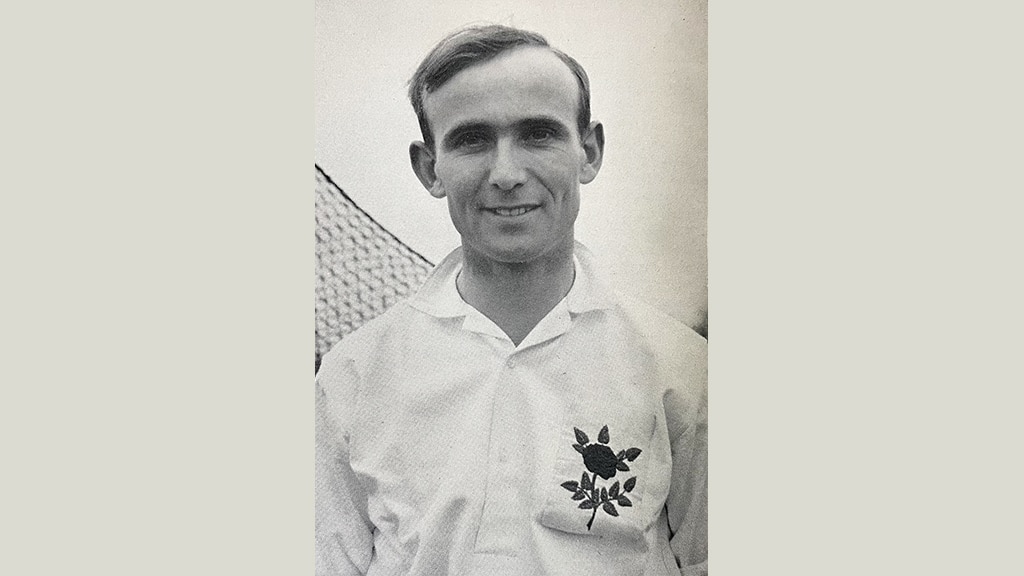
John Cadman in his England playing shirt, 1960s.
John made his England debut on 23 April 1960, scoring twice in a 3–0 win against Scotland in Glasgow. Over five years he earned 14 England caps and scored three goals. His Great Britain (GB) debut followed on 4 May 1963; a 1–0 win against Spain at the County Ground in Norwich. He went on to earn 13 GB international caps and score four goals, including performances in the 12 Nations Pre Olympic Tournament in Lyon, France in 1963 (two goals in five matches) and representing Great Britain at the 1964 Olympic Games in Tokyo.
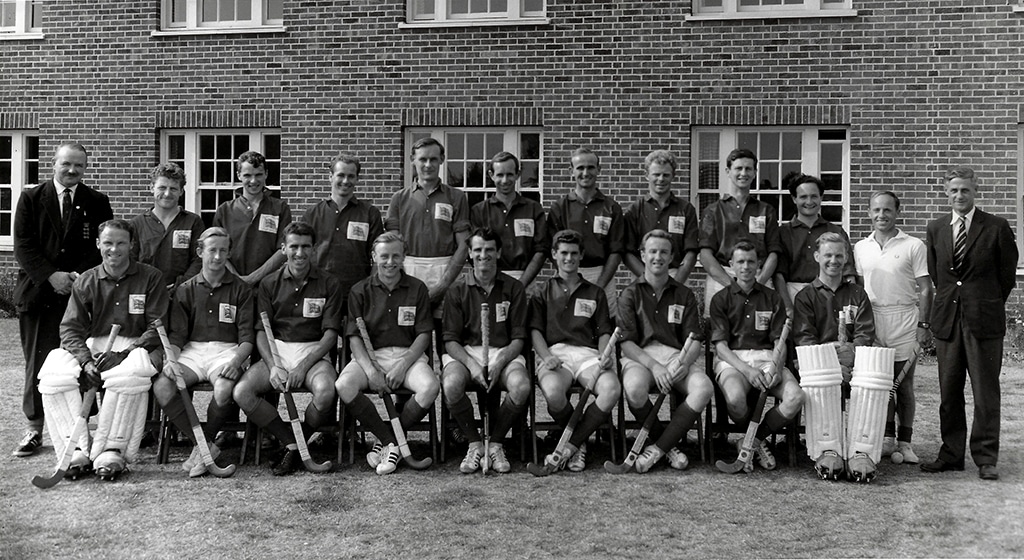
Great Britain men’s squad for the Tokyo 1964 Olympic Games. John Cadman is standing, back row, sixth person from the left.
Yet it was after his playing days that John’s influence became truly transformative. In 1969, he was appointed National Coach by the Hockey Association (HA) – the first position of its kind in the world. Visionary, principled and tireless, John helped steer English hockey out of the ‘amateur era’ towards a more structured sport, with nationally accepted systems and standards of coaching and training (and courses for coaching tuition). As Gavin Featherstone wrote in The Hockey Dynamic, John’s role was not simply to coach but “to guide the direction of the game for the nation.” Other nations were ‘professionalising’ faster than England prior to John’s appointment by the HA and other hockey coaching contemporaries were equally pioneering – the West German coach Horst Wein, for example, was a renowned tactician, author and lecturer – but John was the first to be employed in a national coach/national director of coaching role.
John believed deeply in building from the ground up. He introduced coaching into clubs and in adult hockey ensuring that it was accessible and consistent. Notably, he also had the vision to recognise the importance of coaching in schools:
“I came in, right from the base of the pyramid … I aim to get more hockey played at all types of schools.”
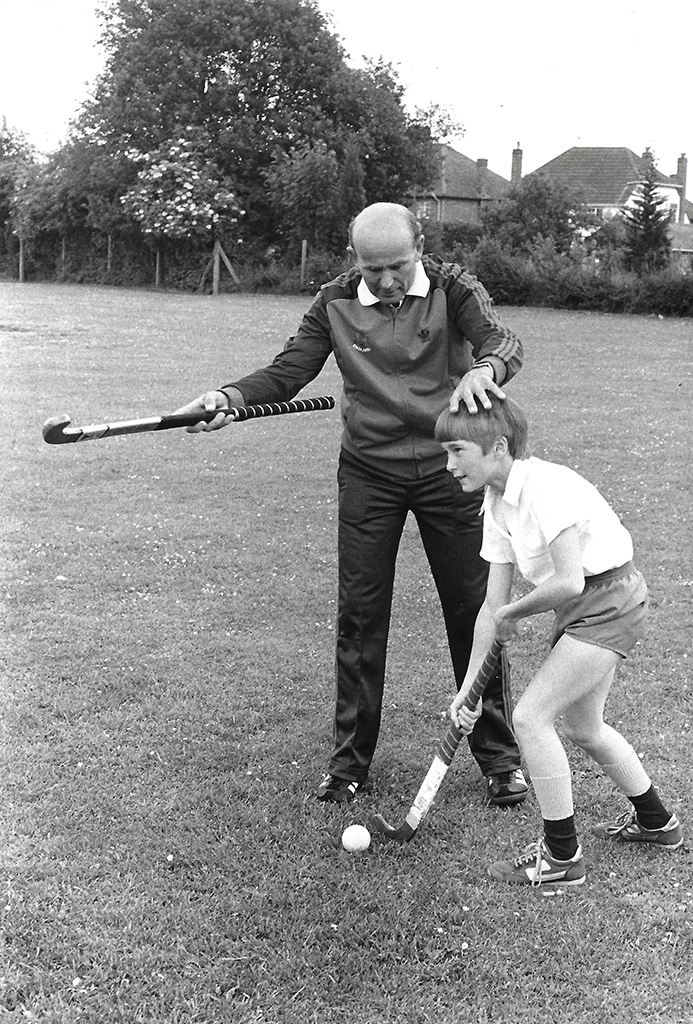
English National Coach John Cadman coaches a young boy to play hockey with his head up.
One of John’s lasting innovations was the invention and introduction of mini hockey, giving children a form of hockey designed for their needs and abilities. This single idea has shaped generations of young players in Britain and far beyond. His advocacy for expanded competition – leagues, indoor and outdoor knock-out cup competitions – helped grow the sport’s depth of talent, visibility and professionalism.
As an educator and communicator, John was prolific. His many books, including Hockey: Sports for Schools (1965), Indoor Hockey (1978), Hockey Rules Illustrated (1979), Games for Hockey Training (1981), and Hockey: The Skills of the Game (1985) became foundational texts for coaches around the world. He travelled extensively to share his ideas, shaping hockey culture on a global scale and inspiring countless coaches to pursue excellence.
John qualified as an International Hockey Federation (FIH) coach in 1978 and went on to coach Cambridge University Hockey Club for 13 years (1984–1997). He also moved into the world of artificial pitches with En-Tout-Cas before becoming an independent artificial pitch consultant. His deputy, Trevor Clarke, took over as Director of Coaching at the HA.
John mentored and collaborated with many who would themselves become giants of the game. Former players and colleagues remember him fondly: a player of natural speed and athleticism; an inventive thinker; a firm coach who was always fair; a booming voice with a warm laugh; a dependable friend. Though widely respected – often described as the ‘father of coaching and coach education’ in the UK – John was approachable and unpretentious, always willing to share advice, champion new ideas, or simply enjoy a conversation about a sport he loved wholeheartedly.
Whether guiding England juniors in the 1970s, helping to launch hockey innovations for companies like Mercian Sports, or building the first generation of structured coaching courses at Lilleshall, Loughborough and Bisham Abbey, John’s dedication was constant. Many recall the rigour of the early coaching qualifications he helped design – two week residential courses with demanding standards and a notoriously low pass rate – but also the inspiration he provided, the belief he instilled, and the integrity with which he led.
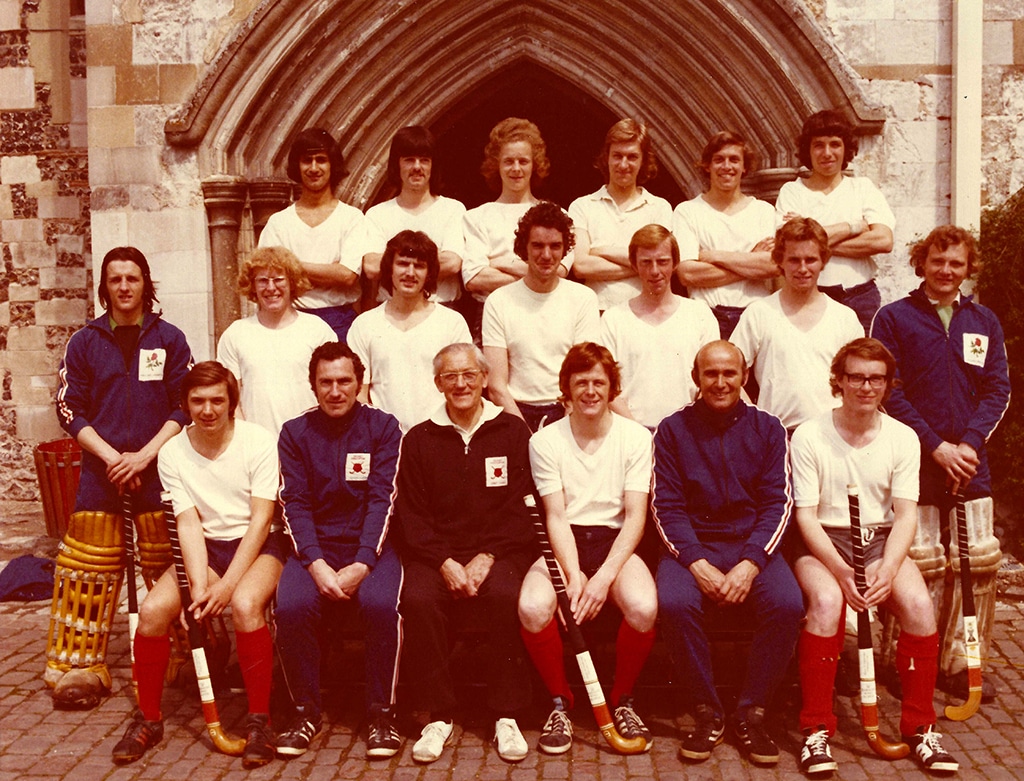
England Juniors squad, 1975. John Cadman is seated front row, second from the right.
As former England and GB goalkeeper John Hurst recalled:
“I did my Hockey Association Coaching Badge under John Cadman, Trevor Clarke and CIM Jones at Loughborough in 1971. They only ran two courses a year, so it was a prized qualification and there weren’t many of us! At 19, I was the youngest to qualify as a coach. 50 years later in 2021, Rob Clift and I were privileged to travel to Colchester to present John with his GB honours cap [link to stories]. Although he wasn’t very mobile, he was certainly the life and soul of the gathering and his booming voice as strong as ever.”
John Cadman leaves behind an extraordinary legacy: as an international player of distinction; as a global pioneer in coach education; as an author whose work shaped learning for decades; and as a beloved mentor, colleague and friend. English hockey and the international game are profoundly different because of him.
He will be deeply missed, but always remembered with admiration, gratitude and affection.
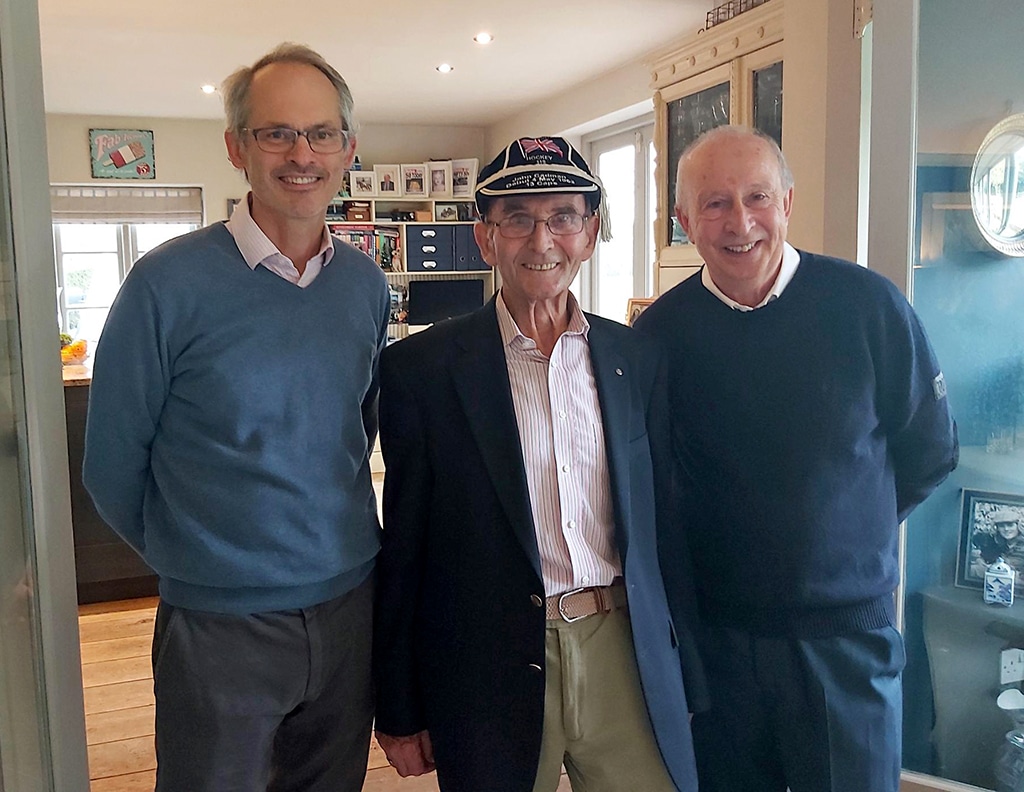
England and Great Britain international players Robert Clift (left) and John Hurst (right) present John Cadman with his Great Britain honours cap in December 2021.
Funeral arrangements
A private cremation will be held for John Cadman on 1 April. A Thanksgiving Service will be held at St George Church, Bradfield, Bury St Edmunds, IP30 0DH at 12 noon on Monday 20 April.