Written by Ernie Vickery in March 2022 (abridged). Ernie is a former Civil Service player, Civil Service Representative Team Manager and President.
The earliest tangible record we have of the Civil Service Hockey Association’s (CSHA) existence is in the form of the minutes of a meeting on 26 June 1922 – hand written in fountain pen – in which a decision is recorded “to arrange fixtures for the coming season with the RAF [Royal Air Force] and London University and to unofficially sound out the Army and Navy Hockey Associations.” At the next meeting in September of the same year “First Civil Service London Area Hockey Trial was fixed for the November 1, at either Chelsea Gardens or Polytechnic Ground, Chiswick.” In those London centric times, it was also decided to write to Areas “…asking for notification of any prominent Civil Service hockey players in the provinces.”
It is also recorded that “Inter-Departmental fixtures were arranged by the various club secretaries present”, but I can find no information about which departments were involved or what the results were.
The Civil Service Ground at Chiswick was opened by King George V at Duke’s Meadows in 1926. It covered 30 acres and, among all the other sports on display and in front of some 12,000 spectators on the day, hockey matches were played by the men against the RAF and the women against the Women’s Royal Naval Service (WRNS).
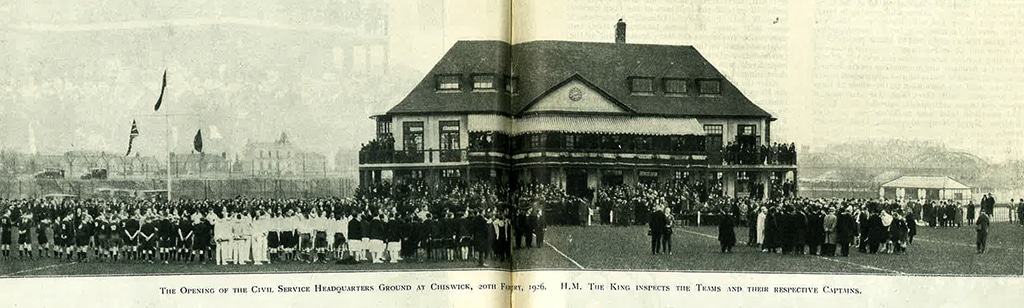
The opening of the Civil Service Sports Grounds at Chiswick on 20 February 1926. His Majesty, King George V, inspects the teams and their captains.
Photograph from the Civil Service Sports Journal, April 1926.
These facilities had to be paid for somehow, and the charges for some sports were surprisingly high. While a tennis court went for £30/season (£5 per weekday, £8-10 at weekends), cricket nets were £10/season for club nets and football pitches cost £50 for the season. Hockey pitches came in at £25/season for midweek fixtures or £40 for weekend fixtures. Four hockey pitches graced Duke’s Meadow, along with six cricket squares, four football pitches, a netball court, a bowling green and 10 hard and 26 grass tennis courts. This glorious estate was overlooked by a suitably regal two-storey pavilion.
My own recollection of the hockey pitches is that they were sometimes adequate but never anything better than that (and sometimes a lot worse). This is borne out by a minute from 1983 which records that “…there is generally a shortage of grass.” It’s fair to say that the pitches did not favourably bear comparison with the renowned Bank of England grass a few miles down the road!
By 1931 the minutes begin to show how seriously the CSHA was beginning to take the Representative matches. For that year, it was agreed that, for the games against the Navy, Army and Air Force “…the Sports Council should be asked to make a grant of £30.” Worth bearing in mind, next time we’re out on the town in Portsmouth.
Although the minutes show that fixtures continued to be arranged against the Armed Forces throughout the 1930s, few results were recorded: those I have been able to find are listed at the end of this compilation.
After the minutes for the Committee meeting in December 1937, the very next page shows the minutes for the 24 January 1950, so it appears that even hockey had to be put on hold in deference to the constraints imposed by the Second World War. Minutes continued through the ‘50s and ‘60s without any startling revelations until, in Oct 1966, item one on the agenda announced the setting up of the National Inter-area/Departmental Competition. Entries had been received from 12 sides, namely Farnborough area, External Telecommunications Executive SSA (ETESSA), London Telecoms Region, National Physical Laboratory (NPL), Ministry of Technology, Inland Revenue, Ministry of Defence (Navy Deptartment) Bath, Taunton Area, Birmingham CSSA, Edinburgh Area, Rosyth Area and Ministry of Pensions and National Insurance (MPNI) Newcastle. The winners of this first recorded competition were Edinburgh Area who beat ETESSA 5–1 in the final.
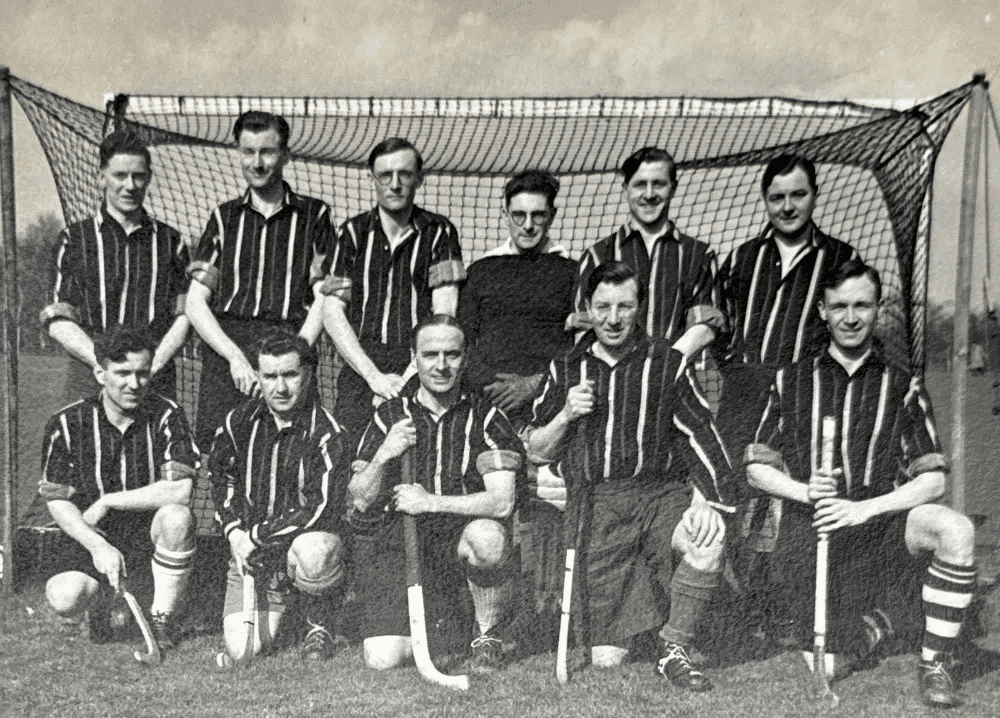
A Civil Service team, mid-century, late 1940s-early 1950s. Do you recognise any of these players or the team?
The following season saw the competition endowed with a name – the Evans Cup, after Sir John Evans – a trophy was provided by the Civil Service Sports Council (CSSC). That lasted for just one season. By October 1968, KM Hancock (President of Edinburgh Civil Service Hockey Club) had kindly presented a cup for this inter-area/departmental competition. The Chairman wrote to Sir John Evans who readily agreed to it being known as the Hancock and Evans Cup, of which more later.
From the 1970s onwards, Civil Service hockey began to reflect the multinational, multicultural nature of Britain as we know it today. First, there was an influx of Scottish internationals: Chris Sutherland, Alan Stobbie, Derek Batchelor, John Kilgour, Maurice Wilson and Brian Taylor became the backbone of the Representative side from whom we came to expect half a dozen goals a game. Chris Sutherland in particular was a ‘one-off’. I remember a penalty flick of his that went something like this:
Umpire blows the whistle for the flick to be taken. Chris starts gazing to his right at the corner flag. Goalkeeper follows his gaze while Chris nonchalantly slams the ball into the top corner right of the keeper. Sutherland then walks towards the same corner flag. Keeper starts to walk there too before realising that Sutherland has just scored!
He was at times a genius and at times outrageous.
As the Scottish invasion subsided, we were hit with a minor Welsh and Asian invasion. The Welsh aspect was minor only in terms of numbers – just Howie Williams although the tradition later continued with Mike Hannon and Jonny Gordon. Howie was the Great Britain (GB) centre half and, as we approached the 1980 Olympic Games, he was touted by many as “the best in the world”. Regrettably, the world never got to see him on the Olympic stage, as GB hockey was one of the sports which withdrew. Howie was not just a great player, he was a great mentor, and great drinking partner and great friend and a great loss when he died around 50 years old.
The Asian aspect came mostly in the form of players from BT Westel and later Indian Gymkhana and Hounslow, several of whom brought their fabulous skills to the Civil Service Representative side and brightened our hockey lives throughout the ‘80s (until you came to play against them in the Hancock and Evans Cup – most of the time they were just too damn good for the rest of us!). Upkar Singh Langotra (known as Joli), Harjinder Singh Dogra, Kalwinder Singh Hanspal (known as Kinde) and Harvinderpal Singh Sibia were all mainstays of the team during this period, along with life member, Paul Vijay.
A 1982 report from The Times is the first mention I can find of our ever-present umpire Jim Patel, without whom Civil Service hockey would simply not be the same. Thanks to Jim and all his colleagues without whom we just couldn’t play.
The late ‘90s saw the beginning of our long-standing relationship with Northern Ireland, cemented by our visit to Belfast in 1998, where we had a game or two of hockey and a pint of two of Guinness. Names such as Willie Redpath, Rob Johnston and Ali Reilly would continue to ring out well into the twenty-first century. Rob (known as Sticky), having finished his playing career, would return with an international umpiring badge to officiate in some of our games at Portsmouth. Willie belied his years by playing and coaching like a 20-year-old, and Ali – well, he’s just Ali and his name is at the top of the all-time scorers list. If you are in any doubt about the stats, just ask him: but you’ll need an hour or so to spare!
Regrettably, as the game became more ‘professional’, the press turned its attention almost exclusively to the National League and to international hockey and reports of our Civil Service games against the Armed Forces and British Police became a thing of the past, even though top-level players continued to appear in them.
As we moved into the twenty-first century so began the CSHA’s now well-established relationship with the Royal Navy and what has almost become our home ground at HMS Temeraire, Portsmouth.
As the RAF withdrew from our annual games, we obviously lost the opportunity to play at Halton and, thanks to the efforts of Steve Lemon, we have staged most of our games against the Armed Forces and British Police at Temeraire for most of this century.
Overall, our time at HMS Temeraire has been largely successful but the new century also presented us with a significant loss when our former figurehead, Brian Ware, died. However, Brian was insistent that his legacy should continue to shine within Civil Service hockey, so he left us enough in his will for the purposes of “foreign trips and entertainment” to provide for, among other things, a short visit in 2009 to Barcelona, where the CSHA accomplished itself both on and off the field.
The twenty-first century has not been plain sailing all the way. In 2012-13 the CSHA, along with all other sports bodies came within a hairs breadth of losing all funding from CSSC after a financial review showed that continuation of the latter’s contribution to events was not viable. However, a change of personnel at the top, face-to-face (and heart-to-heart) meetings, and the steadfastly sound budgetary management of our treasurer, Chris Munden, ensured that we eventually lived to both tell the tale and continue to embellish the story over the coming years.
Since that watershed moment, Civil Service hockey has continued to flourish with no small credit to our Head Office representative, Hilary Gray. ‘Hils’ has been our arterial connection to the CSSC, ever charming and ever helpful. She has now officially retired, but her help was invaluable.
The Hancock and Evans Competition
Grassroots hockey in the Civil Service continues to flourish and the Hancock and Evans Cup is one of its flagship annual events. I’ve always thought of it as being a kind of ‘all things to all men’ phenomenon. Since the inter-departmental competition became known at the H&E (for Hancock and Evans) in 1968, in some years we had 10 or 12 teams competing and we would be talking about the involvement of some 150 players. In those numbers, there obviously has to be a wide range of ability and it is to everyone’s credit that the team spirit of all competitors has always been at the very core of what the H&E is about.
Before we settled into playing the whole competition in one place, globe-trotting was the order of the day (okay – maybe UK trotting). Departments were relatively generous about time off, special leave was usually to be had and, what is more, colleagues in one’s local office showed a genuine interest in the result of the games when we got back.
I can remember playing for the Revenue in Bristol, Cardiff and some remote hillside pitch somewhere in Scotland where the sheep had to be shooed off the grass before we could start and where the local train was held for us after the game so that we could make it to the overnight sleeper back to London.
Those teams that made it though the preliminary rounds would then meet for the finals, first at Duke’s Meadows, in later years at NPL in Teddington then, when glorious grass was supplanted by all-purpose ‘astro’, at Indian Gymkhana until the early 2000s; then Beeston HC became our stage for the whole tournament.
Having all the teams together for the whole tournament has had two big benefits – firstly – the opportunity for everyone to socialise over a couple of days re-enforces the sense of camaraderie that I hope we all have as members of the Civil Service and, secondly, those involved in the selection of the Representative side are able to see many prospective candidates in one place, playing with and against each other. Long may we continue.
Civil Service men’s records
The total number of players to have represented the CSHA since the early 1970s is something I can only guess at. In the twenty-first century, the list comprises at least 90 different names, so a reasonable estimate for the last 50 years in total might be in the region of 225–250.
As to who might have played the most games, well, again I’m afraid we can only surmise; what I can tell you though, is that Richard Jones, (Jonah, Jonesy), right back, right midfield, right wing, call him what you like, first appeared in The Times as a Representative player on 22 February 1991 and has been pretty much ever present ever since. His latest appearances have been at Portsmouth this year in our successful trouncing of allcomers.
| Matches played between 1949/50 and 1982/83 | ||||||
| Played | Won | Drawn | Lost | Goals For | Goals Against | |
| Royal Navy | 30 | 17 | 5 | 8 | 66 | 38 |
| RAF | 31 | 7 | 7 | 17 | 49 | 74 |
| Army | 33 | 11 | 6 | 16 | 54 | 69 |
| Comb. Services | 3 | 2 | 0 | 1 | 4 | 4 |
| Total | 97 | 37 | 18 | 42 | 173 | 185 |
| Matches played between 2000 and March 2022 | ||||||
| Played | Won | Drawn | Lost | Goals For | Goals Against | |
| British Police | 21 | 8 | 3 | 10 | 62 | 67 |
| RAF | 8 | 5 | 1 | 2 | 42 | 22 |
| Royal Navy | 22 | 17 | 4 | 1 | 93 | 36 |
| Army | 18 | 13 | 1 | 4 | 68 | 37 |
| Total | 69 | 43 | 9 | 17 | 265 | 162 |
Read about the history of women’s hockey in the Civil Service: A history of hockey in the Civil Service – The Hockey Museum