In February 1996, England women pulled off an incredible victory to snatch gold from the Germans at the European Nations Indoor Championships. Until then, Germany had a clean sweep of every European indoor crown. As the unofficial kings and queens of indoor hockey, they played the indoor game for three months of the year due to the severe winter weather. With international teams packed full of Olympic and indoor stars, their men’s and women’s sides were seen as almost unbeatable.
The first England women’s indoor team was selected in 1980 and following European bronze medals in 1985 and 1987 they continued to improve. In the previous Championship in 1993 England had made the final, only to be well beaten by the German team 8-3. So, how did they make the unexpected step up to win gold in 1996?
Captain Lynn Bollington remembers how everything just seemed to fall into place:
“Not only did we have a very talented squad of indoor players, the management team were outstanding and the team spirit and togetherness between us all was unbelievable. It was without doubt the best we’d been prepared going into a tournament.”
Certainly, having the very experienced and tactically astute Maggie Souyave as coach was a real plus and with team members that included Lynn, Jackie Crook, Sue Chandler, Mandy Nicolls (both Great Britain) and Carolyn Reid in goal there was no lack of talent and heart on the court.
England’s tournament got off to a great start with a 10–1 victory over Austria, although they did concede an early goal to go 0–1 down. In an interview with Cathy Harris (see article), Carolyn put this early goal this down to having “shopping legs”. On further questioning, Carolyn explained that “…this refers to how your legs feel after a day out shopping!” England then went on to beat Slovakia 11–2 and played out a final pool game 4–4 draw with Spain. So far, their success had been built on great corners from Jackie Crook, outstanding goalkeeping from Carolyn Reid and great team play. This earned them a semi-final match against Scotland.
This match was never going to be easy as the event was being played in the Kelvin Halls in Glasgow – it turned out to be a thriller. England started well; Lorraine Marsden scored the first and while Scotland pushed them all the way, England eventually ran out 5–4 winners.
England had reached the final against the Germans for the second successive year and the Scottish crowd were now loudly cheering every German move. Lynn Bollington also remembered:
“…just before the final, the fire alarm went off and the hall had to be cleared. It meant a delayed start to the game which added to the tension. But we were really focussed and were not distracted by the crowd or the task at hand.”
In the final England played a disciplined and committed game to deny the Germans the open play they thrived on. England twice came from behind with goals from Jackie Crook and Sam Wright to level the score at 2–2 and so the match moved to a penalty shoot-out – most players’ nightmare, but not for England goalkeeper Carolyn Reid. Carolyn still has very clear memories of preparing for that moment:
“I knew that when we went to penalties we could win. I always loved the challenge of penalty strokes and never felt the pressure – all of that was on the penalty taker who had to beat me. I always had the same routine: calm myself, make the player wait, tap the post and tap the backboard, then step forward onto the goal line to appear psychologically bigger. I knew if I could save one or two, we could win, especially with the quality of our penalty takers!”
And save two shots she did – the second save giving England the gold medal! Carolyn added:
“When I saved their final stroke, what a feeling it was to finally win gold!”
Winning the European gold was a momentous achievement, still not matched by any other England indoor side.
Jackie Crook, top scorer with 11 corners converted, proudly remembers:
“What a victory – beating Germany and winning the European Indoor gold. At the time it was the highest achievement possible in indoor hockey. A cherished lifelong memory and a brilliant team to be part of.”
Head coach Maggie Souyave has similar thoughts:
“The gold medal was not just an award for that group of players, but a symbol of hard work, perseverance, resilience and success over many decades – an exceptional feat and major achievement in our Indoor hockey history.”
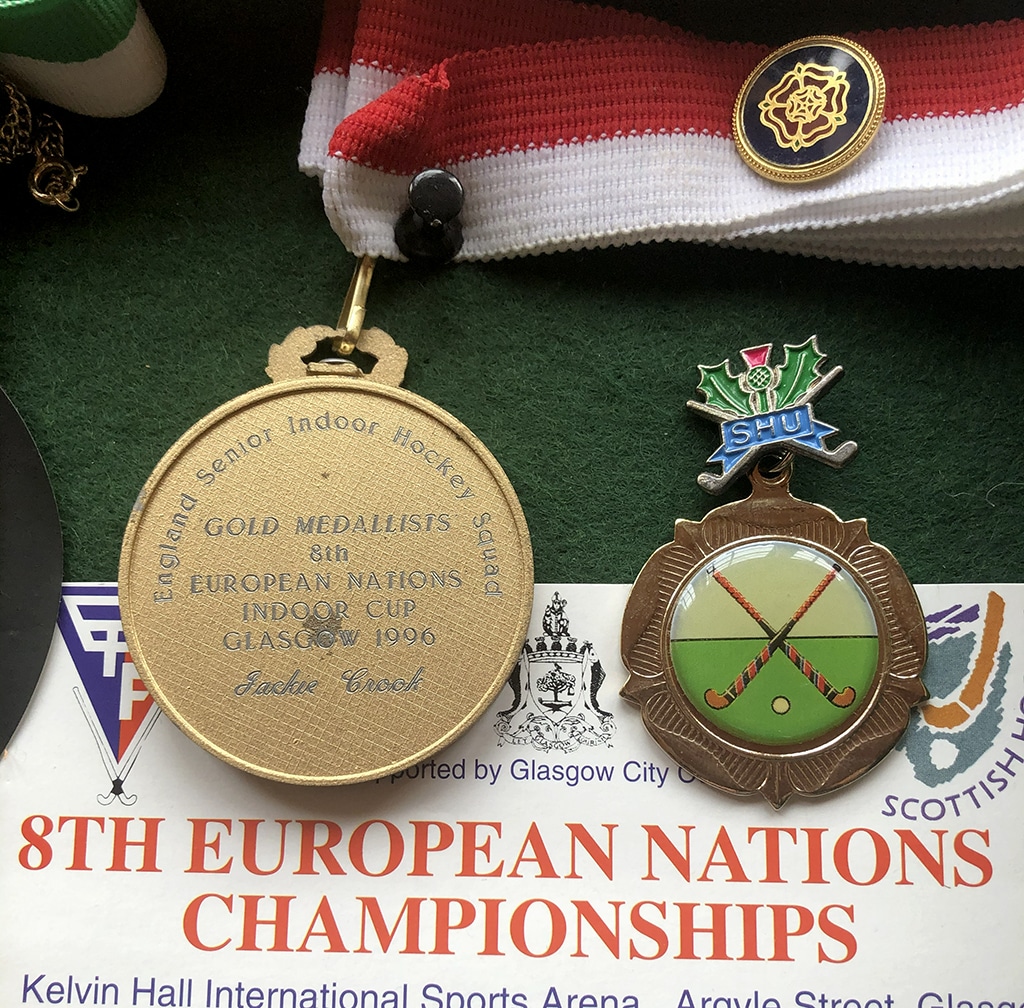
Jackie Crook’s memorabilia from the European Nations Indoor Championship in 1996, including her gold medal.
Indoor hockey today
So, where did England indoor hockey go after this success? In the next European Nations Championships in 1998, England again reached the final and played Germany but was unable to scale the same heights with Germany running out comfortable 8–0 winners. This was the last time England women appeared as medallists in Division 1 and were soon relegated to Division 2. Some years after that England Hockey withdrew altogether from the men’s and the women’s international indoor programme.
Sadly, indoor hockey no longer holds the same status alongside the ‘outdoor’ game as it did from 1980s through to the early 1990s. It is probably fair to say that the arrival of outdoor artificial pitches has facilitated the development and transfer of the tactics, skills and fitness that were once the domain of the indoor game. Furthermore, the lack of indoor facilities and the milder climate in England have meant there is not the demand for an extended indoor closed season as there is in much of central Europe. By 2009, Great Britain and England had also established a highly successful centralised hockey programme. This performance programme was pivotal in shifting athletes to a full-time professional environment of outdoor training. This would also have had a profound and disadvantageous impact on the value placed on the indoor game.
The indoor club and schools’ events still continue, which is great to see, and England Hockey’s Indoor Finals Day (these days branded as the Super 6s Championships) is still a great success. However, the lesser focus on indoor hockey today means that the indoor game in England is unlikely to ever again match the heights of excellence of England women’s 1996 performance.
England indoor squad
| 1 | Carolyn Reid (goalkeeper) |
| 2 | Sukie Knight (goalkeeper) |
| 3 | Lynn Bollington (Captain) |
| 4 | Sue Chandler |
| 5 | Jackie Crook |
| 6 | Tina Cullen |
| 7 | Lucy Culliford |
| 8 | Michelle Liptrop |
| 9 | Lorraine Marsden |
| 10 | Mandy Nicholls |
| 11 | Jane Smith |
| 12 | Samantha Wright |
| Maggie Souyave (Coach) | |
| Jane Swinnerton-Ions (Manager) | |
| Sarah Gilroy (Assistant Coach) | |
| Kim Chesterfield (Physiotherapist) |
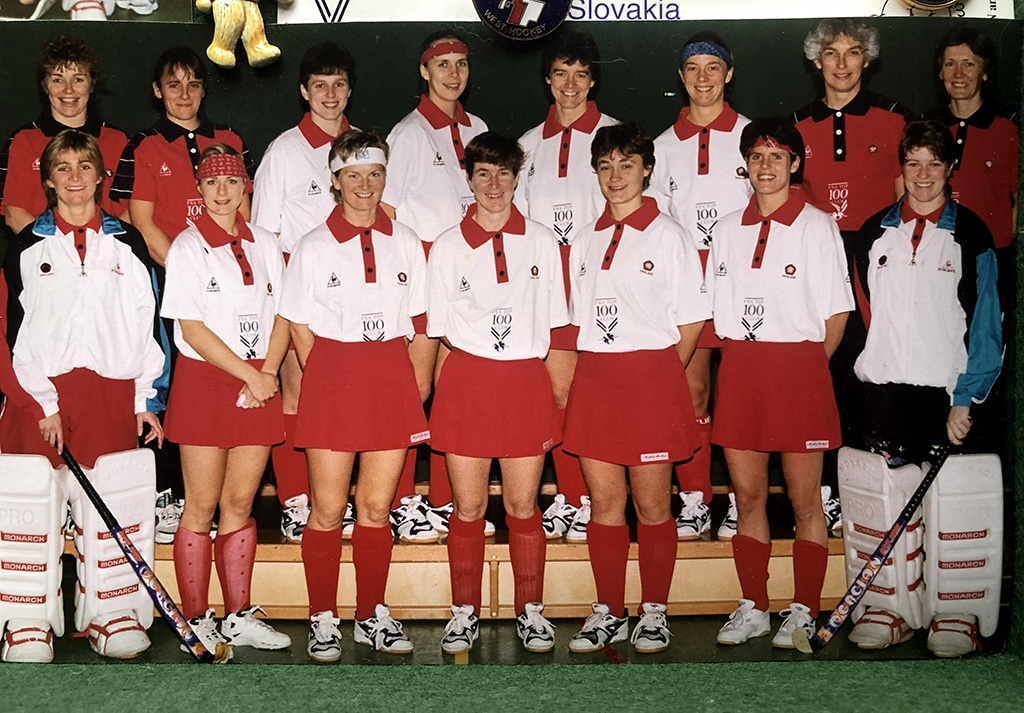
Photograph of the England Indoor team in 1996, minus Mandy Nicholls.
Back row, from left to right: Jane Swinnerton-Ions (Manager), Kim Chesterfield (Physio), Michelle Liptrop, Jane Smith, Jackie Crook, Sue Chandler, Sarah Gilroy (Ass. Coach) Maggie Souyave (Coach).
Front row, from left to right: Suki Knight, Sam Wright, Lorraine Marsden, Lynn Bollington (Captain), Tina Cullen, Lucy Culliford, Carolyn Reid.
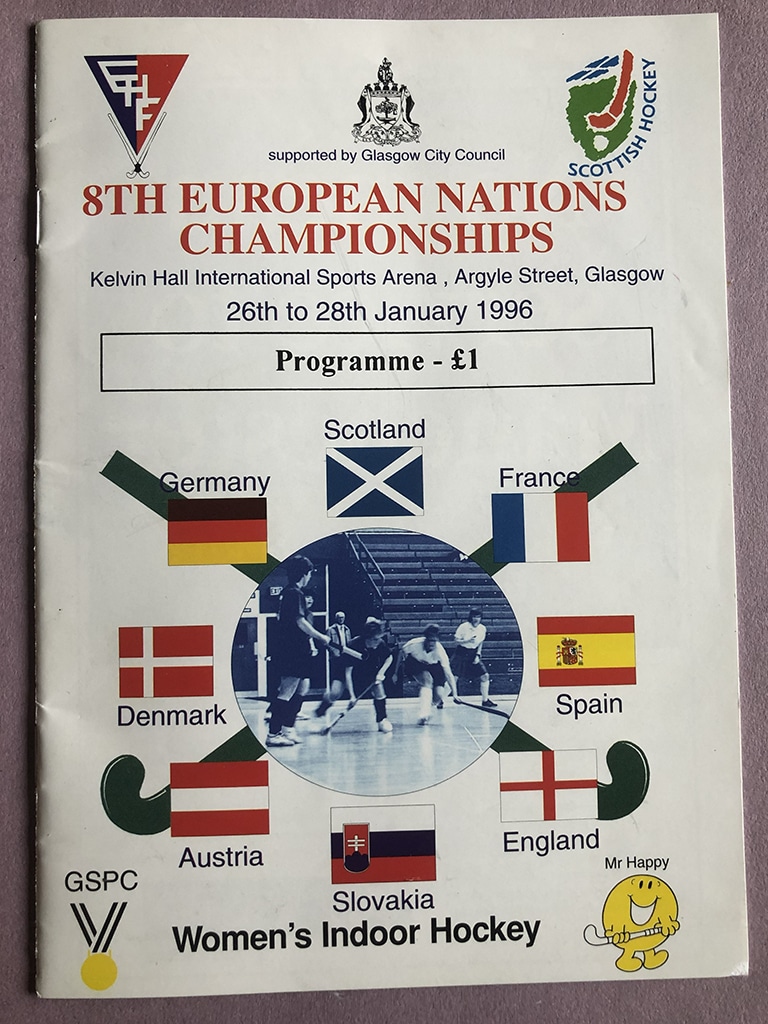
Tournament programme from the eighth European Nations Championships in January 1996