50 years ago in November 1975, the All England Women’s Hockey Association (AEWHA) took its first steps in promoting indoor hockey in England. They did this by organising what was then billed as the first National Ladies’ Indoor Tournament. It was held at Birmingham University on 2 November.
The AEWHA had received an invitation to send a women’s team to the HDM Indoor Tournament in the Netherlands – HDM (Haagsche Delftsche Mixed Hockey Club) is a major club in The Hague that organised an annual indoor event. Without any sort of structure for indoor women’s hockey in England at the time, the AEWHA’s inaugural event was the method chosen to select a team to attend. Due to clashes with County outdoor fixtures, only five teams were able to attend: Ealing, Redland (Bristol), Stafford, Sutton and Swindon. The tournament was played to a round-robin format with Ealing coming out on top winning all four of their matches, with Redland placed second. As a result, Ealing were invited to attend the tournament in The Hague in December and Redland had the unexpected bonus of an invitation to play in Hamburg, Germany, at the end of November. What an experience for both of these English teams, who came up against hardened German and Dutch opposition more used to continental club competition and to playing hockey in large purpose-built sports halls.
The background to women’s indoor hockey in England
The first references to women’s indoor hockey appear in the 1960s. According to Joyce Clarke, writing in The Century Makers book published in 1995, the first documented playing of hockey indoors to adapted outdoor rules was in modern-day Surrey in 1962. Former AEWHA President and great moderniser of the women’s game, Hilda Light, attended one of these evenings and was so impressed with the potential of this form of the game that she and others took it upon themselves to write some rules. These were based on rules used in Germany where the game was more advanced but adapted to account for the lack of purpose-built sports halls in England at that time.
This 6-a-side indoor version of the 11-a-side outdoor game has its origins in Germany where, as in other northern, mainland European countries, months of winter snow prevented outdoor games from being played and indoor hockey flourished in its absence.
From its early base in Surrey/Middlesex area, the English women’s indoor game spread all around the country. There may not have been any large sports halls, but leagues were set up in a variety of indoor venues: village halls, school gyms, disused warehouses and boarded-over swimming pools. All these venues had their challenges with ‘local rules’ needed to cope for situations where the ball went under the cubicle doors or got stuck under the climbing frame! In many venues it was also mandatory to play with a sock over the head of your stick to prevent damage to the floor. In those early days the game was played with outdoor sticks and a softer rubber ball called a ‘pudding ball’ was used.
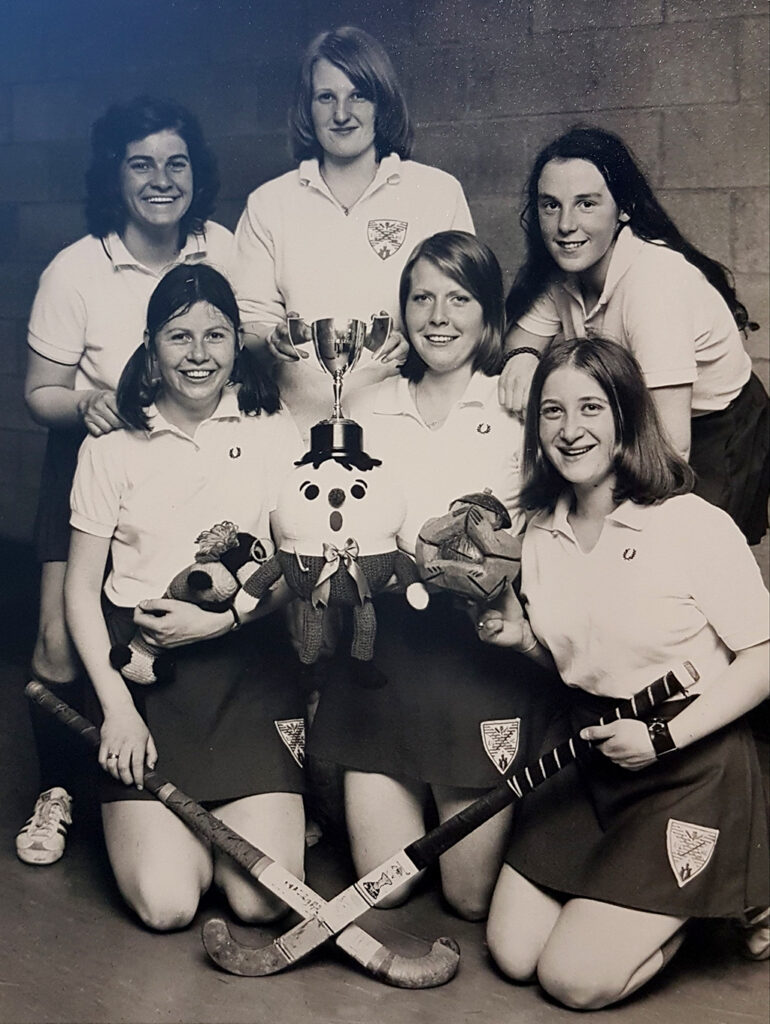
Edinburgh University’s indoor hockey team, winners of the 1974 Scottish Indoor Clubs Championships.
Back, from left to right: Linda Scotland, Marion Lauder, Jean Cursiter. Front, from left to right: Katie Dodd (the author), Ivy Harris, Joyce Livingstone. They are playing indoor hockey with outdoor hockey sticks.
Men’s indoor hockey also started in the early 1960s but grew faster than in the women’s game. Mike Smith (founder of Mercian Sports and now President of The Hockey Museum) recalls first playing indoor hockey at Digbeth Civic Halls, Warwickshire between 1962-64 in tournaments organised by the great David Morgan. Mike thinks he would certainly have been playing with an outdoor stick at that point in time. When Mercian was set up in 1974 only a few indoor hockey sticks were sold, but within a couple of years all the top men’s and women’s teams would have been using them. Yellow indoor plastic balls made by Readers first appeared in the early 1970s and it wasn’t long before indoor balls set the trend for hockey balls being available in a range of colours. The Crystal Palace Men’s Indoor League, initially sponsored by Grays, started in the early 1970s and the magazine Indoor Hockey News (also sponsored by Grays) was first published in 1973 by Nevill Miroy.
By 1973 the growing and worldwide popularity of this indoor form of the game necessitated the agreement of a common set of rules for men and women wherever it was played. Indoor hockey was about to take off in a big way. The big rise in the popularity of women’s indoor hockey in England came when the AEWHA gained the support of Stuart Surridge sponsorship to organise the first National Indoor Championships for Schools, Clubs and Counties at Crystal Palace National Sports Centre in the spring of 1977. The clubs event may have been the highlight of the weekend but it was the schools tournament that proved to be an unexpected success and bring on the skills of this next generation of young players.
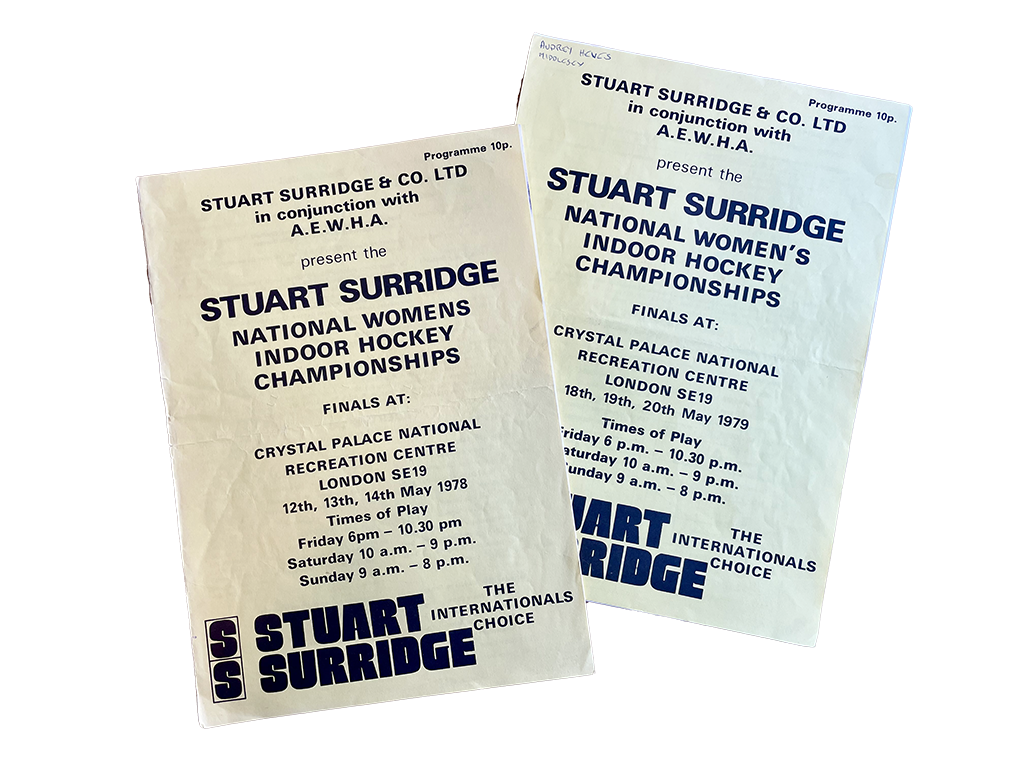
National Women’s Indoor Hockey Championships programmes, 1970s.
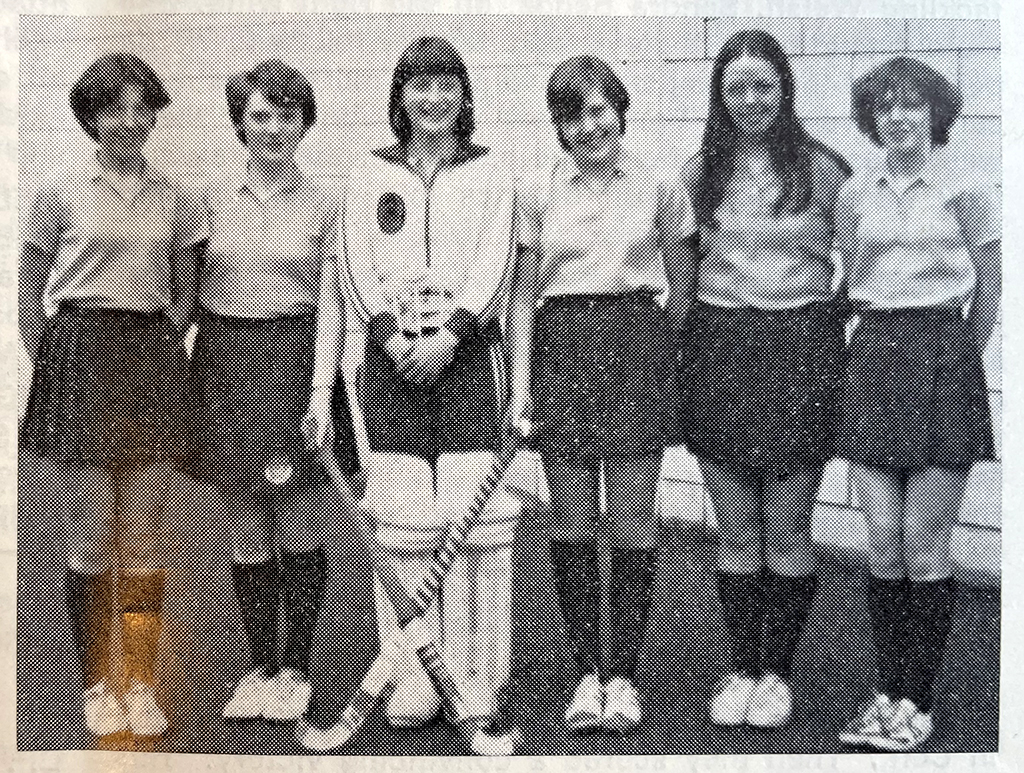
The Notre Dame High School, Woolton indoor hockey team, 1978. Notre Dame were the Merseyside, North West and Northern England schools’ champions. They competed at the Indoor National Schools Championship at Crystal Palace in May 1978.
English women’s indoor hockey teams in Europe
So, how did Redland and Ealing fare in their first forays into Europe in late 1975. For Redland in particular, it was a trip into the unknown as captain Jane Cornelius (later an England Indoor international player) recounted in her report for the January 1976 edition of Hockey Digest magazine. Redland had hardly played a game of indoor hockey prior to the tournament at Birmingham University. As Jane reflected, “some of the players were reading the rules” on the way to the event, which indicates their lack of experience. But Redland had some very good hockey players who managed to borrow indoor sticks and obviously adapted well at the AEWHA event to place second. Playing in Hamburg, however, proved to be a completely different challenge. The German sides were packed with international stars who trained three times a week. In their opening match against Harvestehuder Hockey Club, Redland managed to hold the score to 1-1 at half time; yet the Germans put 12 past their courageous goalkeeper in the second half. They managed to score another three goals making the final score 13-4. This was the pattern for the rest of the weekend. The team came away well beaten but inspired by witnessing first-hand how this fast and skilful game could be played.
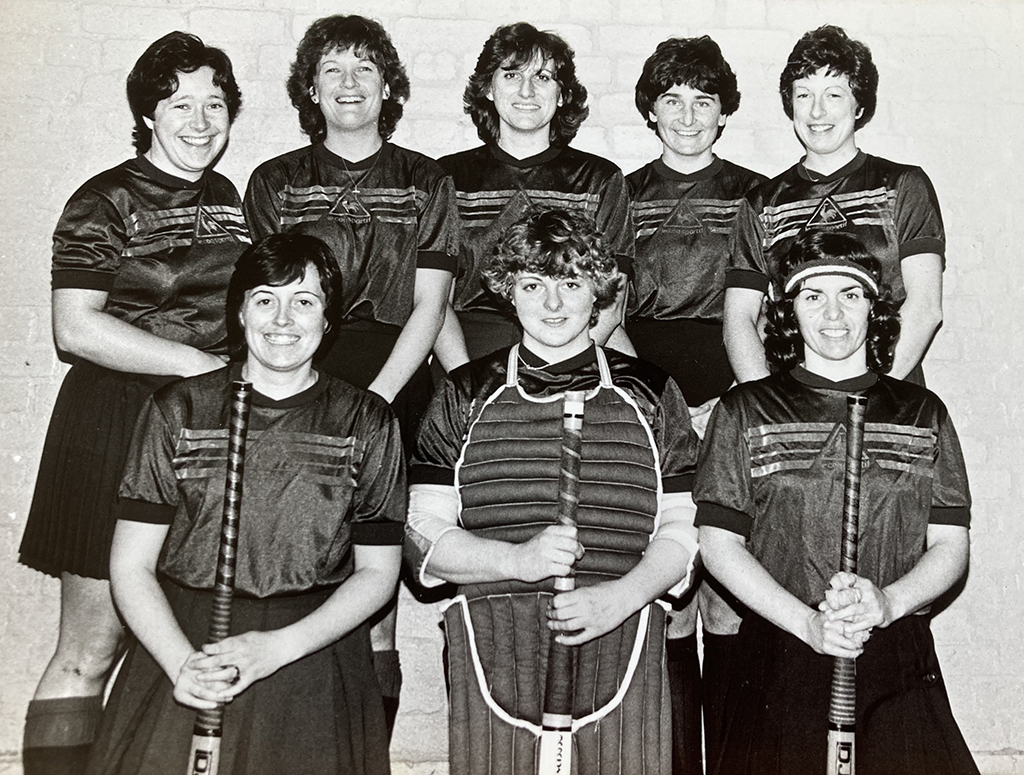
The Redland (Bristol) Ladies’ Hockey Club indoor team at the AEWHA National Indoor Championships at Crystal Palace in the early 1980s.
Back, from left to right: Sue Holden, Chris Barrow, Sue Hodge, Nuala Gallaghan, Cath Coombs. Front, from left to right: Sue Hilton, Rachel Smyth, Jane Cornelius.
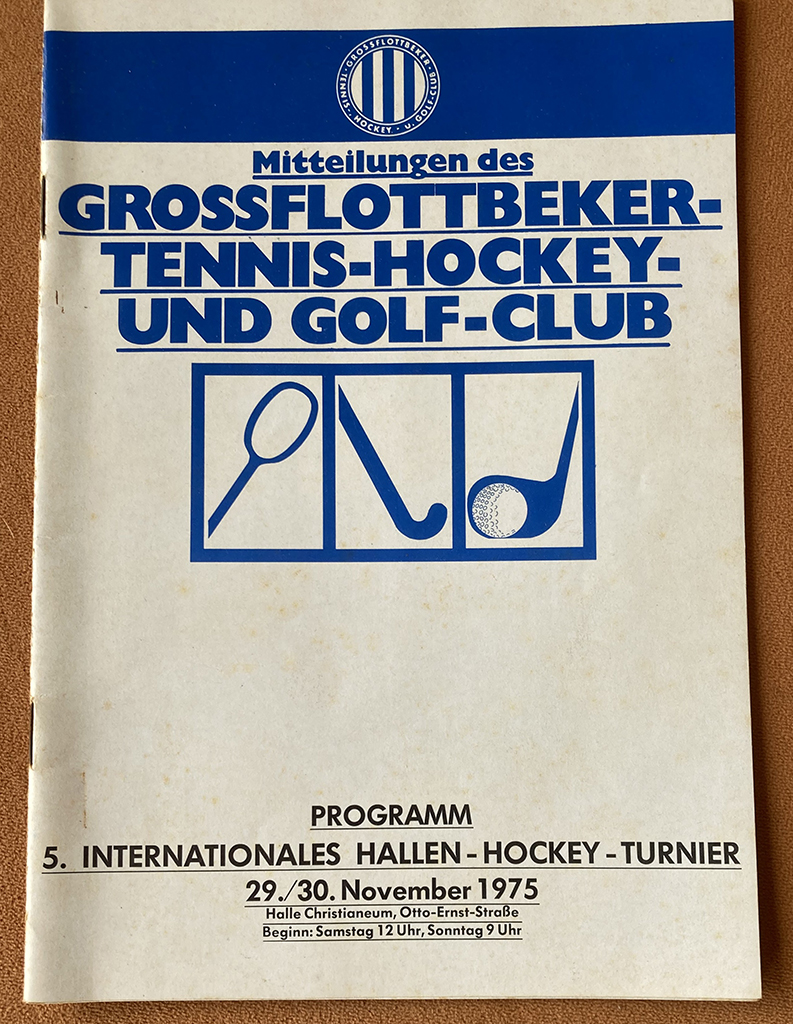
Programme from the Grossflottbecker Hockey Club’s indoor tournament attended by Redland (Bristol) Ladies’ Hockey Club. The tournament took place in Hamburg, Germany, 29-30 November 1975.
Both photographs courtesy of Jane Cornelius.
Ealing Ladies’ Hockey Club did have some experience of playing in local indoor leagues – in small halls where the ball would often bounce up off the side beading or uneven floorboards! But going to The Hague in December was a whole new experience. The halls were enormous with proper side boards, and they faced not dissimilar opponents to Redland – top German and Dutch teams. Netta Forward, the Ealing captain, remembers the shock of that first match against Berliner Hockey Club who shot 13 goals past the team – mostly penalty corners from the stick of Christina Moser. Christina was only 15 years old at the time and would go on represent the German national team for many years, including at the 1984 Olympic Games. After some tactical discussions (and a few beers) overnight, Netta remembers a more savvy team going out the next morning to play the Dutch indoor national team and winning 5-4. A famous victory, even if the Dutch were not at full strength. While the team did not win any other matches, much was learned on the pitch and from watching the other games. Like Redland, the Ealing players came home inspired.
These were tough first indoor outings for both clubs but ones which they both benefitted from in the coming years. Their experience in Europe gave them the impetus to develop their indoor skills, find a coach and train more regularly. Indeed, both clubs went on to be regular attendees at the AEWHA National Indoor Championships that were initiated in the spring of 1977.
Women’s indoor hockey photographs – can you help?
In researching this story, The Hockey Museum staff have realised that the museum does not have many early images (1960s-1970s) of women’s indoor hockey teams or games being played. If you do have any good quality photographic prints, slides or negatives wherein the players, venues or tournaments can be accurately identified, and if you would be willing to donate these to The Hockey Museum, then please get in touch.