22 April 1955 – 13 January 2026
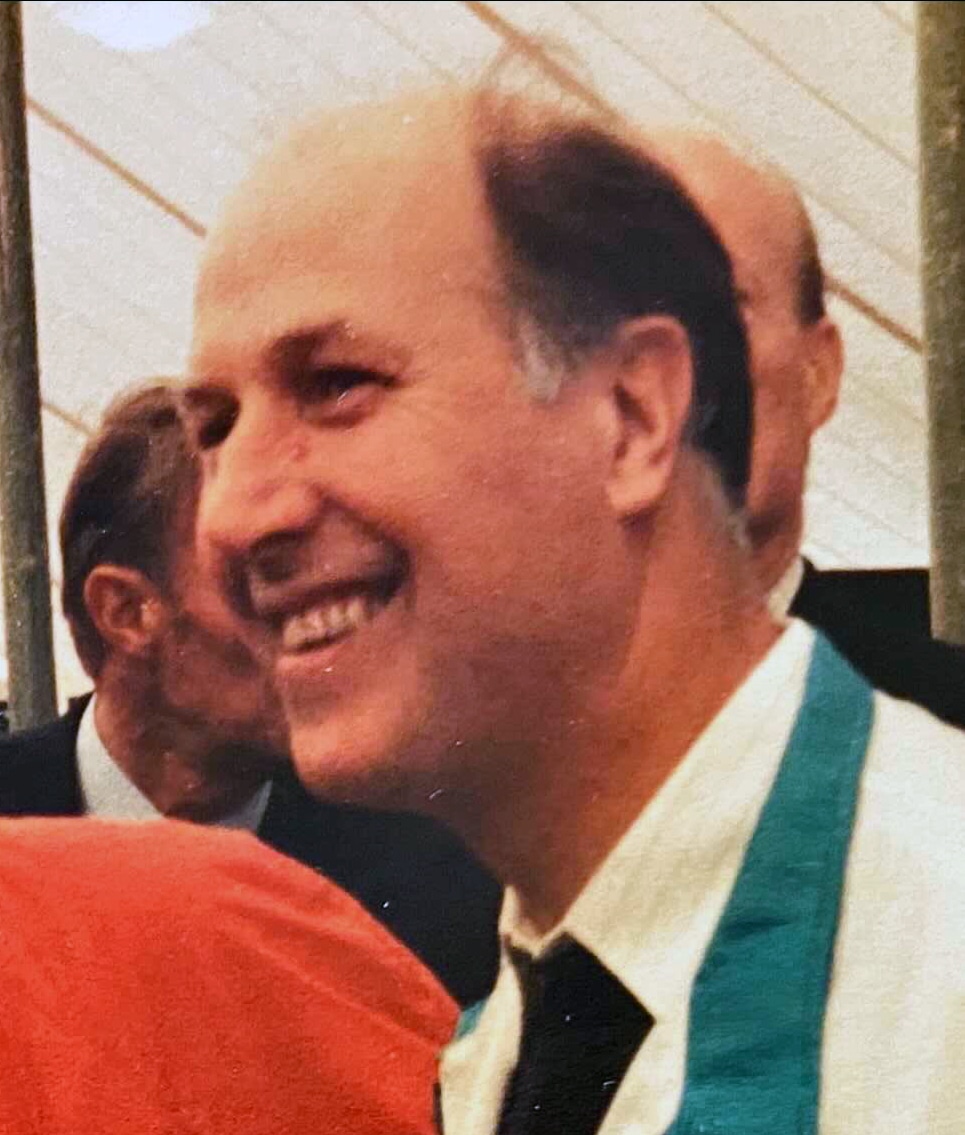
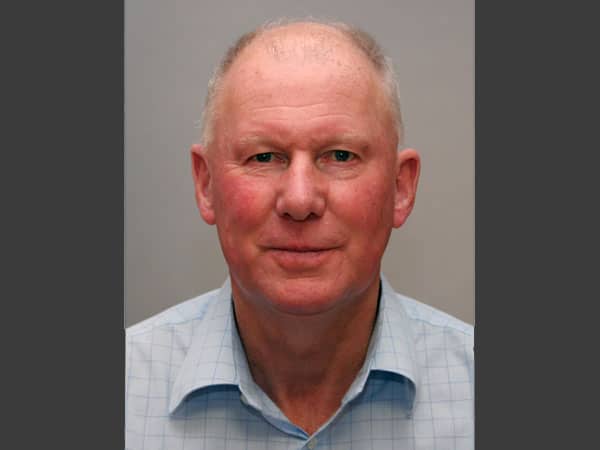
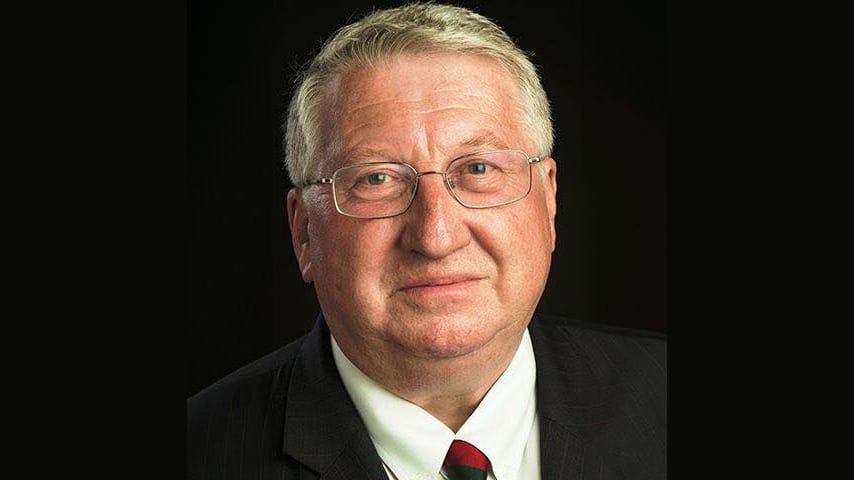
David Gordon Collier OBE, one of the most influential and respected sports administrators of his generation, died on 13 January 2026 at the age of 70. His lifetime contribution to sport – most notably hockey, cricket, and later rugby league – left an enduring legacy across national and international sporting institutions.
Born on 22 April 1955, David was educated at Loughborough Grammar School and later at Loughborough University, where he studied Sports Science and Recreational Management. This early academic grounding set the stage for a career devoted to strengthening sport at every level: from officiating on the pitch to steering major governing bodies through periods of change.
Hockey: integrity in officiating and leadership
David Collier’s involvement in hockey began long before his rise to senior leadership. Starting in 1985, he built a distinguished career as an international umpire, respected for his deep understanding of the game. Within the National Programme Umpiring Association (NPUA), he was a long-standing and formative figure. He later served hockey as an umpire assessor and umpire manager known to be “firm but fair.”
His expertise naturally led him into technical officiating. David became one of the world’s leading Technical Delegates, taking charge of many of the sport’s most demanding events, including the 2010 Commonwealth Games in Delhi, India, the 2017 EuroHockey Championships in Amstelveen, the Netherlands, and the 2018 Indoor World Cup in Berlin, Germany. The European Hockey Federation (EuroHockey) and the International Hockey Federation (FIH) frequently turned to him in difficult or complex situations, valuing his judgement, integrity, calm authority and meticulous organisational skills.
In 2022, David donated some of his tournament hockey memorabilia to The Hockey Museum (THM).
Beyond the field of play, David took on an array of leadership roles that helped shape the sport’s modern era. He served as Vice-President of the English Hockey Association (EHA), was a member of both the European Hockey Federation and FIH Executive Boards, and a Non-Executive Independent Director of Great Britain Hockey following the 2006/07 Framework Agreement between the Home Nations. As Chairman of the FIH Hockey Rules Board, he oversaw key developments to the rules of the game, guiding hockey through significant evolution.
Roger Webb, who worked alongside David at the FIH, recalls:
“Having known David as a friend and fellow umpire for many years, it was a delight and privilege to work with him during my tenure as FIH Sport Director. During this time, David held various positions within FIH including as chair of the Hockey Rules Board/Committee for a number of years. We therefore worked very closely together. It was notable that David had a clear vision for the development of the game and would lead the Board in a structured and focussed way. He had the ability to encourage dialogue and ensure contributions from all participants before bringing a discussion to a clear and fair conclusion. We were therefore able to establish hockey rule changes which were sometimes contentious but based on thorough and thoughtful judgements under David’s leadership.”
One of his most consequential contributions to hockey came during the financial crisis that, in 2002, threatened the future of the EHA. Appointed Chair of the Finance and Business Committee, David worked tirelessly alongside Maurice Kittrell to help EHA President Mike Corby navigate the £600,000 deficit that had placed the future of the national governing body in jeopardy. Their crisis talks with Sport England culminated in a pivotal Special General Meeting of the EHA attended by representatives of 800 clubs where the financial picture was laid bare. The meeting resulted in the approval of a rescue package (a £500,000 interest-free loan from Brighton & Hove Hockey Club President Stewart Newton) that ensured the continuance of hockey in England. It also paved the way for the establishment of England Hockey (to govern domestic hockey in England) and World Class Hockey (to initially govern the England national teams). David’s determination and financial acumen were instrumental in safeguarding the sport’s domestic and international future.
His contributions were recognised in January 2003 with the Sydney Friskin Memorial Award from the Hockey Writers’ Club, honouring his outstanding service to hockey. Their press release (in THM archives) stated:
“No one has done more or been more involved with the rescue act to save English hockey during 2002 than David Collier […] David was deeply involved from the outset of the crisis. Initially identifying the problem, David then became very involved with Stewart Newton’s rescue act and then with the budgeting and planning for the continuance of hockey in England.”
Despite the pressures of his EHA role, throughout 2002 David continued to make himself available as a match official at National League games and other hockey events, further demonstrating his steadfast commitment and enthusiasm for the game.
David stepped back from involvement in English hockey’s national governance following the creation of England Hockey in 2003, turning his attention to the world of cricket.
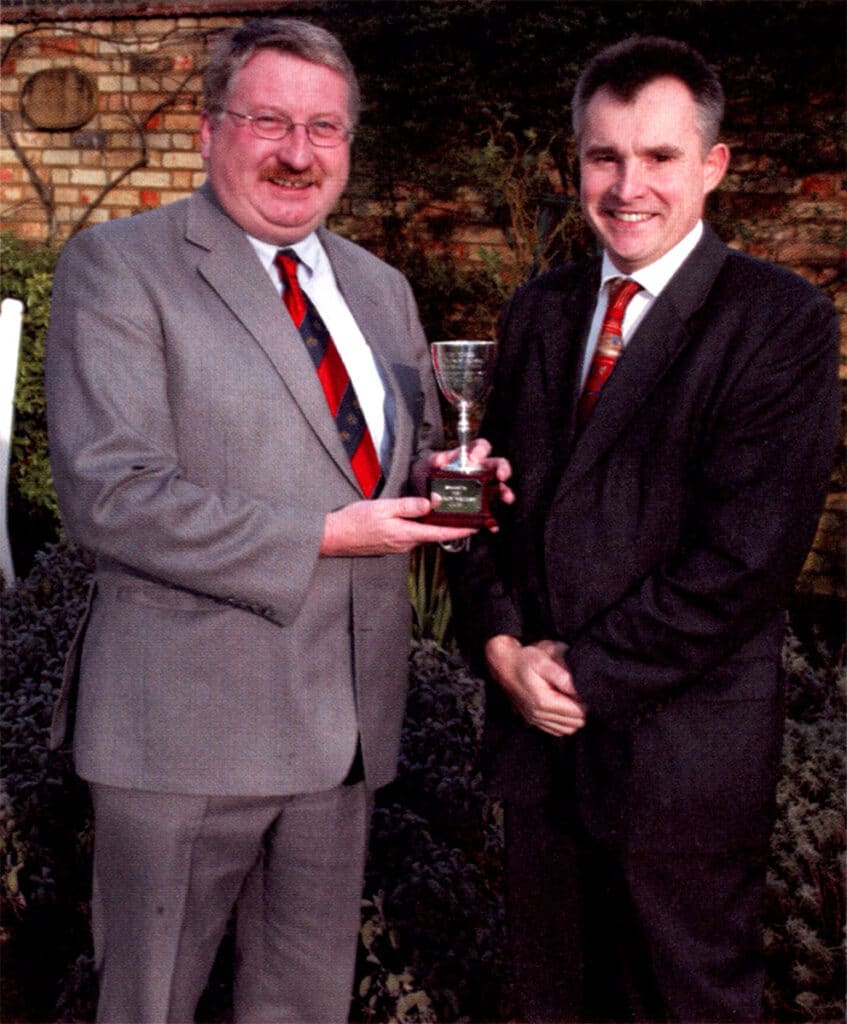
David Collier (left) received the the Sydney Friskin Memorial Award from the Hockey Writers’ Club in 2003. The presentation was made by David Chappell, Sports Editor of The Times.
Cricket: stewardship and success on the world stage
David Collier’s sporting leadership extended far beyond hockey. In 2004 he became the second Chief Executive of the England and Wales Cricket Board (ECB), a role he held for a decade (2004-2014). His tenure coincided with one of the most successful eras in modern English cricket.
Under his stewardship, England Men won the Ashes four times and England Women an extraordinary five. Global success also flourished: England Women won both the ICC Women’s World Cup and Women’s T20 World Cup in 2009, followed by the men’s historic ICC Men’s T20 World Cup victory in 2010. The unforgettable double Ashes triumph of 2005 – for both men’s and women’s teams – stood as a defining moment of his leadership, celebrated by thousands of fans who filled the streets in nationwide jubilation.
David always found time for hockey and for hockey people despite his esteemed role with the ECB. As Roger Webb recalls:
“At a personal and individual level, David was an exceptional person to work with. Because of his numerous significant interests and responsibilities he might be preparing for a meeting with government ministers or be somewhere in the world on high-level corporate business – but would always respond to messages or emails promptly and helpfully.”
Similarly, Ben Rea recalls David’s generosity towards hockey:
“I organised the 2006 FIH Congress on behalf of England Hockey when David was at the ECB. I was delighted to be able to offer Lord’s Cricket Ground and all its facilities as the venue, reflecting links going back more than 40 years to when international hockey matches were regularly held on the outfield at the Home of Cricket. The Congress was a great success and the venue greatly appreciated as being one of the best ever. Without the major support of David much of what was achieved at the Congress would not have been possible.”
David’s contributions to sport were formally recognised in the 2015 New Year Honours, when he was appointed Officer of the Order of the British Empire (OBE) for services to cricket. It could equally have been for services to hockey.
Wider sporting contributions and legacy
After leaving the ECB, David continued to demonstrate his breadth of expertise and passion for sport by serving as Chief Executive of the International Rugby League Federation. He also chaired the sports management firm HIX Management Group, which he co-founded with former professional golfer Andrew Hicks.
His commitment to using sport as a force for social good was profound. As Chair of the Lord’s Taverners, he championed programmes supporting disadvantaged and disabled young people, reflecting his lifelong belief in the power of sport to transform lives and strengthen communities. He also served as a trustee of the Hockey Umpiring Trust, remaining closely connected to the officiating community that had shaped so much of his career.
David’s achievements were further recognised through honorary doctorates from both Loughborough University and Nottingham Trent University.
While David’s CV was formidable, those who worked with him closely remember his warmth, generosity, and ability to support others even while balancing demanding leadership roles. Colleagues recall his honesty and his willingness to mentor younger officials on the NPUA circuit. He was a gifted and likeable raconteur who drew effortlessly on his many and varied experiences across sport. His candour and stories – often shared over a well-chosen glass of wine – made him such a cherished figure at tournaments and meetings alike.
David Collier is survived by his children, Simon, Zoe, and Mark, and by a global sporting community that benefitted immeasurably from his expertise, leadership, and kindness. His legacy lives on in the institutions he strengthened, the sports he helped elevate, and the countless individuals he supported throughout his remarkable life.
He will be deeply missed across hockey, cricket, rugby league, and beyond.