For years, Joanne Chadwick’s family knew it simply as Grandma’s Lancashire hockey medal.
It belonged to Joanne’s grandmother, Jane Miller (née Halsall), and it was one of Jane’s most treasured possessions. Joanne knew that hockey had been enormously important to her grandmother. As she put it simply:
“Hockey was life.”
But exactly what Jane’s medal represented was less clear. So, Joanne contacted The Hockey Museum. What followed was the beginning of a fascinating historical investigation.
The reverse is engraved:
ENGLISH LADIES
HOCKEY LEAGUES ASSOC. K.O.
1934–35
WINNERS
LEYLAND MOTORS
Those words provided The Hockey Museum volunteer Mark Evans with a route into the story.
Research into Leyland Motors Hockey Club, women’s league hockey in Lancashire and the English Ladies’ Hockey Leagues Association revealed that the medal related to the first season of a new knockout competition – the English Cup.
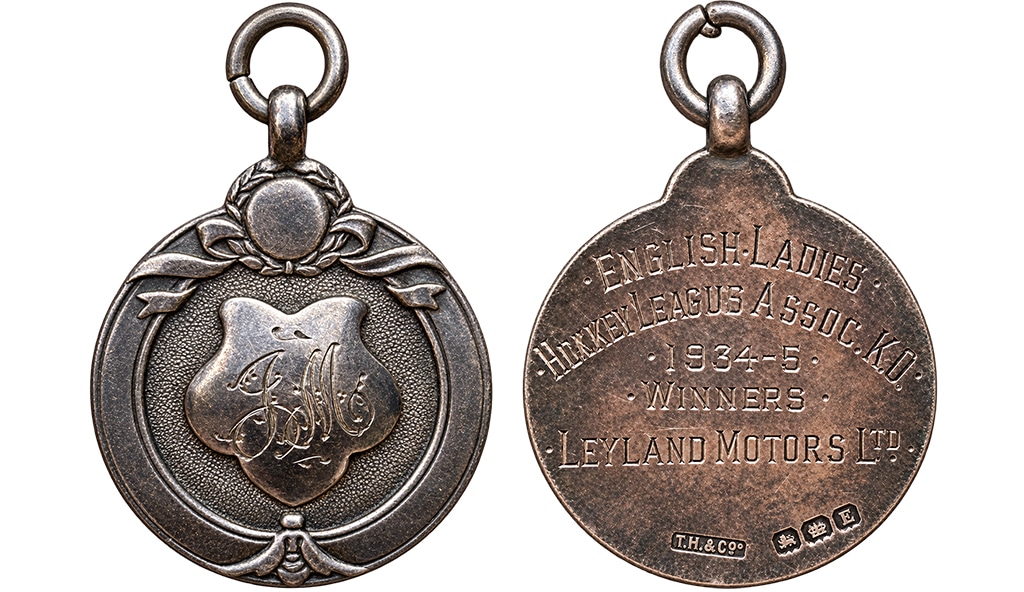
Medal won by Jane Miller from the first English Ladies’ Hockey Leagues Association knock-out competition held during the 1934-35 season.
Jane Miller and Leyland Motors
Before her marriage, Jane was Jane Halsall. Her family believes that the initials “JM” on the front of the medal may have been added after she became Jane Miller.
One particularly interesting detail is that Jane apparently did not work for Leyland Motors. She was not unusual in that respect. The surviving history of the club records that many of the women who played for Leyland Motors were not company employees. Players could pay a small affiliation fee, while Leyland Motors provided much of the equipment and shirts. Works transport was also made available for away matches.
The club had another major advantage. Leyland Motors was regarded as having one of the best hockey grounds in the north of England, maintained by paid ground staff. A wonderfully domestic detail also survives. At half-time, it was apparently somebody’s responsibility to leave the pitch and start the bath water running.
These details reveal something of the world in which Jane played. This was organised, competitive hockey – but it was also a community.
A different tradition of women’s hockey
The national governing body for women’s hockey, the All England Women’s Hockey Association, had been formed in 1895. It opposed league and cup hockey. Yet competitive league hockey was established across parts of northern England despite this. By the early twentieth century, women’s leagues had developed in places including Manchester, Stockport, Liverpool, Lancashire Central, Bury, Leigh, Wigan and Rochdale.
In 1932, the English Ladies’ Hockey Leagues Association (ELHLA) was formed. It provided a structure for this league-playing hockey community. Then, in 1934, businessman Frederick Corlett Johnson donated a trophy to the Association to be used for an annual knockout competition. It became known as the English Cup.
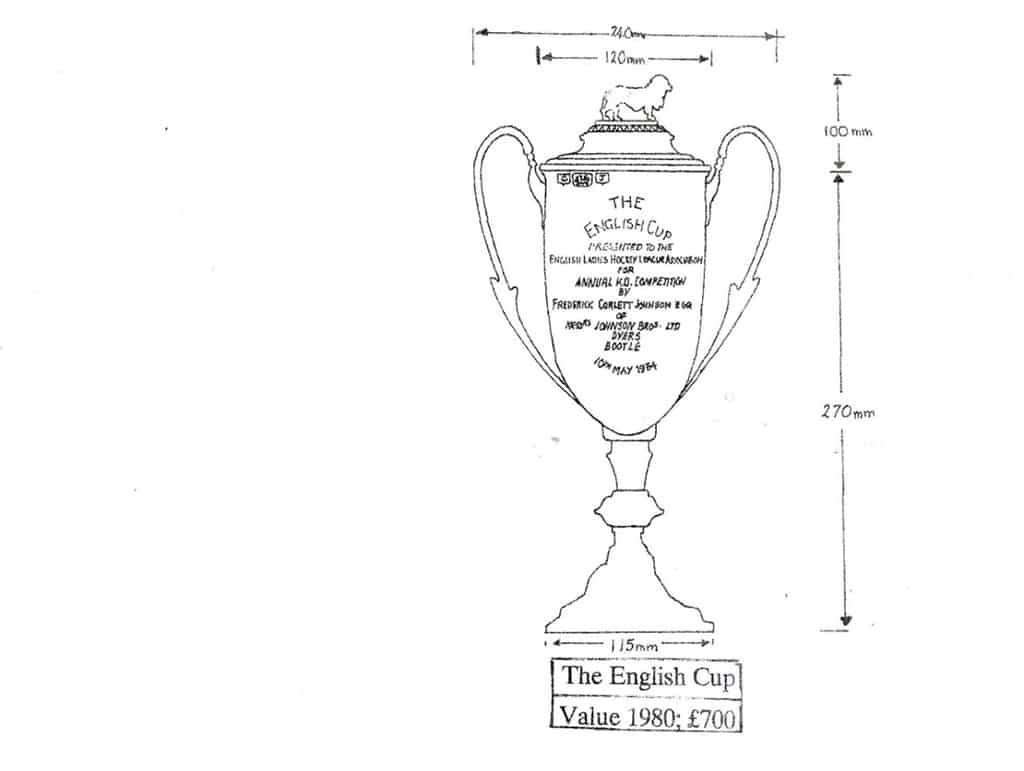
Drawing detailing the design, dimensions and value (as of 1980) of the English Cup trophy, awarded to the winners of the English Ladies’ Hockey Leagues Association knock-out competition. The trophy is believed to have been lost to hockey.
The first English Cup
Leyland Motors entered the new competition during the 1934–35 season. They would become its first champions.
Contemporary newspaper reporting allows some of their progress through the competition to be reconstructed.
In the first round, Leyland Motors defeated Manchester LMS Railway 7–1. A player reported as “J. Millar” scored four goals. Later, Leyland played Dick Kerr’s at Ashton Park and won 4–2. The first Leyland Motors goal was scored by “J. Miller”. Leyland then defeated Bebbington 3–1 to reach the final where they faced Liverpool Olympic. Leyland Motors won 3–1 to become the first winners of the English Cup.
The club also won Division One of the Lancashire Central Women’s Hockey League during the same season.
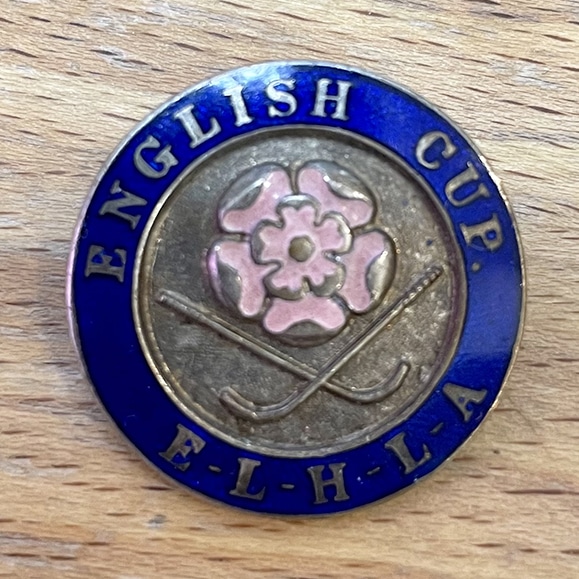
An example of the pin badges awarded to players commemorating their success in the English Cup knock-out competition.
Was J Miller, Jane?
This is where the surviving evidence becomes particularly interesting.
Jane Miller played for Leyland Motors. Contemporary reports record a J Millar and J Miller scoring goals during the club’s English Cup campaign. Mark Evans’s research suggests that these references may relate to Joanne’s grandmother, but at present the evidence does not allow us to state that conclusively. Names were not always recorded consistently in contemporary newspaper reporting, and surviving records are incomplete. So, the Museum’s position is deliberately careful. The player may be Jane. The player is most likely to be Jane.
The research continues.
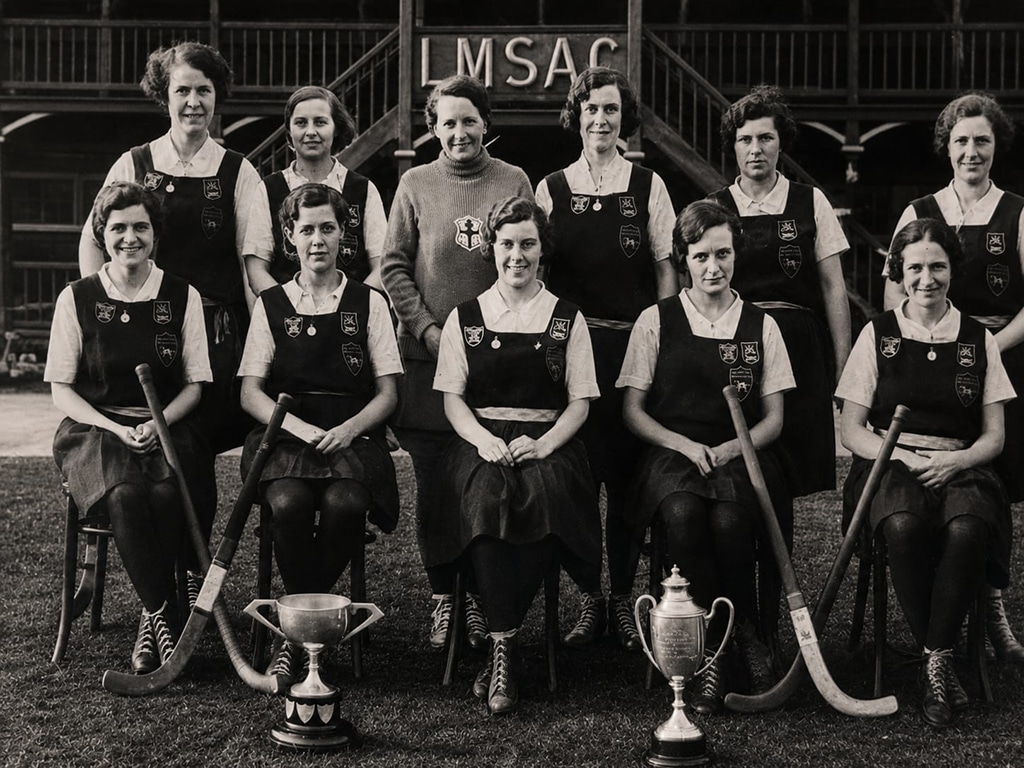
Members of Leyland Motors Hockey Club pose with trophies following a successful season, date unknown. The group is arranged in front of the Leyland Motors Social and Athletic Club pavilion.
The scrapbook
There may be another source of evidence.
Jane’s family has preserved a scrapbook containing decades of hockey material. It begins around 1932 and continues until approximately 1965. The scrapbook contains photographs, newspaper cuttings and material relating to hockey in Lancashire.
Joanne and her family have offered to donate the scrapbook and photographs to The Hockey Museum. The material may help us answer questions about Jane, but its significance may be wider than one player. Family scrapbooks often preserve names, photographs and match information that never entered official archives. Other women’s hockey stories may be waiting within its pages.
A family legacy
Jane’s familial connection with hockey did not disappear when her playing days ended. Her great-grandson now plays for Leyland & Chorley Hockey Club and represents Lancashire at junior county level.
Joanne’s comment is difficult to improve upon:
“It must be in the blood.”
Almost a century after Jane was playing hockey in Lancashire, another generation of her family is still playing the game.
One final mystery
Jane’s medal has helped us reconstruct part of the story of the English Cup. Yet the trophy itself presents another question. After the English Ladies’ Hockey Leagues Association was dissolved in the early 1960s, surviving research suggests that the English Cup was handed to the Lancashire Central League.
It became known as the Lishman Cup commemorating John Lishman, a key driving force behind the ELHLA and its long-time secretary. A photograph from the 1963–64 season (below) appears to show the original English Cup continuing in use under its new name.
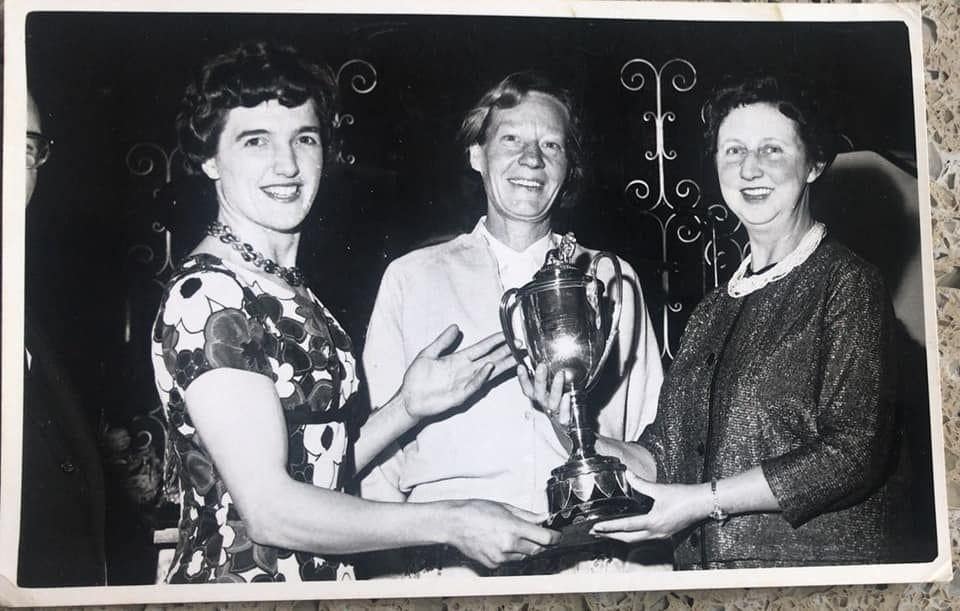
The former English Cup trophy is awarded as the Lishman Cup during a presentation at the Leyland Motors Social Club during the 1963-64 hockey season.
The ageing trophy was eventually replaced. The whereabouts of the original are now unknown. So, we would like your help.
- Did you play in the Lishman Cup?
- Do you have photographs of it?
- Was it displayed at your club?
- Do you remember what happened when the trophy was replaced?
If you have information, photographs, programmes or family memories relating to the English Cup or the Lishman Cup, please contact The Hockey Museum.
Contact Us – The Hockey Museum
Jane’s story began with one family asking a question about a medal. Perhaps another family can help us answer the next one.