By Atlanta Tsiaoukkas, University of Cambridge
Whilst Angela Brazil is typically credited as introducing jolly hockey sticks schoolgirls to British girls’ fiction, her lesser-known contemporary Kathleen Ainslie, is as likely a candidate for this laudable position in hockey history. Ainslie’s 1907 picture book, Mops versus Tails, whilst aimed perhaps at a younger audience than Brazil’s schoolgirl stories, taps into the same emerging culture of girls’ school hockey in the early years of the twentieth century. In fact, Mops versus Tails predates Brazil publishing any fiction which features girls’ hockey matches. We can imagine that, for many girls growing up in the 1900s, Mops versus Tails would have been their first encounter with schoolgirl hockey, priming them for later girls’ school stories and their own girlhood careers on the hockey field.
Born in 1858, little is known about Ainslie, despite producing at least twenty-three successful picture books for publishers Castell Brothers Ltd. from 1905 onwards. Census records simply indicate she grew up in Somerset among many siblings, a curate father and an illustrator mother, Catherine Susan Sadler. Likely buoyed by her mother’s own creative endeavours, Ainslie produced picture books alongside illustrated calendars, Christmas cards and postcards. She is best known for her series of picture books featuring the adventures of wooden Dutch peg dolls, a popular toy for young girls at the time. A contemporary article on Ainslie described her as doing for Dutch dolls what Louis Wain did for cats.
View Kathleen Ainslie’s wooden Dutch peg dolls artworks in the Royal Academy collection: Kathleen Ainslie | Artist | Royal Academy of Arts
Writing and illustrating a picture book about girls’ sports in the early twentieth century, Ainslie adeptly embraced two innovations in children’s publishing – picture books and the girls’ sports story. Children’s picture books can best be differentiated from earlier illustrated fiction through a unique intertwining of image and text into interdependent stories, rather than simply illustrating written tales. Among the earliest examples of this emerging genre is Beatrix Potter’s The Tale of Peter Rabbit (1902), whose drawings and text were produced together, rather than the story being outsourced to an illustrator. However, whilst Potter stuck to naughty rabbits, Ainslie was more interested in the escapades of girls, of whom readers may have recognised themselves more keenly than woodland creatures.
Ainslie’s stories are full of sporting fun for girls at a time when the notion that girls could risk working up a sweat was still controversial. Her signature peg dolls play badminton in Me and Catherine Susan (1903), tug o’ war in Lady Tabitha and Us (1905) and go mountain climbing in Catherine Susan’s Little Holiday (1905). Mops versus Tails appears to be her only hockey-centric tale, and, with so little known about Ainslie’s life, whether she had had much experience on the hockey field can be left only to speculation. Yet, by 1907, few authors for girl readers had attempted to take as much time as Ainslie in examining out the dynamics of rival hockey teams, and it would not be until a year later, in 1908, that Dorothea Moore would do the same for older readers, in A Plucky School-Girl. Mops versus Tails follows the eponymous rivals, the Mops and the Tails, as they prepare for a vicious hockey match. The story reflects a competitiveness, athleticism and confidence that is often denied girls in fiction of this period. There are many sights in Mops versus Tails which are strikingly radical for children’s fiction – the prospect of girls’ dresses torn from aggressive play, a weight-lifting regime to make ‘my muscles bigger’ for the match – whilst other elements, such as the celebratory ‘jolliest tea’ and excitement over hampers sent from home, resonate with the midnight feasts and lively school suppers of the girls’ school story.
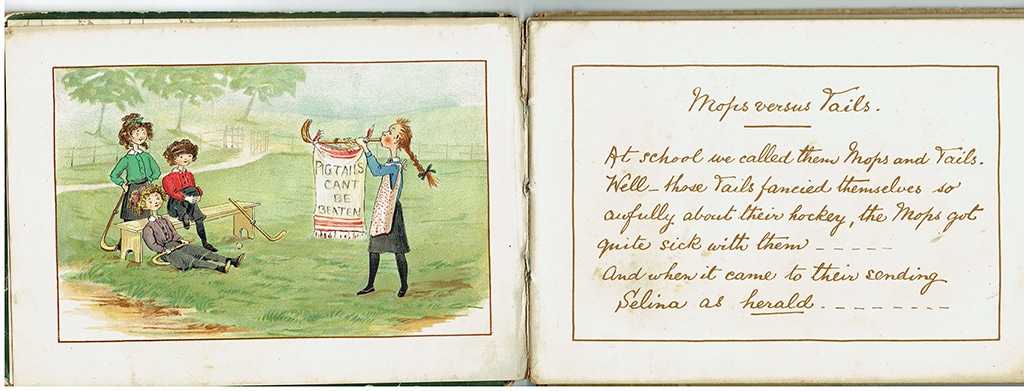
Double-page spread of the children’s book Mops versus Tails (1907) by Kathleen Ainslie.
From The Hockey Museum collection.
Mops versus Tails is a beautifully produced picture book, a testament to evidence that Ainslie’s work was often gifted to its readers. Using chromolithography, innovative at the time, what is most striking at first glance is the loping hand-written cursive of the text. This choice to handwrite rather than letterpress the text allows for Ainslie’s characteristic expressiveness to show through beyond her charming illustrations. Words are made bigger and smaller, underlined, unique punctuation of exclamation marks and dashes turn the pages of text into visual media as much as the art alongside it. As Susan Bailes has highlighted, Ainslie was fond of wordplay, and Mops versus Tails with its intense rivalry, produces many effusive examples.
As the Tails confidently cry “Tails, Pigtails can’t be beaten!” The rival captain responds, “Tails shall be beaten – – beaten into cocktails !-!-!-”
Ainslie combines pun-ish embedded words with underlined emphasis and dramatising punctuation, evoking an enthusiastic battle for hockey victory.
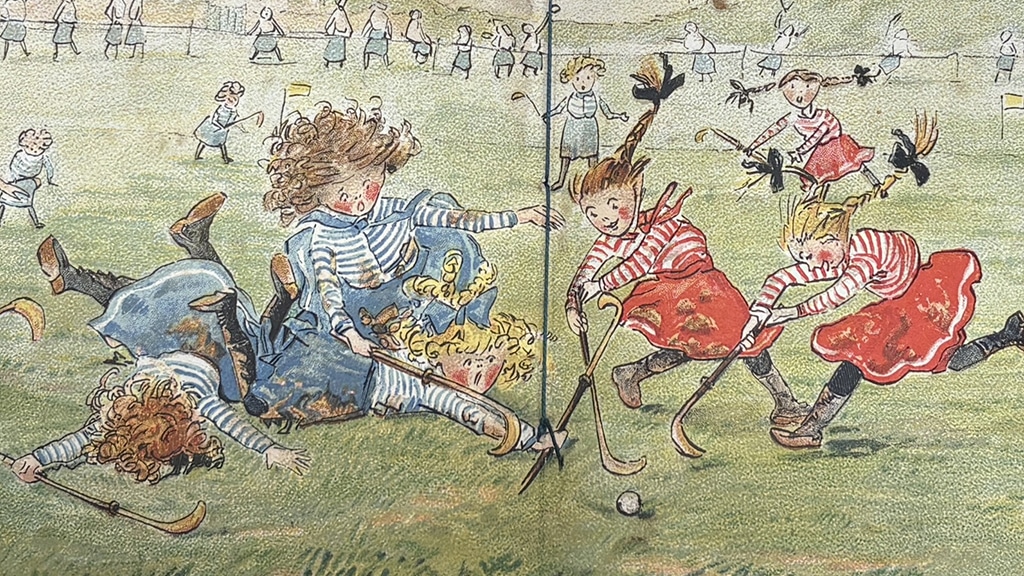
Undoubtedly the most exciting page of Mops versus Tails is the centre spread which depicts the breadth of the hockey pitch as the schoolgirls, covered in mud, battle it out. For a sport that was often only deemed acceptable for girls by restricting rough play, the pile up of Mops, squished into the grass as the Tails run off with the ball seems to defy ladylike expectations. The image evokes the excitement of sports, offering a slice of what was inevitably a thrilling match, and presents the young reader a glimpse into the highs and lows, quite literally, of schoolgirl hockey.
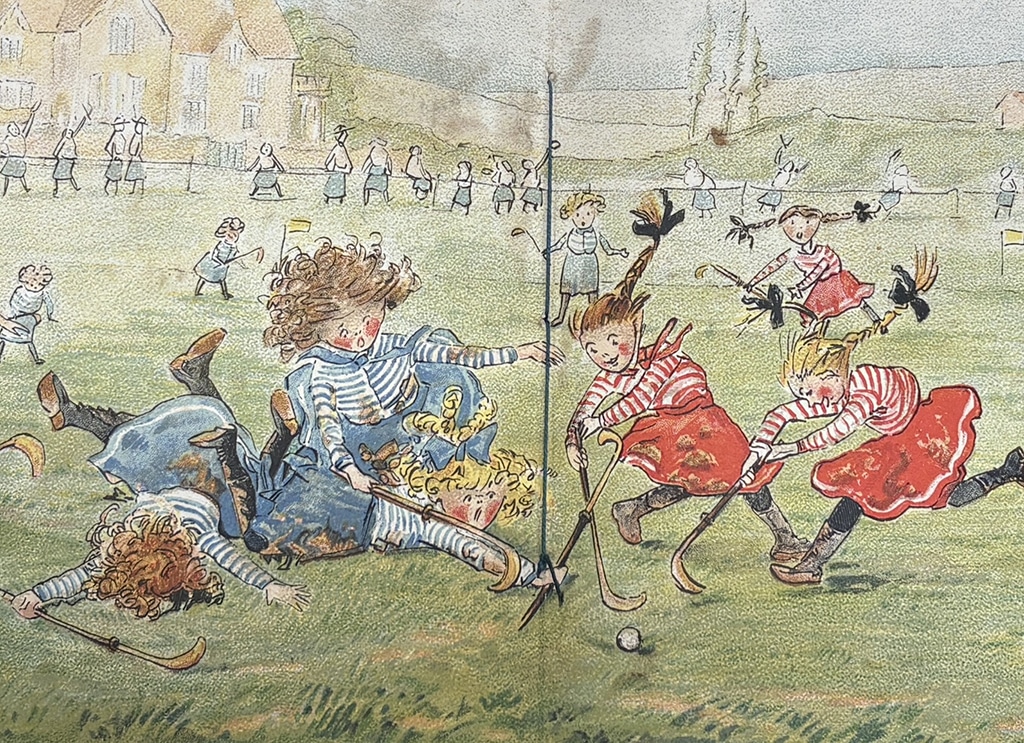
Illustration of a girl’s hockey match from the children’s book Mops versus Tails (1907) by Kathleen Ainslie.
_____________________________________________________________________________________
References
- Kathleen Ainslie, Mops versus Tails (Castell Brothers, 1907).
- Susan Bailes, “Kathleen Ainslie, 1858-1936,” Studies in Illustration, no. 66 (Summer 2017), 21 – 39.