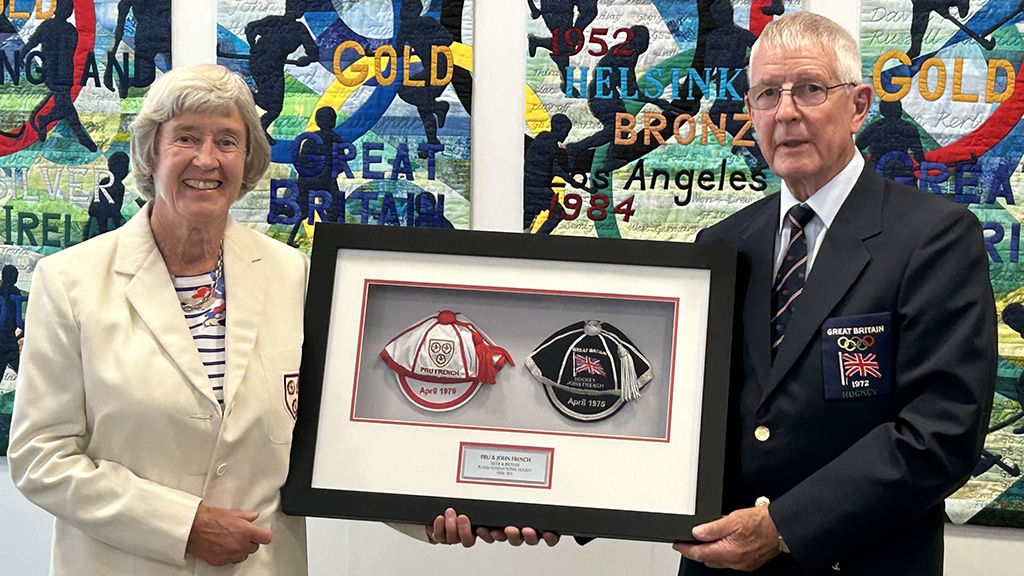
At the end of May 2026, brother and sister international hockey players John French and Prudence Carter (née French) visited The Hockey Museum in Woking for a unique pair of presentations. John and Pru are a rare example of two hockey siblings who competed at the highest level of our sport in the same year: John for Great Britain (GB) and Pru for England, both in 1975. In recognition of this achievement, The Hockey Museum President, Mike Smith, commissioned two pairs of beautifully framed honours caps which represent the siblings’ international status.
Pru and John were both visiting the Museum for the first time and brought children and grandchildren with them making for a special day. Mike delivered an engaging tour crammed with anecdotes and passionate insight, and the museum’s curatorial staff further personalised proceedings with a display of collection material relating to both players’ hockey careers. They were blown away by their experience.
Pru subsequently wrote:
“Thank you so much for the superb guided tour of The Hockey Museum. You and the staff obviously have such a passion for the game and its history. Our day was so special and personal. Thank you for the wonderful mementos you presented to John and myself. On the way home our grandchildren were talking about some of the collection items with great interest and I’m sure they will pass on their memories of the day to their cousins, aunts and uncles. Our whole family has a similar passion for sport and in particular, the game of hockey.”
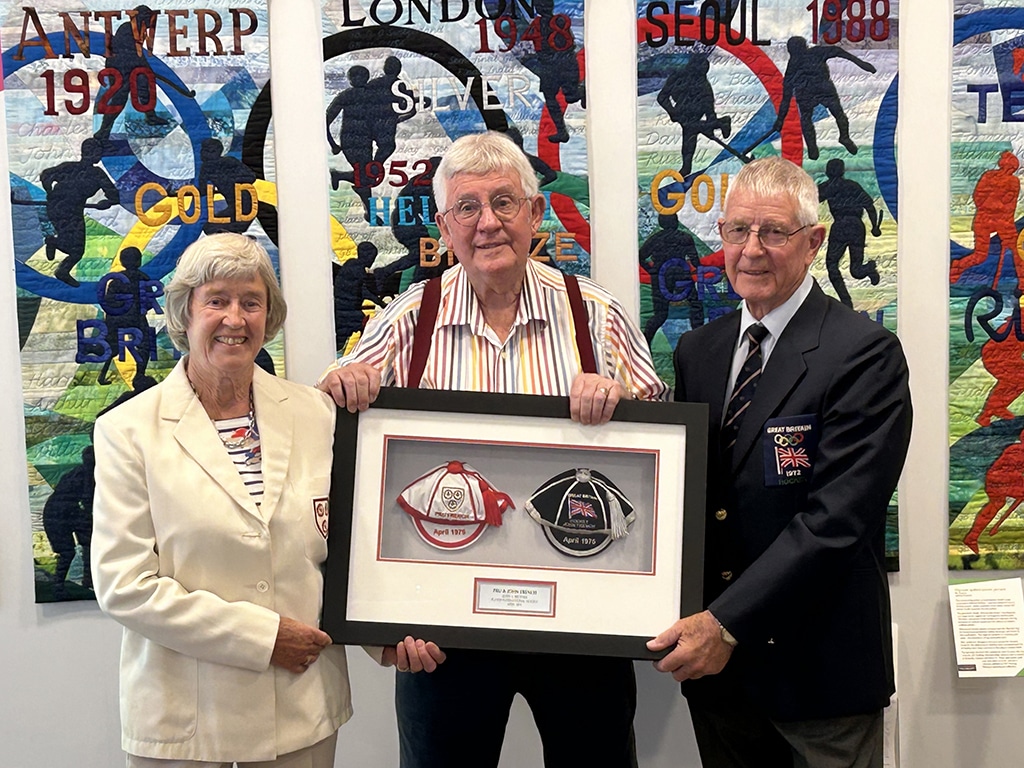
Hockey international siblings Pru Carter and John French receive their framed honours cap presentation from Mike Smith, president of The Hockey Museum during a visit to Woking. Pru is wearing her England blazer and John is wearing his Great Britain Olympic blazer from 1972.
Pru Carter, England international
Pru Carter represented England in hockey for just the one year, receiving her three caps between March and April 1975. She made her England bow at Wembley Stadium against Wales in the Home Countries Championship, a 2–0 win in which Pru scored a debut goal. England would go on to win the tournament with Pru also playing in the final victory against Scotland at Grangemouth, Falkirk (0–1). Her final capped appearance for England was against the Netherlands in Amstelveen, Amsterdam (1–1).
Pru was also selected in the England squad for the International Federation of Women’s Hockey Associations (IFWHA) World Championship in Edinburgh in 1975. She was part of the squad of 14 that emerged victorious under the coaching of Peggy Potts and the captaincy of Anita White. However, none of the three substitutes made it onto the pitch meaning that Pru, Judy Carter and Ruth Grainge did not earn international caps in the tournament despite being crowned world champions.
Pru is perhaps best known for representing England and GB at athletics, specifically in the javelin event. She finished third in the Women’s Amateur Athletics Association (WAAA) Championship in 1968 with a distance of 44.86 metres and she became the national javelin champion, throwing 51.00 metres at the WAAA Championship in 1972. In 1974, she came fourth in javelin at the Commonwealth Games in New Zealand. Pru’s athletics career spanned 1968–1976. She competed in athletics alongside international hockey in 1975, including a GB invitational at Crystal Place, London and trips to Dieppe and Dresden – a busy lady!
Today, Pru and her husband Peter are recognisable stalwarts of Chelmsford Hockey Club. They married in 1974 at the height of Pru’s sporting career and proudly herald three generations of Carter family hockey players.
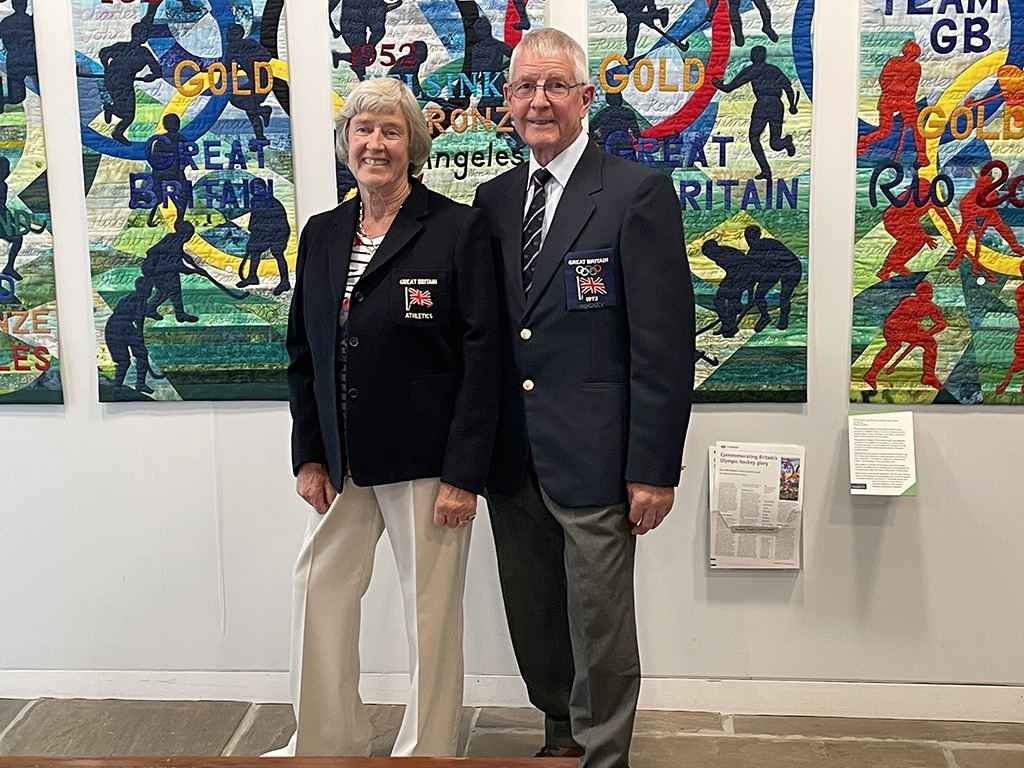
Hockey international siblings Pru Carter and John French wearing their Great Britain blazers, Pru’s for athletics and John’s for hockey.
John French, England and Great Britain international
John French’s international hockey career spanned 1969-1977. He represented England throughout this period earning 45 caps. John participated in several Four Nations Tournaments as well as the second-ever European Cup held in Madrid in 1974 – England topped their group but ultimately finished fourth losing the bronze medal match 1–4 to the Netherlands.
John represented GB between 1971–1976 (31 caps, 6 goals). He made his debut in a 2–1 friendly victory over Poland in May 1971 before joining the GB tour of India in November. He represented Great Britain at the Olympic Games in Munich in 1972, scoring in a 2–1 loss to New Zealand – GB finished third in their group and ultimately placed sixth. They failed to qualify for the Montreal Games in 1976.
John’s international hockey career dovetailed with the beginning of the end of grass hockey and the ascendance of artificial turf pitches. In this period, he has the fascinating honour of having played in a hat-trick of artificial turf ‘firsts’:
- In the first GB men’s tournament on artificial turf – the Eight Nations Pre-Olympic Tournament in Montreal in July 1975.
- In the first England men’s tournament on artificial turf – the Four Nations Tournament, Limburg an der Lahn, Germany, Sept 1977.
- In the first international men’s matches played on artificial turf on English soil – a friendly internationals vs Canada at Hackney Marsh, London in May 1976.
John also holds the world record for the fastest ever goal in international hockey! He scored after just seven seconds – the only goal in a 1–0 victory over West Germany at Trent Bridge Cricket Ground, Nottingham in 1971. He recalls how a deliberate tactical decision led to his world-record goal:
“Having played against West Germany on previous occasions, we knew that they nearly always won the bully off by managing to pass the ball backwards to their half back line of players.
“Before the start of the match, during our team talk, as the player to take the bully off, it was decided that I should not try to win the ball but instead run towards their defence as the bully was being completed.
“The bully off was won uncontested by West Germany. I made little effort to win it, but instead immediately ran toward their centre half who was waiting to receive the ball and was able to knock the ball past him and another defender. Assuming they would win the bully, the full backs had moved up for extra support, level with the half backs.
“I had control of the ball, went past the defensive line, and ran with the ball until crossing the circle, when I took my shot to score the goal – seven seconds after the whistle for the start of the game!”
John’s feat was witnessed by the journalist (and later founder trustee of The Hockey Museum) Patrick Rowley who had started his stopwatch on the whistle. It was subsequently recorded in the Guiness Book of Records.
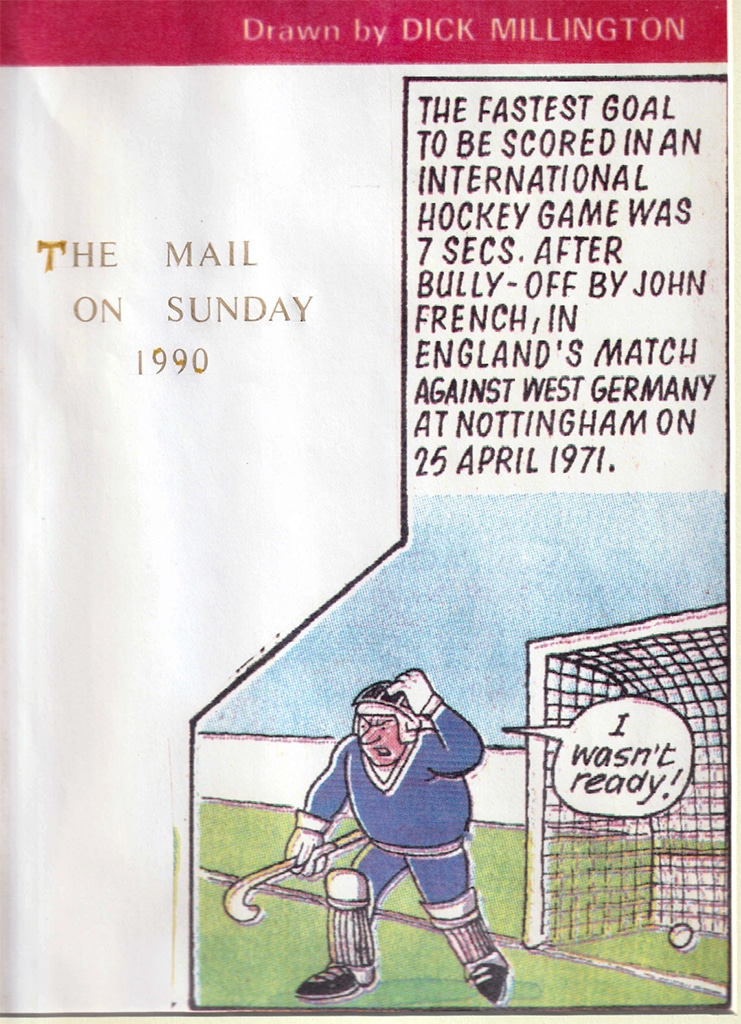
Cartoon from The Mail on Sunday about John French’s world record goal.