Vera Machell Cox was an extraordinary woman – a talented hockey player, administrator and letter-writer who lived at Great Comp, a country house in Kent, during the early years of the twentieth century. Her fascinating story may not have come to light had her great great niece, Frances Thompson, not discovered the series of letters that Vera and her nine siblings wrote to each other from 1906 through to the mid-1950s. These letters record in detail Vera’s many sporting exploits, but also the comings and goings of a family in Edwardian-era England. Over 2,000 letters were donated to the Bodleian Library in Oxford in the 1980s by Vera’s nephews, both Oxford professors, and this is where Frances found them a few years ago when researching her own family history.
Since then, Frances has been working with The Hockey Museum and Great Comp Garden to bring to life the stories of Vera Cox, feminist pioneer Frances Heron Maxwell (the owner of Great Comp during this era) and suffragist Eva McLaren who also lived at Great Comp. All three were amazing women in their own right.
Vera was the youngest of 10 siblings who wrote constantly to each other; the latest letter being attached to the previous ones, so all the siblings got to read everyone’s stories. They called their archive of letters the Family Budget. Three siblings lived abroad in the colonies of the British Empire, with another seven in England, so the letters were very well travelled. They document subjects such as hockey, cricket, politics, the suffragist movement and war, as well as seaside holidays and family life as the Empire’s hold over the world waned. The letters were also a fascinating mix of prose, poetry, press cuttings, cartoons and photos.
Frances has been uncovering numerous fascinating stories whilst transcribing these letters and she shares many of these in her series of podcasts entitled 100 Years of Cox.
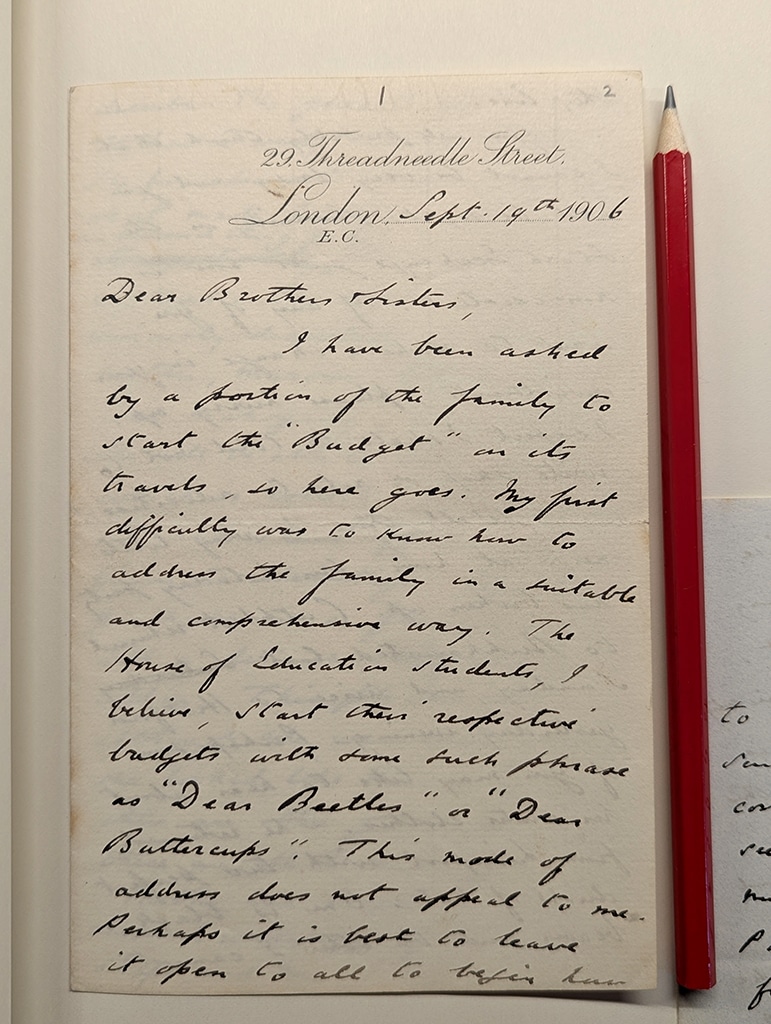
The opening page of the very first Budget letter, written in 1906 by Bernard Cox on headed paper with his work address, Hunt, Cox and Co. Stockbrokers, City of London.
Image courtesy of the Bodleian Library, Oxford.
So, what more do we now know about Vera? She played hockey for Atalanta Ladies’ Hockey Club in Kent, was selected for the Kent County team and represented the East before, at the age of 23, she was selected for England. Vera earned international honours between 1908 and 1912 as a midfield player and then captain. She sadly injured her knee during England’s match against Ireland in 1912 and was never able to play at international level again.
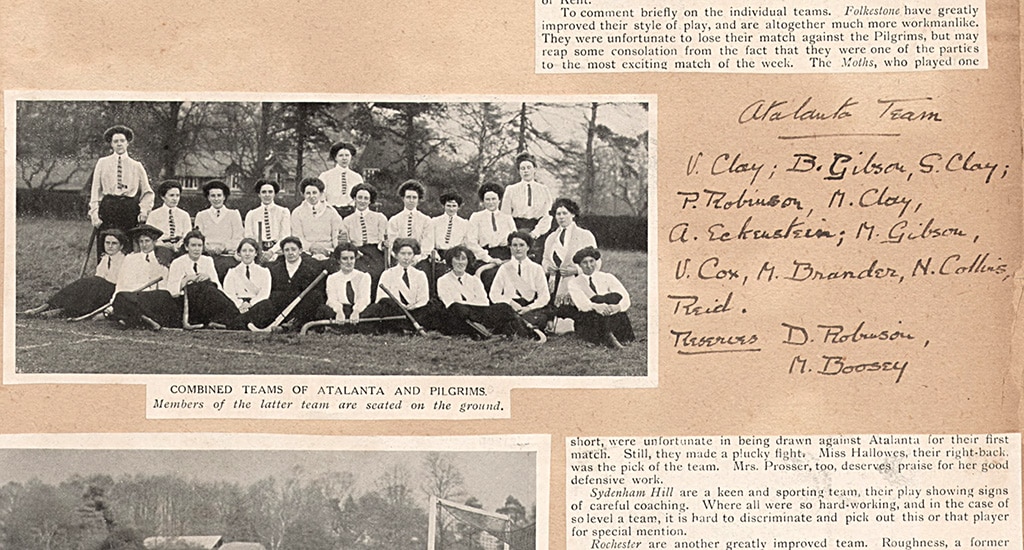
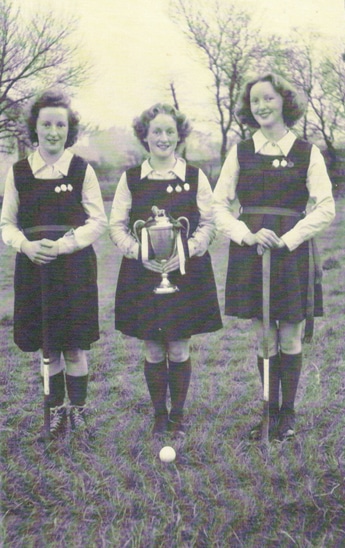
Players from Atalanta and Pilgrims ladies’ hockey clubs. From the Vera Cox scrapbooks held in the collection of The Hockey Museum.
Vera continued playing club hockey but moved her energies into coaching and selecting, and she became an international umpire for over 20 years. She sat on many committees, was passionate women’s physical emancipation (the right to play organised sport), about promoting the game and developing female umpires. She later recalls how the selectors watched territorial matches on muddy fields in freezing weather, wrapped up in rugs and mufflers with hot water bottles.
Along with Frances Heron Maxwell and a group of friends, she went on to set up the Women’s Cricket Association in 1926. Vera continued to serve on hockey and cricket committees for most of her life, as well as running the Women’s Land Army in west Kent during the Second World War, when she entertained her siblings in the letters with tales of government inefficiency and bureaucracy as well as describing thrilling dog fights in the skies above the Kent countryside.
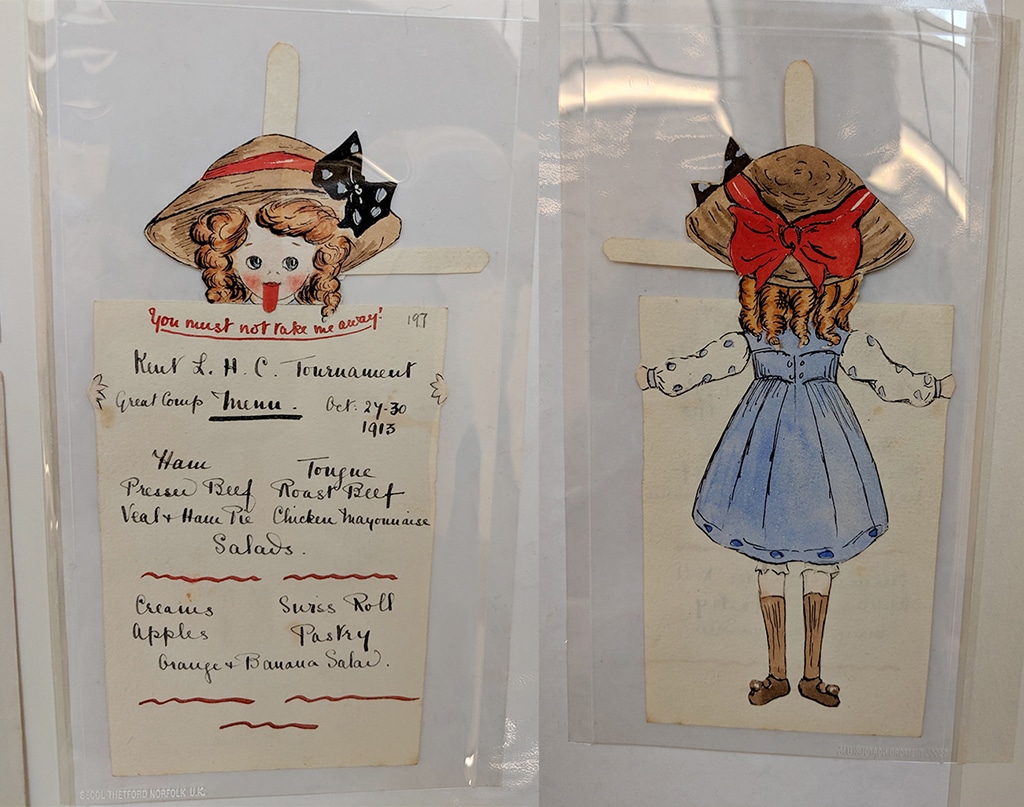
A menu (front and back) from a Kent Women’s Hockey Association Tournament held at Great Comp in 1913, drawn by one of Great Comp hockey girls. Vera Cox included it in one of her letters.
Image courtesy of the Bodleian Library, Oxford.
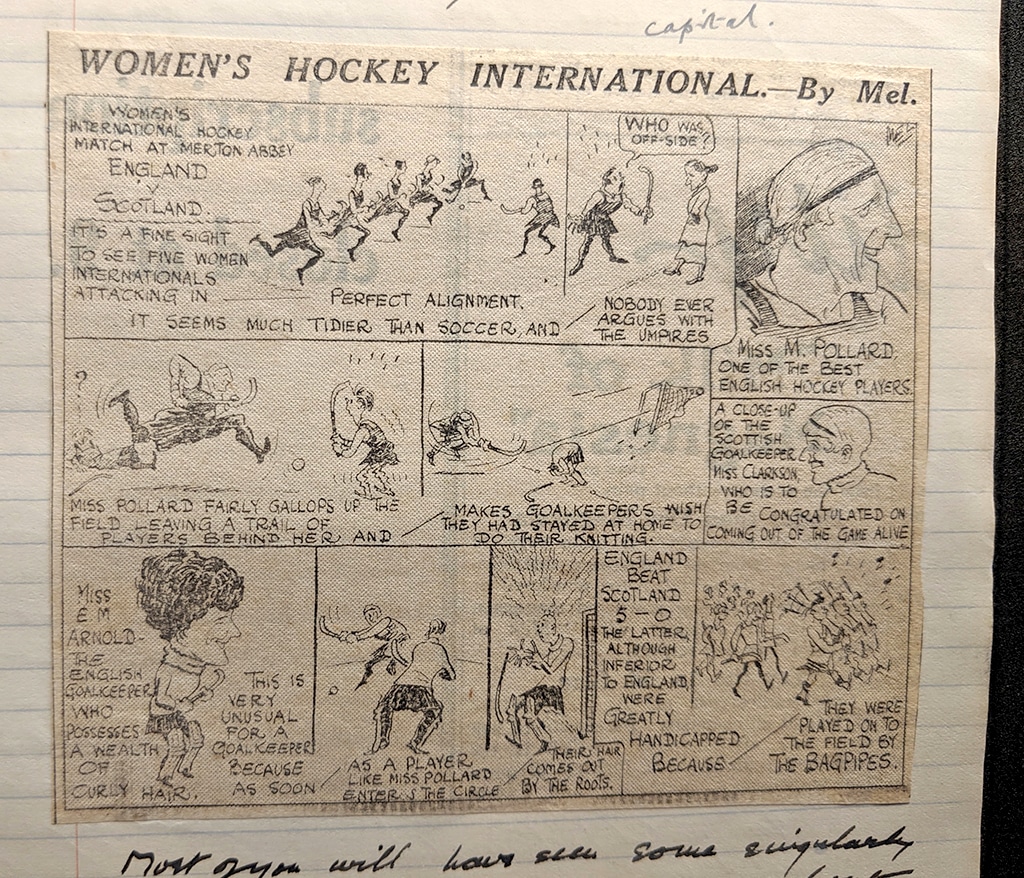
A cartoon published following the England vs Scotland match at Merton Abbey on 12 March 1927. Vera was the umpire. It was included in the Budget by one of the siblings who said that Vera, depicted in the top middle image, was easy to spot.
Image courtesy of the Bodleian Library, Oxford.
Excerpts from the Cox Family Budget
The following are excerpts are from some of the early Budget letters.
Vera’s brother, Bernard Cox, wrote this limerick about her in 1907:
There was a young lady of Kent
Whose shoulders were very much bent
When they said, “Oh my dear!”
She replied, with a sneer,
“Oh rot! I play hockey for Kent!”
(Vera didn’t like Bernard referring to her as “sneering”; he replied – “but it rhymes”.)
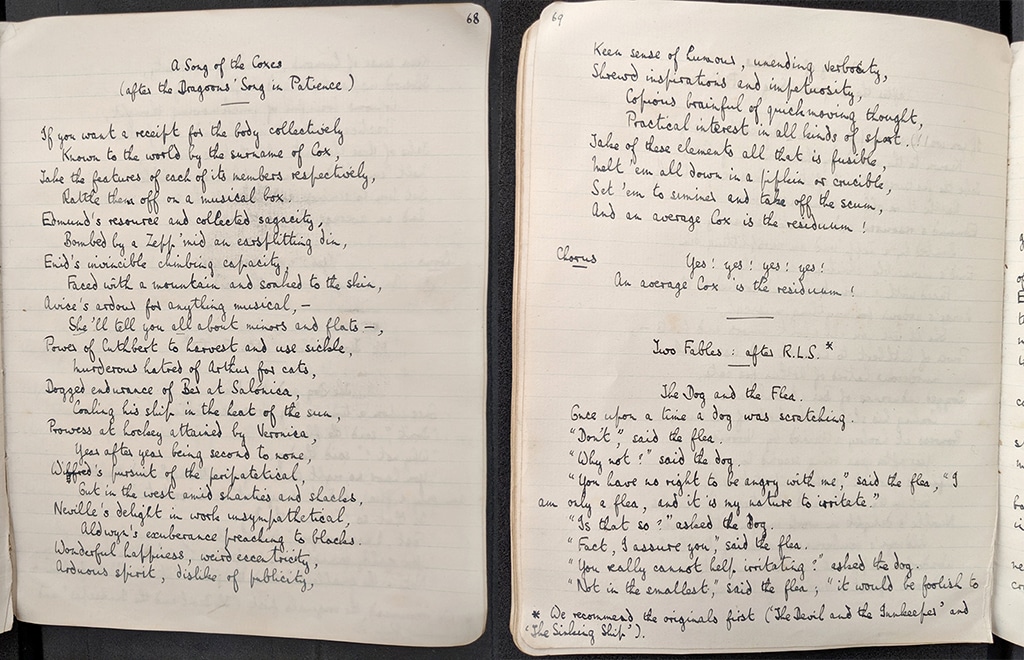
“A Song of the Coxes”, handwritten by Sir Christopher, Vera’s nephew in 1916, but poem is older, probably written by Arthur or Bernard Cox before 1916.
The following section, from Bernard’s 1908 poem, presents the family at breakfast as a telegram arrives inviting Vera to join the England national hockey team. In reality, Vera received a postcard from Miss Julius, Hon. Secretary of the All England Women’s Hockey Association (AEWHA), advising loose black knickerbockers, how and where to obtain her scarlet England skirt and how long it should be – at least 6” from the ground – and who would be Vera’s vote for captain?
It was about breakfast time on a warm spring day,
There came a gallant messenger with telegrams to say –
“We all watched your swift brown feet on many a hockey field,
Opposing teams before your rush have quailed and faintly squealed,
The soul of dash, though never wild, your dribbling and finesse!
Oh, will you play for England? (There’s a very pretty dress).”
Forthwith she banged with wildest glee the gong upon the wall,
And Father threw the breakfast things all out into the hall,
While Mother yelled for marmalade and bolted all the toast,
Then with swiftly written postcards ran out to catch the post.
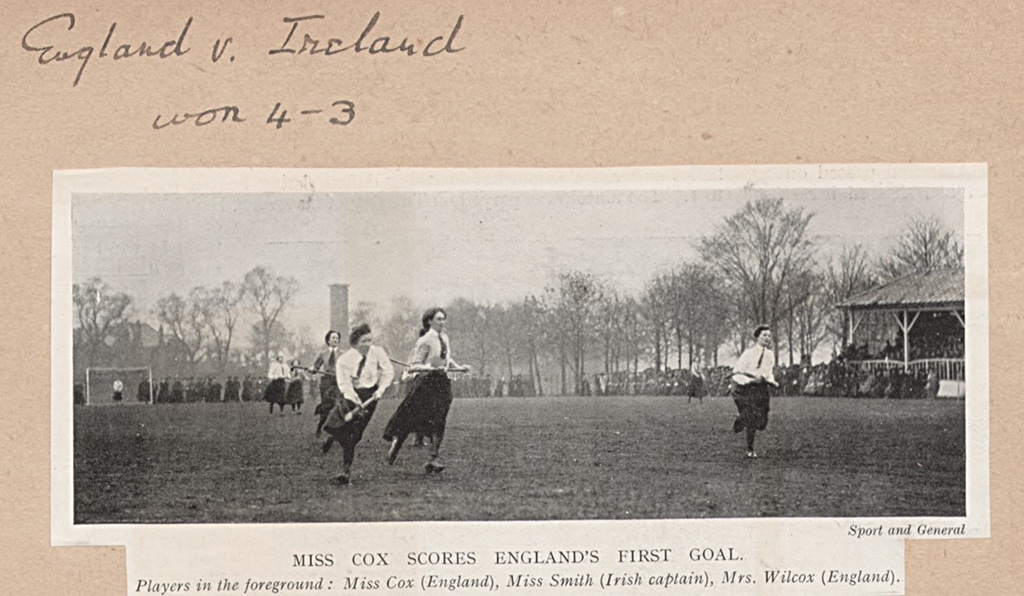
Vera Cox scores England’s first goal during a 4–3 win against Ireland on 15 March 1911 at Old Deer Park, Richmond.
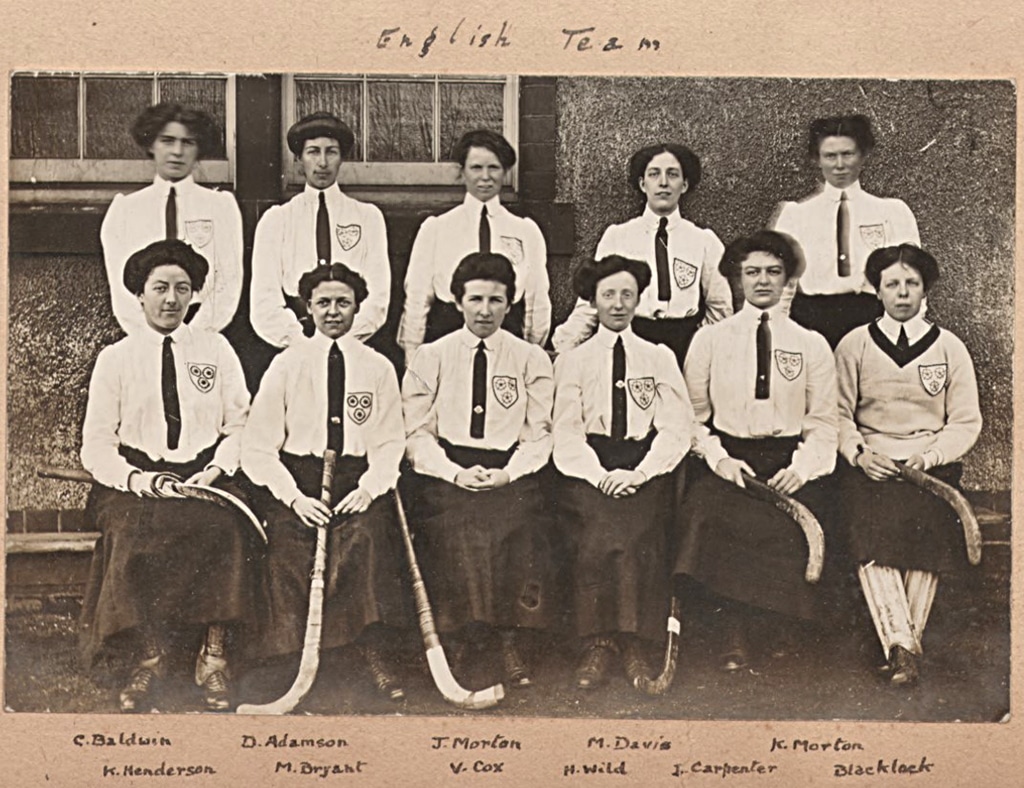
England team photograph vs Scotland in 1911. Vera Cox is seated, third from the right.
In 1909 Vera wrote The Joys of Hockey for her siblings to read in the special Christmas edition of the Budget. Much of it rings true of hockey today, well over a century later.
“There is little doubt that hockey is an almost ideal game for girls and women. It is better than golf or tennis … in that you play for your side, rather than for yourself.
Who … after an afternoon’s play at tennis or golf, can come home having played below form, and say they have thoroughly enjoyed themselves; and yet at hockey this can truthfully be said, if only your side has won… But, apart from the game itself, the social side is one of the most enjoyable features. There is such a general feeling of good comradeship; and as you rise from club to county, and maybe territorial or international honours, you … know hundreds of girls all over England. You make a vast circle of acquaintances, with whom it is a pleasure to meet, and such acquaintances occasionally ripen into real friends …
You meet a very pleasant type of girl at hockey, a little inclined to slang perhaps and occasionally somewhat deficient in manners, but you meet the real person, honest and open as the day … and without any of the affectation that is so often met with in the modern girl. There is a great deal of innocent fun … and well-worn jokes, that never fail to amuse …
A good game of hockey is an outlet for all the … annoyances of the day. The glorious feeling of the springy turf, the race for the ball, the effort to outwit an opponent, the real hard struggle to win the game, and the thrilling moment when the winning goal is shot, all unite to promote keenness, endurance, good temper and good health, and certainly tend to develop character.”
These and other stories are included in one of Frances podcasts: series 3, episode 17; The Joys of Hockey. To listen to it click here: S3E17: Vera – The Joys of Hockey
Frances lives in Australia, but during her recent visits to the UK she has photographed many hundreds of pages of the Machell-Cox letters held at the Bodleian Library and is now busy reading and transcribing the remaining, mostly handwritten letters. With over a dozen different authors over the decades, Frances has had to become adept at deciphering all these different handwriting styles. She is also writing Vera’s story during the period when she was living at Great Comp in Kent with her great friend Frances Heron-Maxwell.
The photographs illustrating this article are from Vera’s personal hockey scrapbooks, held in The Hockey Museum’s archive. These were previously unidentified until Frances recognised Vera’s handwriting during a research visit: Discovering Vera Cox’s Missing Scrapbooks – The Hockey Museum